
I believe in the First Amendment, so I would never support legislation to restrict political speech or curtail the ability of people to petition the government. That being said, I despise the corrupt Washington game of obtaining unearned wealth thanks to the sleazy…
Daily Analysis
As Humorously Explained by Henry Payne, the World Amazingly Didn’t End When Uncle Sam Got Put on a Sequester Diet
When I last checked, Henry Payne was winning the bronze medal in the contest to identify the best political cartoonist. You can see why by checking out this cartoon about Washington’s reaction to sequestration, which (gasp!) slightly slows the growth of the federal…
The IMF, Higher Taxes, and Mitchell’s Law
Here are three common-sense principles. Higher taxes are misguided. They undermine prosperity and finance bigger government. Bailouts also are misguided. They facilitate corruption and encourage moral hazard. And international bureaucracies are misguided. They promote…
Challenge for Keynesian Anti-Sequester Hysterics: Why Did America’s Economy Boom When Reagan and Clinton Reduced the Burden of Spending?
Triggered by an appearance on Canadian TV, I asked yesterday why we should believe anti-sequester Keynesians. They want us to think that a very modest reduction in the growth of government spending will hurt the economy, yet Canada enjoyed rapid growth in the…
Challenge for Keynesian Anti-Sequester Hysterics: Why Did Canada’s Economy Boom When the Burden of Spending Was Sharply Reduced?
In this appearance on Canadian TV, I debunk anti-sequester hysteria, pointing out that “automatic budget cuts” merely restrain government so that it grows $2.4 trillion over the next 10 years rather than $2.5 trillion. I also point out that we shouldn’t worry about…
Obama Suffers a Painful Loss in the First Big Fiscal Battle of His Second Term
The statist agenda of ever-growing government requires more money going to Washington, which is why I think that proponents of limited government should do everything they can to block tax increases. This is the “starve the beast” theory, and I’ve previously explained…
Virginia’s RINO Infestation Results in Higher Taxes and More Spending
The number one goal for fiscal policy is to reduce the burden of government spending. The simple way to achieve this goal is to adhere to Mitchell’s Golden Rule and and make sure the private sector grows faster than the public sector. But when politicians fail to…
Earth to New York Times: Please Show Us these “Deep Spending Cuts” You Keep Writing About
Sigh. I feel like a modern-day Sisyphus. Except I’m not pushing a rock up a hill, only to then watch it roll back down. I have a far more frustrating job. I have to read the same nonsense day after day about “deep spending cuts” even though I keep explaining to…
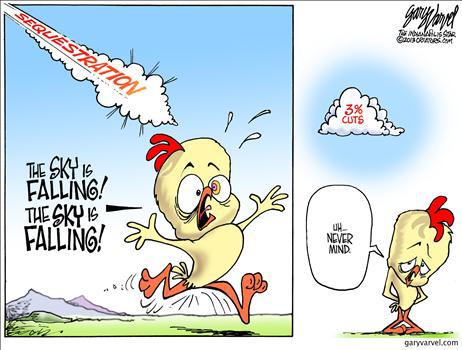
Debunking Sequester Hysteria from the Big Spenders in Washington
I shared a couple of amusing sequester cartoons the other day, and I’ve previously written about the absurdity of anti-sequester hysteria in Washington when all it means is that the federal budget will grow by $2.4 trillion over the next 10 years rather than $2.5…
Will GOP Fumble Away Guaranteed Sequester Victory?
Notwithstanding hysterical rhetoric from the White House, the bureaucracies, and the various pro-spending lobbies in Washington, the sequester does not mean “vicious” or “draconian” spending cuts. I wish that was the case. All it does is restrain spending so that it…