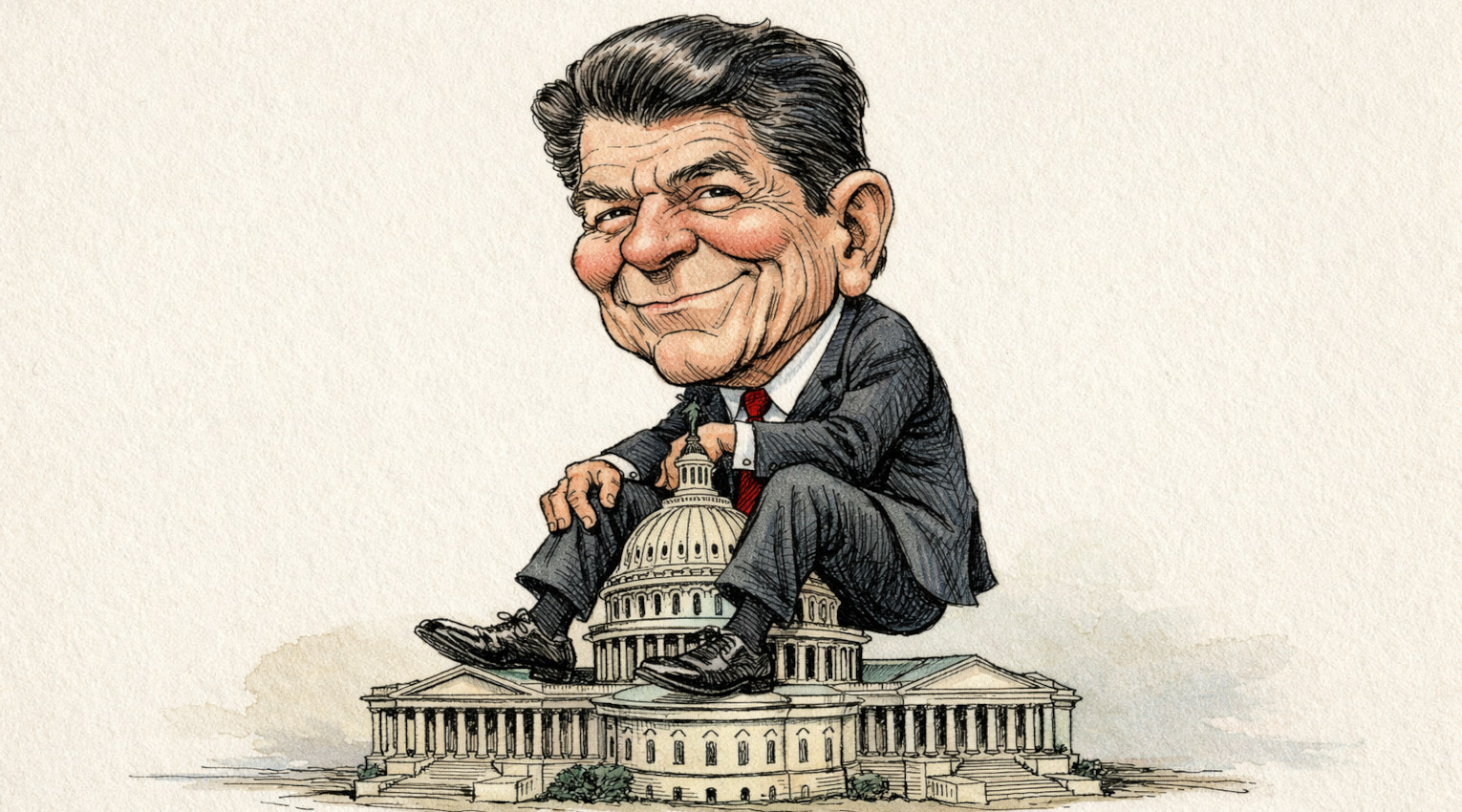
Those are all good answers. But since I’m a fiscal policy wonk who has labored for decades to reduce/constrain the welfare state, I would vote specifically for his amazing record in limiting the growth of domestic spending.
I’m not the only one to wax nostalgia for Reaganism. Here are some excerpts from a 2023 column in National Review by Grover Norquist, where he argues that Reaganism was good policy and good politics:
The Reagan Republican Party is coherent, internally consistent, and low maintenance, and wins elections with an agenda that creates the conditions for future victories. It is sustainable. …Every such imagined alternative to Reagan Republicanism consists of empowering the government to subsidize activities the would-be “fearless leader” wants, taxing the alternatives to desired behavior or outright outlawing them. …Such efforts, however well-intended, will always be outbid and displaced by left-of-center subsidies, taxes, regulations, and laws. Amateur abusers of state power will quickly be crushed by those who have created and wielded power in the U.S. since 1932 — it would be like watching the Washington Generals face the Harlem Globetrotters. …All deviations from Reaganism borrow from the Left the idea that they can make the world a better place by taking things away from some and giving them to others. First, they are wrong. They never understand or admit secondary effects. Second, all attempts to buy votes, including new or old welfare programs promoted as “conservative” programs, can be defeated by the Left. …It is unserious to assert that we could compete with the Democrats by mimicking their tax-and-spend-and-regulate policies.
And here are some passages from an article in The Hub by Sean Speer, arguing that Reaganism is still very relevant today:
The argument, increasingly common among younger conservative intellectuals and journalists, is that Reagan’s conservatism—cheerful, pluralistic, focused on free markets and limited government—was adequate for its time but has little to offer in ours. …these younger voices contend that the Right’s old guard was too passive, too liberal, too content to let the culture go to ruin so long as marginal tax rates fell and trade barriers came down. …The result, they say, is the hollow victory of an efficient economy inside a demoralized culture. …The intellectual heroes of this worldview are less Reagan and Thatcher than Trump and Vance, less Hayek and Friedman… So let me offer a defence of Reagan from his young conservative critics. Start with the economic case. As I’ve argued elsewhere, it would be a serious mistake for conservatives to abandon or even subordinate their core economic ideas. The country’s biggest challenges—including many that animate the new Right—ultimately trace back to a decade of stagnating productivity and faltering growth. …Reagan understood this. His revolution in tax and regulatory policy wasn’t just about GDP growth for its own sake. It was about moral renewal through economic vitality. A society of abundance, he believed, is better able to sustain generosity, optimism, and civic trust. Prolonged stagnation, by contrast, breeds zero-sum thinking, grievance, and resentment—the cultural mood that now defines our politics. …the economy matters too much to cede to the Left. …The populist Right’s flirtation with different forms of government intervention…risks repeating the same errors that caused stagnation in the first place. …The new Right is right about one thing: Our culture is in trouble. The institutions that once transmitted common sense and common virtue have been captured by a new ideology of grievance and identity. …But the manner of that pushback matters. ..Reagan trusted in particular that freedom, rightly ordered, could call forth the better angels of our nature.
Jay Nordlinger made a similar argument in a 2022 column for National Review. Here’s some of what he wrote about the timeless principles Reagan embodied:
Soldiers of the “New Right” deride people like me as “zombie Reaganites.” We are also called “dinosaurs”…you can hear sneers about people who have Reagan’s picture on their wall. …I sure as hell prefer the Gipper to the pin-ups of the New Right: Trump, Orbán, Bolsonaro, and worse. …I came of age…with Reagan. I was 17 when he was sworn in for his first term as president. I was not an admirer of his at first, but I soon became one. …“Children of Reagan.” That’s a term that Marco Rubio used… He meant it positively: “we children of Reagan.” …What is Reaganism? …Free markets, free trade, free enterprise. Free people. A strong military, to safeguard that freedom. The rule of law, to do the same. Limited government. Personal responsibility. U.S. leadership in the world. Civil society, or little platoons. Patriotism — the genuine kind, not jingoism or boobery. Pluralism. Colorblindness. Toleration. E pluribus unum. Betsy Ross. All that good stuff.
Put succinctly, do you want the approach in the top frame or the bottom frame?
P.S. While the focus of today’s column is Reagan’s pro-freedom economic message, let’s also remember Reagan’s victory over communism.
Here are some excerpts from Michael Ard’s article last year in Discourse.
Reagan understood the bigger issues at stake better than most intellectuals at the time did. …Liberal historian John Patrick Diggins assesses that by employing “patient dialogue and mutual trust,” Reagan was our only president to resolve “a sustained, deadly international confrontation without going to war.” This great achievement should not be underestimated. …For Reagan’s strategy to work, he had to tell the world the truth about the Soviet Union; there could be no more ignoring the obvious about its repressive nature. Political correctness or “woke-ism” is no new phenomenon. …memorable speeches, along with the famous 1987 Brandenburg Gate speech—“Mr. Gorbachev, tear down this wall!”—all served to throw the Soviets and their system on the defensive. …The great Russian writer and dissident Alexander Solzhenitsyn believed that Reagan’s pressure on Gorbachev ended the Cold War. …current U.S. leaders and policymakers could learn a lot from Reagan’s approach to the Cold War. Pragmatism in public affairs is meaningless if unsupported by strong convictions and visionary leadership.