

I have a four-part series (see here, here, here, and here) explaining why all good and decent people should focus on reducing poverty rather than fighting inequality.
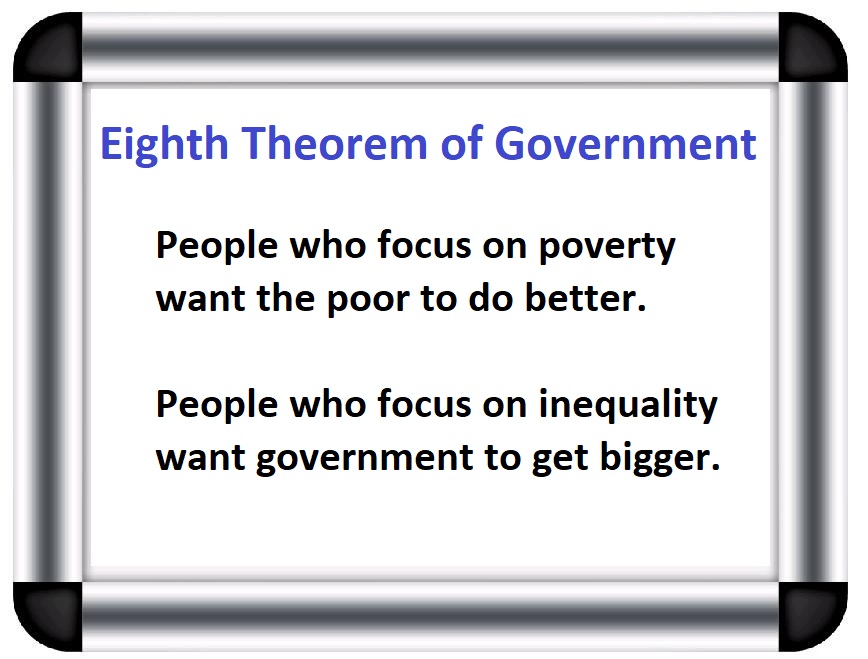
Those four columns are, for all intents and purposes, data-driven examples of why I unveiled my Eighth Theorem of Government back in 2020.
Today, let’s review some more evidence supporting that Theorem.
We’ll start with this chart that was shared by Prof. Branko Milanović. He doesn’t include any editorial commentary, but I’m guessing some readers will think Brazil is moving in the right direction and China is moving in the wrong direction.

But is that correct? Is Brazil doing something right while China is doing something wrong?
To answer that question, I went to the Maddison database to see what’s happened to per-capita GDP in both countries over the same post-1980 time period.
Lo and behold, China went from being much poorer than Brazil to being significantly richer than Brazil. And this happened during the same years that China become more unequal.

In other words, some people in China became richer at faster rates than other people became richer. And they’re now, on average, much better off than Brazilians.
Our friends on the left seem to think that’s an awful outcome if Chinese income distribution is less equal. Yet, as @paleoneoliberal explains, this is a silly distraction.

What matters (if you’re one of the good and decent people I mentioned in the first sentence) is that poverty is now much lower in China.
By the way, nothing in today’s column should be interpreted as an endorsement of overall Chinese economic policy.
Yes, there was a significant improvement in economic liberty during the period known as the Washington Consensus (Brazil also improved), and China climbed out of Maoist poverty.
But China still lags behind the world’s most notable pro-market jurisdictions (and also lags behind other majority-Chinese jurisdictions).
Here’s a chart from Economic Freedom of the World showing the top-10 scores for Switzerland and the United States compared to the mediocre-at-best scores for China and Brazil.

P.S. Prof. Milanović often produces interesting data, but his analysis sometimes is a bit strange.
P.P.S. By contrast, Gabriel Zucman’s analysis on the same issues is always wrong.