

One of the most destructive myths in economics is the zero-sum fallacy.
Back in 2018, I shared a cartoon that sought to debunk the notion that one person getting richer meant another person had to be poorer.
But I wasn’t satisfied with the cartoon, so I offered a modified version. But I still didn’t think it made the point neatly and cleanly.
So I’m very happy today to share a meme that effectively shows why success isn’t offset by failure.

The example of fast and slow cars is so obvious that no further elaboration is needed.
So let’s shift to real world examples.
- Is Mexico lagging because the United States is comparatively richer?
- Is India lagging because Singapore is comparatively richer?
- Is Zimbabwe lagging because Botswana is comparatively richer?
- Is Italy lagging because Switzerland is comparatively rich?
The answer to those four questions is the same. Poor countries are poor because they have bad policies.And it’s very likely they would be even poorer if it wasn’t for the fact that some countries are successful (thus leading to positive spillover effects).
You can also look at historical data. The “hockey stick” of global prosperity shows that average per-capita GDP has climbed dramatically since the advent of capitalism.
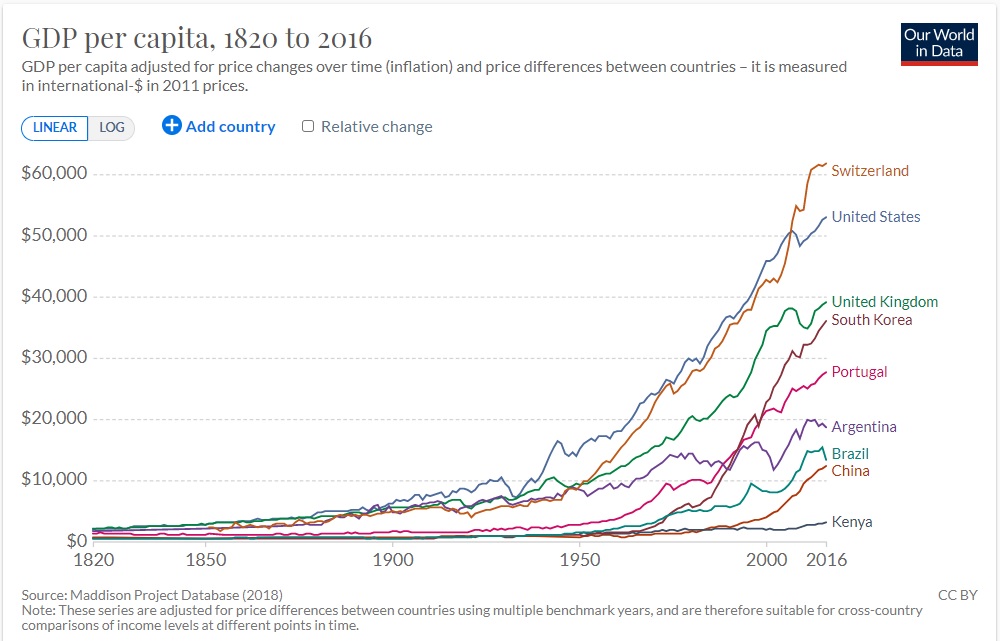
You can also see that the zero-sum notion is laughably wrong by looking at U.S. data. I have a four-part series (here, here, here, and here) showing how Americans have become much richer over decades and over centuries.
Do some people get richer faster than other people get richer? Of course. Is this a bad thing? Not at all, assuming that the more successful people are earning money honestly and not using government to obtain unearned riches.
I’ll conclude by noting that none of this means everyone wins. A key feature of a market economy is that there is creative destruction. And when new technologies and new inventions give us better products, that will be detrimental to old industries (think of what the electric light bulb meant for candle makers, or think what personal computers did to the typewriter business).
But that creative destruction makes society much richer in the long run. And as I said in this video, that means even the children and grandchildren of candle makers and typewriter manufacturers are better off.
P.S. I should emphasize that the analysis in today’s column applies to a system of free enterprise. With government policy, by contrast, it is highly likely that one person’s gain will be another person’s loss (think of how steel protectionism props up a few jobs in the steel-making sector but does far larger amounts of harm to workers in steel-using industries, as well as harm to the general public and enabling corruption in DC).