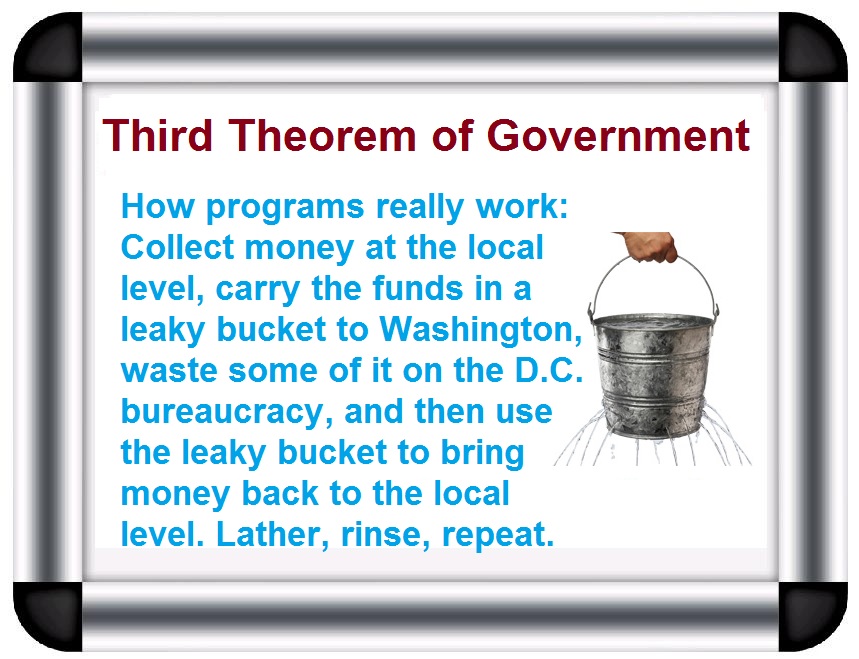
In other words, there’s lots of evidence for my Theorem. But I also will confess that I’m not overly creative. My theorems are just words, occasionally augmented by a simple visual.
So I’m glad to see that Chris Edwards and Ryan Bourne of the Cato Institute have produced something far more comprehensive. Here’s the leaky-bucket visual from their new study.
Their report is 32 pages with more than 180 footnotes, so it’s a treasure trove of data for those who want additional proof about the federal government’s waste and inefficiency.
I’ll merely cite some of the executive summary.
People often hold optimistic views about federal government spending programs. They assume that new and expanded programs can fix the nation’s social and economic problems. …However, solving problems through the federal government is not so simple. Spending programs require funding from taxation or borrowing, and both create collateral damage on the economy. As funds flow through the government, resources are wasted on bureaucracy, mismanagement, and faulty planning. As the remaining funds flow out of the government and into the private sector, they induce people to change their working and investing activities, further undermining the economy. …In this study, we describe the many types of holes in the government bucket, and we argue that the leakage of resources is large. We also argue that the government bucket gets leakier as federal programs and bureaucracies continue to expand. …many…programs are so leaky that their costs outweigh their benefits. These programs are spilling economic resources all over and should be eliminated from the federal budget.
The final part excerpted above is key.
Assuming we want more prosperity, the goal should be to eliminate all programs that don’t pass a cost-benefit test.