I’ve arbitrarily decided, however, that 10 is a limit for any series. Yet Milei keeps doing good things and getting good results.
So I started a new series earlier this year with a shorter title, “The World’s Best Leader,” and today’s column is the second installment.
Let’s start with a 35-minute video featuring Milei’s Minister of Deregulation, Federico Sturzenegger.
I normally don’t share long videos, and I realize many readers won’t have time to watch every second, but Sturzenegger does a great job of explaining the Milei Administration’s progress against red tape.
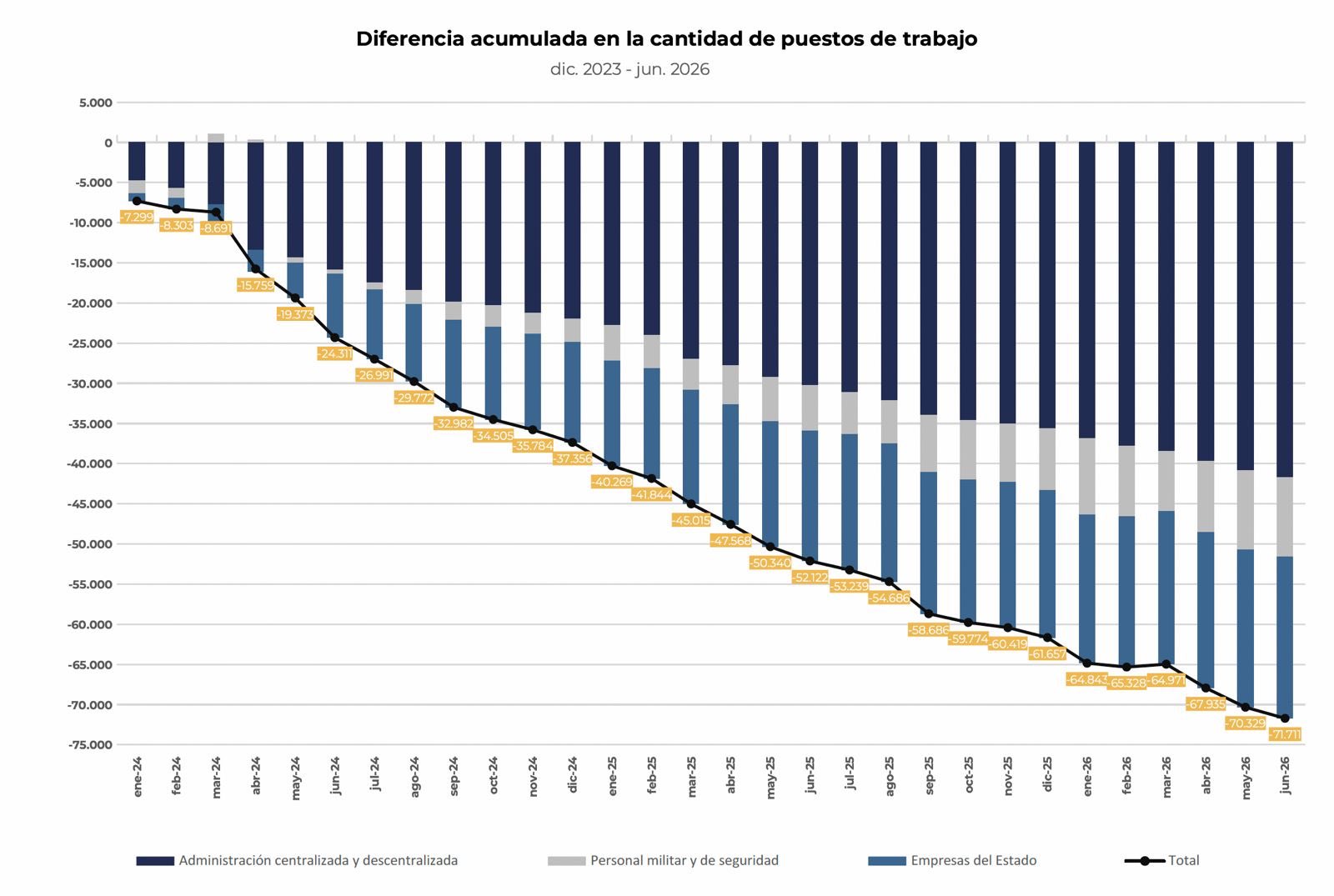
Combined with Milei’s success in reducing the burden of government spending, this has allowed a significant reduction in the number of bureaucrats. Here’s a chart that Sturzenegger shared on Twitter/X (translated to English, the heading is “cumulative difference in the number of jobs”).
Indeed, Milei’s spending restraint has produced all sorts of benefits.
Because there is no need to print pesos to finance deficit, inflation has been dramatically reduced.
Country risk (measured by how high interest rates are for Argentine bonds compared to yields for U.S. government bonds), has dropped from from about 2500 to less than 500.
Argentina’s credit rating has improved.
Regarding the last point, here are some excerpts from a July 25 Washington Posteditorial.
Argentina’s free-market renaissance continues to improve the country’s economic outlook, and investors are noticing. Moody’s upgraded Argentina’s dollar bonds and revised its outlook from stable to positive this week. That was the third sovereign ratings upgrade for Argentina in less than three months, following Fitch in May and S&P Global in June. …When Milei entered the Casa Rosada in December 2023, Argentina was considered at dangerously high risk for default. Not even three years later, Argentina has escaped its “highly distressed” rating and no longer holds some of the riskiest debt in the global market. …This change is not magic or luck. Moody’s noted that Argentina’s “macroeconomic stabilization has advanced beyond the initial adjustment phase into a more durable improvement in credit fundamentals.” …Milei made tacking inflation a top priority. When he took office, the monthly inflation rate hovered around 25 percent. Last month, it sat at 1.9 percent. Milei also tackled the country’s persistent fiscal deficits and reported a modest surplus just a year after his inauguration. This…offers a model for other stagnant economies looking to rebound.
Let’s now peruse some passages from a column in the Washington Examiner by David Haranyi.
He starts by reminding readers how leftists loudly predicted that Milei’s policies would produce disaster.
In fall 2023, over a hundred leading economists from around the world, including progressive darling Thomas Piketty, signed a letter warning that “far-right” Argentine presidential candidate Javier Milei’s policies, which were “rooted in laissez-faire economics,” would cause “devastation,” spike inflation, expand poverty, and unemployment. …Political scientist Ian Bremmer warned, “Economic collapse is coming imminently.” Felix Salmon, then-chief financial correspondent at Axios (now at Bloomberg), argued that Milei’s “wrecking ball” policies would plunge Argentina into “a deep recession.”
What actually happened?
Argentina’s 2025 GDP also blew past expectations, growing 4.4%, the highest in years. The International Monetary Fund expects the GDP to grow at similar rates in 2026 and in 2027. …inflation has dropped by over 200%, plunging to the lowest level in eight years. …this is likely the fastest any nation experiencing hyperinflation has improved its position in modern history… Argentina also had a fiscal surplus for the second consecutive year in 2025, marking the first time since 2008 that it accomplished the feat. The poverty rate dropped significantly in 2025, reaching its lowest level since 2018. The crisis Milei took on was stark: In the first half of 2024, around 52.9% of the population was living in poverty, with 18% in extreme poverty. Poverty fell 14 percentage points to 38% by the second half of that year. It was at 31% in 2025.
I shows what happened to real wages (“salarios reales”) in Argentina over the past five years.
Needless to say, Milei’s numbers (in green) are far better.
What’s remarkable is that all these great things have been accomplished even though the Peronists controlled the legislature his first two years.
And even after Milei’s libertarian party won a big victory in the 2025 midterm elections, that still wasn’t enough to win actual legislative control.
So subsequent victories (like reform of labor law) have been impressive but partial.
But if Milei wins reelection next year, and his party wins control of the legislature, the improvement over the following four years will make his first term seem timid by comparison.
Equally important, he will be a role model for the rest of the world.