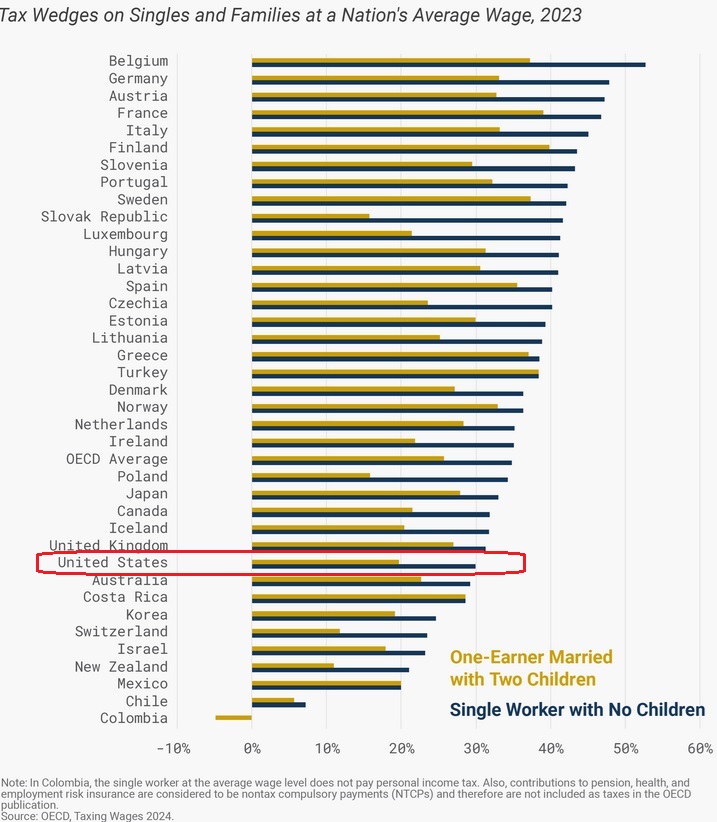
I pointed out in both 2016 and 2022 that the United States has the most “progressive” tax system among rich nations. In other words, compared to other developed nations, the rich in America pay the largest share of the fiscal burden.
Today, let’s look at some new research on that topic, courtesy of Canada’s Fraser Institute. The report (authored by Grady Munro, Milagros Palacios, Nathaniel Li, and Jason Clemens) reconfirms that the rich bear the biggest burden of tax in the United States.
It’s especially true in California. But, because the large fiscal footprint of Washington easily offsets the impact of state tax policies, it’s even true in Texas.
Since the report was produced in Canada, there’s a breakdown of progressivity in all the provinces. In general, Canada’s tax system also is tilted against rich.
And the same is true in nations such as Korea and Austria.
Looking at the tax systems that don’t target the rich (at the bottom of Figure 6), many readers won’t be surprised to see that nations in Eastern Europe have low levels of progressivity. But how many would have guessed that there is very little bias against the rich in Scandinavian nations such as Sweden, Norway, and Finland?
Here are some excerpts from the Fraser report. We’ll start with the methodology (if you don’t care about these details, just skip to the next paragraph).
This study measures tax progressivity at a single point in time to provide a snapshot of the relative rankings of OECD jurisdictions. …the jurisdiction with the most progressive tax system receives an index score of 10 and the jurisdiction with the least progressive tax system receives an index score of 0, while the remaining jurisdictions are scored in between. …This study measures tax progressivity for 45 jurisdictions from 33 OECD countries, for 2023. …Canada, Spain, Switzerland, and the United States all have subnational governments (at the provincial/regional/cantonal/state level) that have considerable taxing powers and impose their own personal income tax schedules. 16 This means tax progressivity within these countries can vary considerably depending on where a person is located. As such, these four countries are split up into their respective subnational jurisdictions. …This analysis utilizes three variables to measure the progressivity of each jurisdiction’s PIT system. The first variable is the percentage point difference between the top and bottom marginal statutory PIT rates, while the next two variables are the income threshold over which the top marginal PIT applies, and the basic exemption, both measured as a share of that jurisdiction’s average wage… The final two variables look at each jurisdiction’s overall tax mix. Specifically, the variables are PIT and consumption tax revenues each, as a share of total tax revenues.
Now let’s look at Fraser’s analysis of the results.
The report has a lot more details, but Figure 6 is so self-explanatory that this small excerpt will suffice.
The extent to which a tax system is progressive determines the extent to which the burden of paying taxes is concentrated on top earners within that jurisdiction. As such, these results suggest that jurisdictions such as California and Newfoundland & Labrador shift a greater share of the tax burden onto those earning higher incomes, while other less progressive jurisdictions like Hungary and Estonia spread more of the tax burden onto those earning middle and low incomes. …It is worth noting the extent to which the Canadian and American jurisdictions are more progressive than European jurisdictions. Indeed, every Canadian and American jurisdiction ranked higher than nearly every European jurisdiction.
Now I’ll add my two cents, looking at the issue from an American policy perspective.
First, a political point. America’s class-warfare politicians are a motley collection of liars, know-nothings, and demagogues. They endlessly bleat that upper-income taxpayers “don’t pay their fair share,” yet the U.S. tax system is the most progressive in the world when looking at developed nations.
Second, the study is only measuring the degree to which taxes are paid by various income groups, not the overall weight of the tax system. The key thing to understand is that the U.S. system is very progressive not because the rich are paying very high rates, but rather because lower-income and middle-class taxpayers are paying very low rates.
To elaborate on the second point, imagine a tax system that was nothing but a 10 percent flat tax on million-dollar-and-up incomes. That would be a hyper-progressive tax code (i.e., every penny of tax paid by the rich), but it also would be a tax system that would make everyone better off compared to today’s punitive system.
So it’s not that progressivity is the defining characteristic of a bad tax code. It’s high tax rates that cause damage, as I’ve noted in my two-part series (here and here). And if you want to see how nations rank on that basis, I have columns from 2014, 2017, 2019, and 2023.
One final point is that the difference between the U.S. and European welfare states is not taxes on the rich (upper-income taxpayers get squeezed on both sides of the Atlantic).
The real difference is that lower-income and middle-class taxpayers are pillaged in Europe and taxed lightly in America.