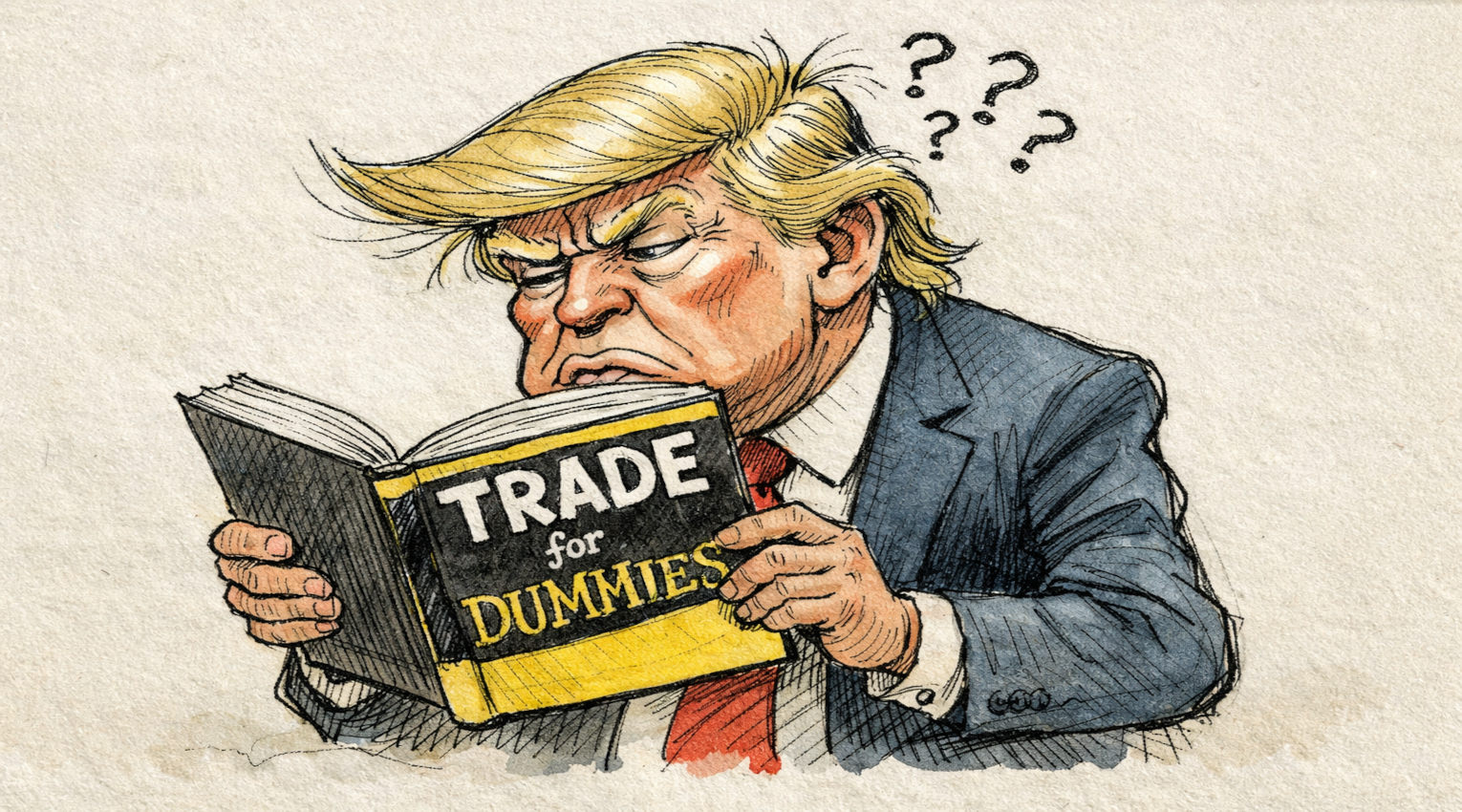
Sadly, we’re going to look the latter topic today’s column.
It’s the one-year anniversary of his disastrous “Liberation Day” trade taxes, so let’s investigate what’s happened since that grim day.
The Tax Foundation has a great summary. We’ll start with this chart, which shows the massive increase in trade taxes in early April. That’s the bad news. The good news (at least relatively speaking) is that Trump had to retreat because of the adverse impact on financial markets.
But trade policy is still much worse now than it was when Trump took office. And it’s been more chaotic. That’s good for lobbyists, but not good for consumers and taxpayers.
So why did Trump subject the economy to all this damage and uncertainty?
Because he mistakenly thinks a trade deficit somehow means America is losing. I’ve already written that the trade deficit did not decline in 2025, so he failed according to his own metric.
Trump also claimed that his trade taxes would lead foreign companies to invest more money to build more factories in the U.S. This second chart showed that didn’t happen, either.
Trump’s biggest talking point was that he was going to create more manufacturing jobs.
Our final chart, echoing what I wrote in January, shows the opposite has happened.
Now let’s look at some excerpts from a column in the Wall Street Journal by former Senator Phil Gramm (R-TX) and George Mason University Professor Don Boudreaux.
One of their key points is that other nations have responded by trading more with each other while the U.S. suffers the pain.
Although the average U.S. tariff rate in 2025 approached the level of the infamous Smoot-Hawley tariff of 19.8% for all imports, our trading partners haven’t retaliated against the U.S. so much as pivoted toward other trading partners, initiating the greatest peacetime trade diversion of the modern era. To compensate for lost U.S. markets, they have mutually lowered barriers and increased trade with each other. …our economy will…suffer from this diversion of trade from the U.S. Most obviously, U.S. households, denied access to the lowest-priced goods on global markets, will have less purchasing power. The tariffs will also make American goods less competitive globally and more expensive at home. Tariffs raise the prices of inputs used by U.S.-based producers, which is no small matter. Dartmouth economist Douglas Irwin finds that more than half of U.S. imports are inputs used in producing goods and services in America. …Tariffs thus divert capital and labor away from uses that would have yielded higher returns to capital and higher wages for workers.
The authors point out that Trump’s trade taxes have resulted in a weaker economy than the one he inherited from Biden.
…evidence of the destructiveness of Mr. Trump’s tariffs comes from comparing America’s economic performance in 2025 to its performance in 2024, when, according to the president, the economy was “dead.” …Real gross private domestic investment last year grew by only 2% after growing in 2024 by 3%… Real U.S. gross domestic product grew by only 2.1% in 2025, compared with 2.8% in 2024… It is therefore unsurprising that job growth in 2025, at 0.5%, was slower than job growth of 1.2% in 2024…
My Trumpie friends tell me that higher trade taxes must be good because the stock market did well in 2025.
Yet they can’t explain why stock markets in other countries rose even faster.
Investors share this negative assessment of the tariffs. While U.S. equities outperformed those of other developed countries in the decade prior, in 2025 the three major U.S. stock indexes underperformed indexes in most other developed countries. Last year the Dow Jones Industrial Average rose by 13%, the S&P 500 by 16%, and Nasdaq by 20%. But Germany’s DAX was up by 23%, Japan’s Nikkei by 26%, Canada’s S&P/TSX by 29%, and South Korea’s Kospi by 76%.
The bottom line is that Trump‘s protectionism is a massive self-inflicted mistake.
The United States is paying a high price because of the President’s economicilliteracy.