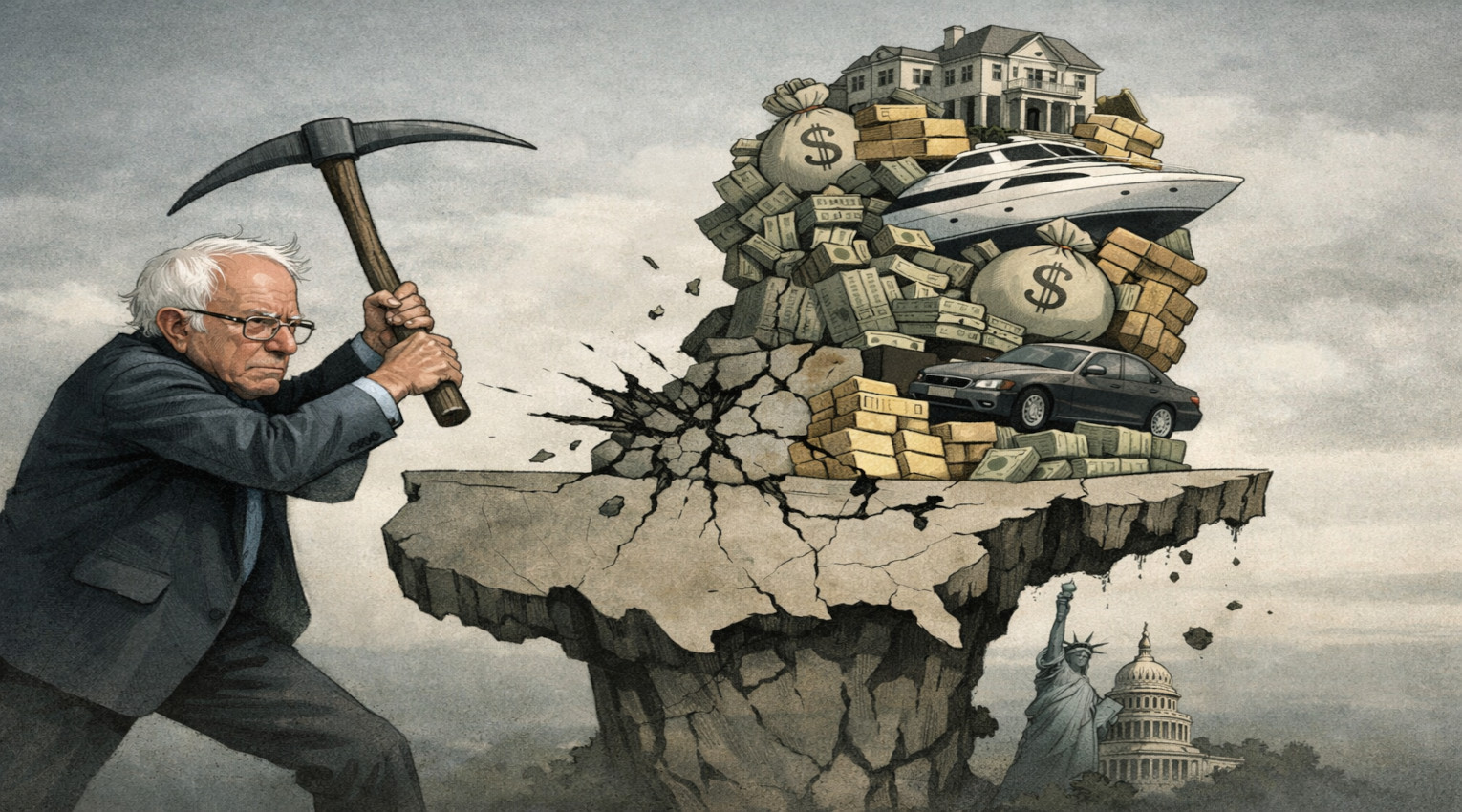
The reason I’m not joking is that there’s a very depressing scenario for America’s near-term economic outlook. It involves these six potential developments.
Thanks in part to mistakes by the Trump Administration (most notably protectionism), the economy is mediocre and dissatisfied voters give the left control of the House of Representative this November.
The left also may win control of the Senate later this year, but that will almost surely happen in 2028 if it doesn’t happen this November.
Because of a generic desire for change, as well on a 2020-style backlash against Trump, voters also elect a left-leaning president in 2028, giving Democrats control of both the White House and Congress.
Just like when Democrats had full control during Biden’s first two years, they will push a radical agenda to expand the size, scope, and cost of government.
But this time, the left is fully unified and has the ability to enact crazy policies (unlike in 2021 and 2022 when Senator Manchin and Senator Sinema refused to support Biden’s full “Build Back Better” agenda).
High on the list of crazy policies is a national wealth tax that would impose de facto confiscatory tax rates on saving and investment.
And we definitely should worry about the possibility of a wealth tax.
Senator Bernie Sanders and Representative Ro Khanna have just proposed an annual 5 percent wealth tax.
Given this development, it is fortuitous that scholars at the Hoover Institution have a new study on the economic consequences of wealth taxation.
Here are some excerpts from the report, which was authored by Joshua Rauh, Benjamin Jaros, Matheus, Cosso, and John Doran.
Efficient and reliable tax systems minimize distortions by setting tax rates commensurate to the relevant elasticities of supply and demand in those markets. For example, if imposing a sales tax on an item would substantially reduce the number of transactions in that market (e.g., a luxury tax on yachts), then a rate commensurate to that response would be more efficient and less distortionary. …wealth taxes spur adverse behavioral responses because the tax bases upon which they are levied are highly elastic. This is due in large part because such taxes are levied on the stock of assets considered wealth, rather than on a flow such as income. …In the long run, capital flows to jurisdictions with lower taxes. …Wealth taxes also alter taxpayer incentives to accumulate and deploy capital productively. Because wealth reflects the outcome of savings, investment, and entrepreneurial success, taxing the stock of wealth directly reduces the reward to long-term economic effort. Over time, this weakens incentives to build businesses, reinvest profits, and undertake capital-intensive or high-risk projects whose returns depend on retaining accumulated assets. These effects operate independently of short-term tax planning and contribute to lower capital formation, reduced entrepreneurship, and slower growth… By conditioning tax liability on crossing an arbitrary cutoff, the tax encourages behavior aimed at remaining below the threshold rather than expanding economic activity. Taxpayers may respond by increasing consumption, reducing saving, or restructuring assets solely to avoid triggering the tax, even when such actions are economically inefficient.
Because of all these problems, many European nations have repealed wealth taxes.
The study includes this list, which also identifies the main reason the taxes were eliminated.
Sanders wants to confiscate 5 percent of all assets every year from America’s billionaires, with the goal of stealing half their fortunes. He estimates, unrealistically, that this could raise $4.4 trillion over 10 years to fund a wish list of progressive fantasies, including something akin to a universal basic income… Rep. Ro Khanna (D-California), who has made no secret of his presidential ambitions, will sponsor the House version of Sanders’s bill. …a 5 percent tax on every asset they own would virtually wipe out any gains they make in a normal year. …In addition to being unconstitutional, a federal tax on unrealized gains would force people to sell illiquid assets every year. …The federal government struggles to administer the already complicated tax code; thousands of new bureaucrats would need to be hired to fight with tax lawyers over asset valuations for collections of wines, art, jewelry, and yachts. …studies analyzing what other wealth taxes have raised show they raise less than their boosters promise because people shift their behavior. Many billionaires would simply flee or find new ways to shield their holdings. Plenty of European countries already learned this lesson.
I’ll wrap up today’s column by citing an article from the U.K.-based Economist.
That magazine also pours cold water on wealth taxation.
A dozen OECD countries had wealth taxes in 1990, but over time the approach has fallen out of favour. …Politicians abandoned such taxes because they did not work. The Mirrlees Review, a mammoth repository of good sense about tax policy published by the Institute for Fiscal Studies, a think-tank, and completed in 2011, found that wealth levies “might raise little revenue, and could operate unfairly and inefficiently”. They face numerous problems. Valuing wealth, and therefore the amount of tax to take, is supremely difficult. In response to new levies, the rich have an annoying habit of moving abroad. Consequently, wealth taxes do not raise much money. …Thomas Piketty…has gone in the past decade from advocating mild wealth taxes to ones that would confiscate 90% of the biggest fortunes. Mr Piketty recently floated the possibility that rich folk who tried to leave France to avoid the tax should be arrested at the airport.
Arrested at the airport?!? I guess this is good evidence that I wasn’t exaggerating when I opined that totalitarian governments opt for exit taxes.
I’ll close by stating that I think all three documents cited above actually understate the economic damage of wealth taxation.