

Last year, as part of a series of short videos on what is needed to complete Argentina’s economic rejuvenation, I shared this video on the nation’s anti-growth tax system.
Since the videos were kept deliberately short, I didn’t have an opportunity explain the political obstacles to better tax policy.
So I want to expand on what I wrote nearly three months ago about remaining challenges in Argentina, motivated in part by the fact that I’m in Amsterdam to speak later today about the Milei Miracle.

Regarding challenges, notwithstanding very successful mid-term elections last October, Milei’s party doesn’t control the legislature (they have 95 seats in the Chamber of Deputies, but need 129 for an outright majority).
That is – at least for now – an insurmountable political hurdle.
The key thing to understand about fiscal policy in Argentina is that provinces automatically get a share of federal taxes. Which means they have a public-choice incentive to keep the current system.
Combined with the ideologically based opposition of the Peronists, this means it is effectively impossible to create a legislative coalition to impose meaningful reductions in the fiscal burden of government (above and beyond what Milei already achieved).
Which is unfortunate. New data from the OECD shows that Argentina has the 4th-highest tax burden in the region.

To make a bad situation even worse, here’s the OECD data showing how the tax burden more than doubled between 1990 and 2015.

That’s the bad news.
The good news is that the tax burden has come down slightly over the past few years. And some of the reduction even took place before Milei took office.
But the tax system today is still far worse than it was just a few decades ago.
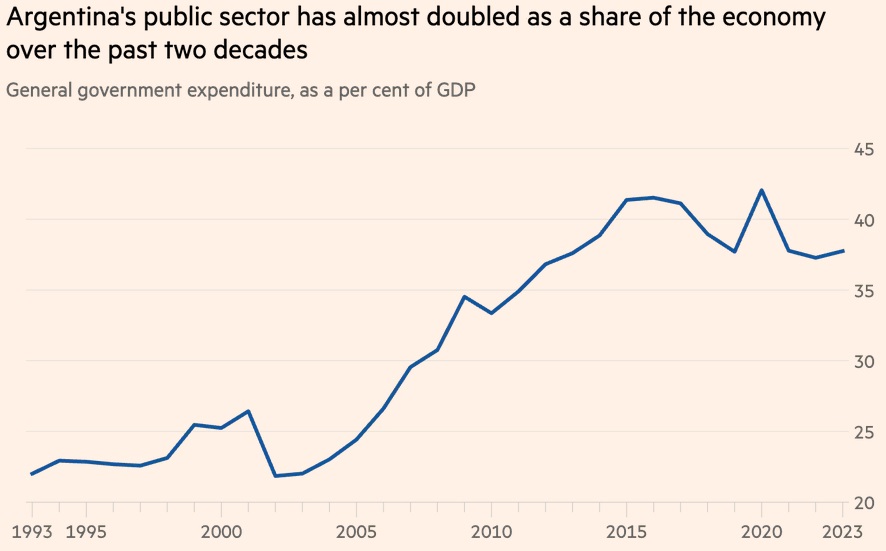
Incidentally, you won’t be surprised to learn that the tax burden dramatically increased as the nation’s spending burden increased.
There’s actually a “starve the beast” debate among academics about whether higher taxes lead to higher spending or whether higher taxes enable higher spending.
As far as I’m concerned, it’s bad news regardless of causality.
I’ll close with a political observation.
Argentina has made great progress since Milei took over. But there are still big reforms that are needed. For additional problems to be solved, Milei needs to win reelection next year and his libertarian party to win de jure or de facto control of the legislature.
Fingers crossed.
P.S. What’s ultimately needed in Argentina (and other nations) is genuine federalism, such as what exists in Switzerland.