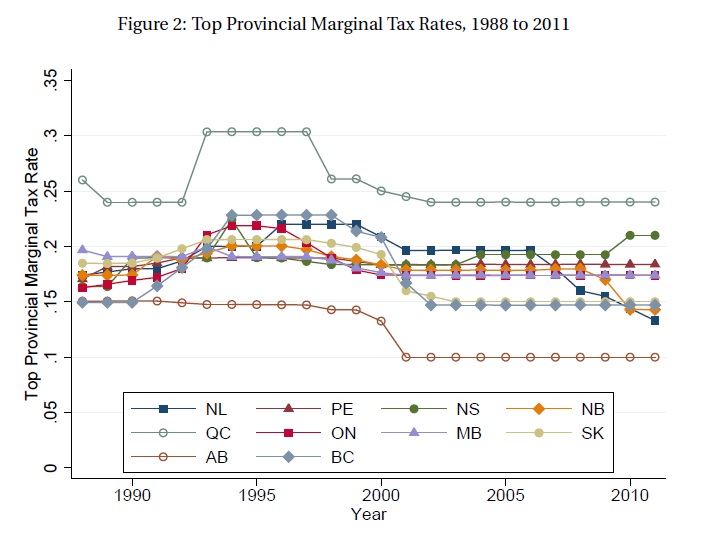
In Part I of this series back in 2014, we looked at some academic research from Canada showing that the revenue-maximizing tax rate on the richest taxpayers was 27.5 percent.
A key insight from that research is that high-income taxpayers have considerable control over the timing, level, and composition of their income (just like in the United States), which makes it relatively simple for them to protect their money when government gets too greedy.
As such, our friends on the left need to decide what’s most important: Do they want to collect more revenue (which means they should lower tax rates on the rich) or do they want to punish success for reasons of envy (if which case, impose punitive tax rates).
But psychological shortcomings on the left are not the focus of today’s column.
Instead, I want to share some new research from five Norwegian economists (Michael Graber, Morten Håvarstein, Magne Mogstad, Gaute Torsvik, and Ola L. Vestad) looking at revenue-maximizing top tax rates.
Here are some excerpts from their study, which was published by the National Bureau of Economic Research.
…we use our estimates of income and substitution effects to quantify the efficiency cost and revenue effect of increasing the marginal tax rates on middle- and high-income individuals. We also calculate the implied revenue-maximizing top-income tax rate. …We conclude that ignoring income effects and heterogeneity in elasticities can lead to severely downward-biased estimates of excess burden. In our setting, the actual efficiency costs of taxation are four to five times larger than those implied by the conventional specification. …For incomes above 650,000, the revenue function is negative, indicating that reducing marginal tax rates for these incomes would increase tax revenue. …We now turn to deriving and computing the revenue-maximizing top-income tax rate. …he revenue-maximizing top rate is at most 0.4. It declines with the effective consumption tax rate ˜τ , and reaches 0.25 when ˜τ is at its upper bound. For ˜τ = 0.21, obtained using observed expenditure shares, the revenue-maximizing tax rate is around 0.27. …These findings imply a substantial excess burden of taxation, and that reducing the top-income tax rate would increase tax revenue.
This is interesting. The authors estimate the revenue-maximizing tax rate is 27 percent, almost exactly the same as the Canadian study cited above.
By the way, here’s Figure 9 from the study, which wonkier readers may appreciate since it summarizes key findings.
For what it’s worth, I don’t want tax rates that maximize revenue.
It’s a bad idea to even get close to that level (as I wrote in 2012, that implies “it’s good public policy to destroy a large amount of private output in exchange for a small increase in tax revenue”).
But you know what’s even worse than maximizing revenue? Being on the downward sloping side of the Laffer Curve. That means destroying so much private output that the government loses revenue (which is something that some other Norwegians recently did).