

My Ph.D. dissertation last century was about Australia’s system of personal retirement accounts, so I have a long-time interest in how to fix America’s Social Security system.
Which leads me to a good news-bad news situation.
The good news is that politicians will probably be forced to deal with Social Security at some point in the next few years. To be sure, they would prefer to kick the can down the road. However, even though the Social Security Trust Fund is nothing but IOUs (see what Bill Clinton’s OMB wrote if you think I’m exaggerating), lawmakers will be forced to act because those IOUs will run out early next decade.
The bad news is that politicians are always capable of making a bad situation worse.
Here’s something I put together back in 2020 to help illustrate the various ways of dealing with the program’s ever-expanding burden.
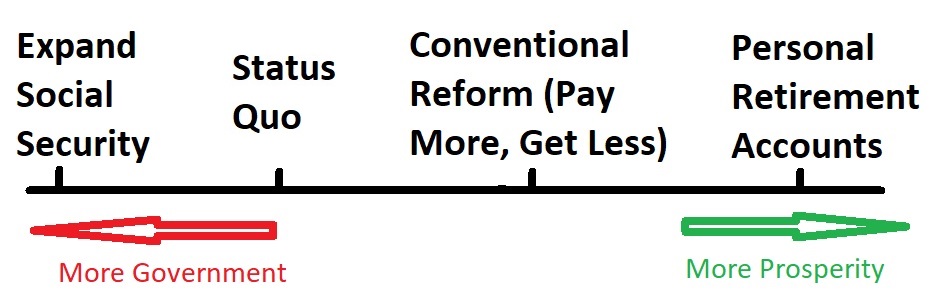
Sadly, there is no way my favorite option – personal retirement accounts – is going to happen. Which is sad since many other nations have figured out how to make that shift.
Instead, politicians will choose to make the program worse, to maintain the status quo, or they will choose the pay more-get less option.
I’ve already opined about the foolishness of expanding Social Security.
And I’ve also written about the insanity of kicking the can down the road (which will happen if politicians pass a law saying all promised benefits must be paid even of the Trust Fund IOUs are gone).
So today’s column will focus on the pay more-get less option.
I’m not a huge fan of this approach because it exacerbates the other Social Security crisis.
That being said, there’s a big difference between “pay more” and “get less.”
The number-crunchers who run the Penn Wharton Budget Model recently estimated the effects of various proposals to fix Social Security’s 75-year financial shortfall.
I especially urge readers to pay attention to the consequences of the choosing Package A (which is all tax increases) and Package F (which is all benefit restraint).
As you can see, you get better results for every variable by opting for benefit restraint. In some cases, such as GDP, capital, and wages, the difference is enormous.

Andrew Biggs of the American Enterprise Institute looked at the Penn Wharton report.
Here are some of his observations.
A new analysis by the Penn Wharton Budget Model shows that which approach we choose matters enormously for avoiding a debt crisis and keeping the economy strong. Any Member of Congress entering Social Security reform deliberations without understanding how Social Security reform can affect the economy is, literally, missing half the story. …the Penn Wharton model projects how households respond to policy changes through their decisions to work and save. And, because the federal government levies taxes on work and savings, those economic responses feed back into the federal deficit and debt. …The tax-increase and benefit-reduction packages represent opposite reform philosophies, but their effects on Social Security’s finances are almost identical. That’s by design: both are calibrated to make Social Security solvent for 75 years. …the real kicker comes from higher long-run GDP: 12.1% under the benefit-reduction package versus just 0.4% under the tax-increase package.
I’ll close by preemptively dealing with a likely question from some of my left-leaning friends.
They’ll probably want to dismiss the Penn Wharton numbers as somehow representing right-wing thinking. But that’s simply not true, as you can see by looking at their projections for Trump’s One Big Beautiful Bill.
P.S. Allow me to fantasize that we’ll get personal retirement accounts in any future legislation to ostensibly fix the program.