
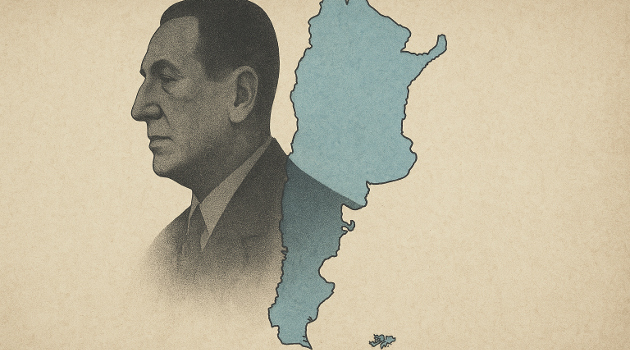
Today’s column is about Argentina, but it’s not going to be about Javier Milei or the libertarian changes (here, here, and here) he has made since becoming president in December 2023.
Instead, we’re going to focus on how Argentina became an economic basket case in the seven-plus decades before Milei.
We’ll start with a chart comparing per-capita GDP in Argentina and Spain. It’s in Spanish, but should be self-explanatory.
It shows that Argentina was consistently richer than Spain before Juan Perón became president in 1946. Then there was a massive change.
Argentina began to languish, giving Spain an opportunity to catch up around 1980. After 1980, here has been divergence, with Spain becoming comparatively richer.

By the way, Spain has not been an economic powerhouse, so the relative decline is even worse than seen in this chart (a comparison between Argentina and the USA is more dramatic).
So what lesson can we learn, other than that I have a new example for my Anti-Convergence Club?
The main lesson is summarized by this tweet from Prof. Santiago Calvo. Argentina, he explains, suffered a big relative decline because of a destructive form of statism called “Perónism.”

To give you an idea of how far Argentina has fallen, here’s another Spanish-language chart shared by the professor. As of 1910, Argentina was the 8th-most prosperous nation in the world

Incidentally, Argentina as still in or near the top-10 at the end of World War II. The big decline began when Perón took office and started expanding the size and scope of government.
As a result, Argentina declined to the mid-60s in the per-capita GDP rankings by the time Milei took office.
I’ll conclude by reiterating what I wrote last month, which is that Milei has made great progress, but there is still a long way to go to fix all the damage caused by Perón and his mostly awful successors.