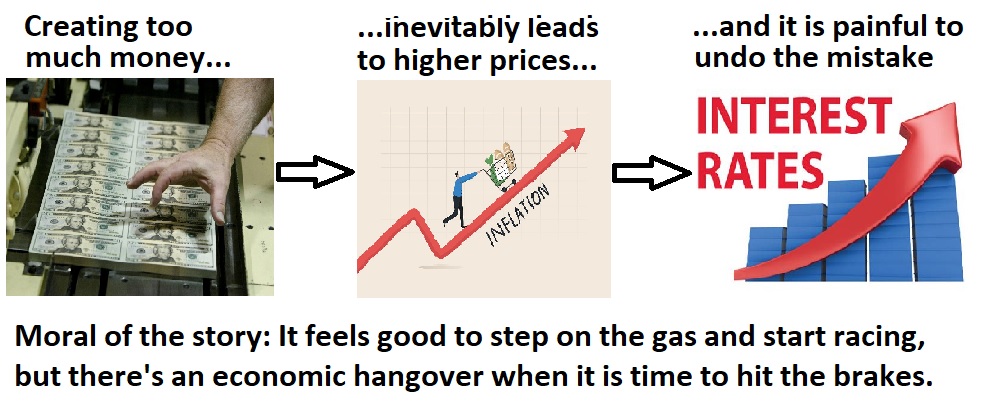
I wrote a two-part series (here and here) in 2024 that looked at evidence against economic populism and one of the strongest conclusion was that populist leaders lead to higher inflation.
Our third installment in the series will look at some fresh evidence about populist monetary policy, which I define as easy money (creating excess liquidity to artificially lower interest rates and thus juice the economy with a “sugar high“).
That feels good when it first happens, sort of like the buzz after three shots of booze.
The problem is that easy-money policy leads to inflation (too much money chasing too few goods), which is akin the hangover.
And the hangover can be very severe since inflation in many cases is followed by an economic downturn as central bankers try to undo their mistakes and because inflation tricked people into making unsustainable economic choices.
But enough boring discussion of monetary policy. Let’s look at some research on the topic. Here’s a chart showing how populist governments produce a combination of lower interest rates and higher inflation.
The chart comes from a new working paper from the International Monetary Fund, authored by Marijn Bolhuis, Rui Mano, and Hedda Thorell.
The authors looked at what happens when politicians appoint populist central bankers (the authors use the term “politically motivated transitions”). Here are some excerpts from their research.
This paper studies the macroeconomic consequences of undermining central bank independence through politically motivated transitions of central bank governors. Leveraging a new panel dataset covering 132 central bank governor transitions in 28 advanced and emerging market economies since 2000, we document the timing, frequency, and political drivers of these leadership changes. Tenures of governors with politically motivated appointments are associated with higher and more volatile inflation, realized and expected. Professional forecasters also tend to expect such governors to be more dovish when responding to shifts in inflation. Using local projections in a difference-in-difference setting, we find that following the announcement of a politically motivated governor transition nominal and real short rates decline and expected and realized inflation rise. …These effects are more pronounced when the incoming governor professes unorthodox views on monetary policy, suggesting that political interference in central bank leadership induces a temporary growth–inflation trade-off. Long-term inflation expectations only rise in the case of unorthodox governors with politically motivated appointments, suggesting costs to central bank credibility are much more pronounced in those cases.
Regarding the “unorthodox” appointees, here’s another chart from the study.
As you can see, those are the central bankers associated with the worst inflation outcomes.
Now let’s shift from theory and data to the present day.
So it will be interesting to see what happens now that he’s appointed a new Chairman of the Federal Reserve. Time will tell whether my concerns are legitimate.