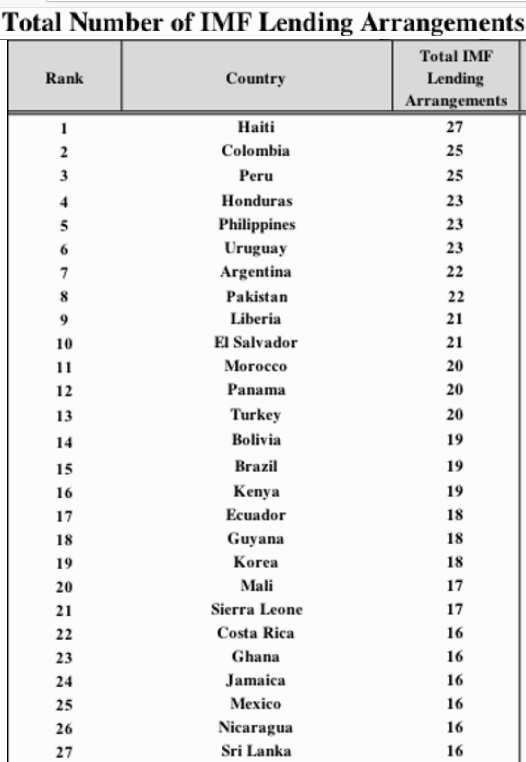
But fairness requires me to acknowledge that the IMF usually is bad because most governments are bad. So when a country gets in fiscal trouble and the IMF is asked to intervene (which can range from advice to bailouts), it is very common that the bureaucrats will recommend various tax increases because those are the only “consolidation” proposals that the country’s politicians will accept.
That’s no excuse, of course. After all, tax increases exacerbate fiscal problems rather than solving them, which is why many governments are repeat customers for the IMF.
But today is an exception. No, I’m not changing my mind about that goal, but I am going to write something nice about some new IMF research.
Here are some excerpts from a newly released study authored by Prepared by Gee Hee Hong, Naowar Mohiuddin, Rasmane Ouedraogo, Danila Smirnov, and Maryam Vaziri.
This paper provides an integrated quantitative framework for thinking about consolidation in high-debt advanced euro area economies. The analysis is built around two main consolidation scenarios that deliver the same headline fiscal effort but differ in composition—expenditure-based (ExC) and revenue-based (ReC)—and a complementary exercise in which the expenditure-based path is paired with growth-enhancing structural reforms (ExC+SR). Comparing the two main scenarios, we find that…Expenditure-based adjustment is associated with lower short-run output costs and faster debt reduction than revenue-based measures, reflecting lower fiscal multipliers and more favorable household incidence. By contrast, revenue-based consolidation—particularly through labor taxation—induces larger demand contractions, especially in…many high-debt euro area economies. …The additional exercise on structural reforms shows that complementing expenditure-based consolidation with sustained TFP gains can convert a contractionary adjustment into a growth-friendly one over the medium term. Higher productivity supports real incomes, investment, and the tax base, and the wage channel delivers disproportionate gains to hand-to-mouth households, making the package both more growth- and more equity-friendly. …Beyond confirming the static composition lessons familiar from the literature, our HANK-based framework underscores that in high-debt euro area economies, delaying adjustment is a costly policy stance through the sovereign-spread feedback channel, and that the choice of consolidation path is also a choice about the distribution of who bears its cost.
As a quick aside, “HANK” means “Heterogeneous Agent New Keynesian,” so this research is definitely not the result of a secret cabal of libertarians hidden at the IMF.
Here are some graphs showing the main results. As you can see, “expenditure consolidation” beats “revenue consolidation” for all these key indicators.
And if you add “structural” to the equation (meaning deregulation), the results are even better.
I’ll close by noting that the research is based on outcomes for high-debt advanced countries in Europe.
But there’s every reason to think the lessons apply to the United States, Japan, and other nations.
P.S. While the results bolster the case for spending restraint, I’m sure the results would be far stronger if the model was made more realistic (primarily by showing that politicians generally respond to higher taxes by increasing spending and incurring more debt – which is confirmed by looking at fiscal data for Europe).