Just like the swallows return every year to Capistrano, I write every year (2025, 2024, 2023, 2022, 2021, 2020, etc) about the horrible fiscal outlook for Social Security.
Since the Social Security Administration just released the annual Trustees Report, let’s look at the 2026 version of the program’s grim finances.
We’ll start by looking at projections of annual spending and tax revenue (taken from Table VI.G5 of the “Supplemental Single-Year Tables.”
These numbers are adjusted for inflation, so this chart shows how Social Security spending will more than triple by the start of the next century.
The good news is that the economy is projected to grow over the same time period, so the actual fiscal burden of the program (as a share of economic output) will only climb from 4.7 percent of GDP to 6.1 percent of GDP.
Here’s the chart that deserves more attention. It shows that Social Security’s current multi-hundred billion dollar deficits will become trillion-dollar-plus deficits in just a few decades.
The reason that this chart is more important is that red ink is the reason that politicians eventually will be forced to deal with the issue.
Indeed, the action-forcing moment will probably occur in the next few years because the “Trust Fund” is projected to run out of money by 2032.
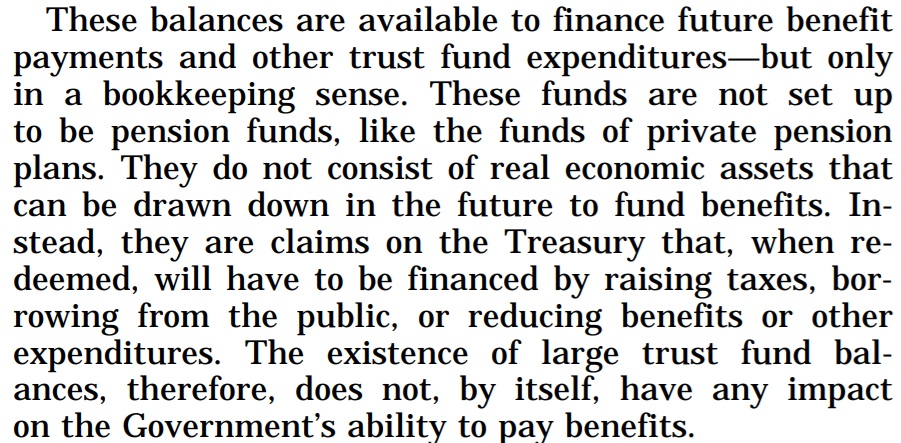
Economically, the Trust Fund is a mirage. It only holds IOUs, as explained by Bill Clinton’s Office of Management and Budget.
But it is real in the narrow sense that current law requires automatic benefit cuts once the IOUs are all cashed in. And it goes without saying that politicians won’t allow that to happen.
I’ll conclude today’s column by citing some excerpts from the Washington Post‘s editorial.
…the next president, whoever it is, will need to deal with this looming crisis during their term. Politicians don’t like to talk about reforming Social Security… It’s popular and millions of seniors rely on it. But that’s all the more reason to take its impending insolvency seriously. …The Social Security trust fund is an accounting gimmick. The government did not accumulate a surplus that it is now spending down. It spent the money when it came in, and Social Security adds to the deficit right now. But the trust fund mechanism still matters because the law says that when the trust fund hits zero, benefits are not allowed to exceed revenue. The trustees estimate that will mean only paying 78 cents for every dollar in promised retiree benefits. …It’s incumbent on every presidential candidate to say what that something should be. Do they want to raise taxes, cut benefits or both? Are they thinking bigger about modernizing the program to match current demographics? Or are they content to just borrow more to make up the difference? …Any candidate who doesn’t have a plan isn’t serious about leading the country.
Maybe, if I’m lucky, there will be a Reagan-type candidate who proposes a real solution (the United States missed a chance to enact good reform about 20 years ago when our fiscal situation wasn’t so grim).
P.S. I speculated last year on how Washington will react. My best guess is that they’ll simply change the law so that benefits are fully paid by debt financing. In other words, kick the can down the road, meaning future politicians will have to deal with a genuine fiscal crisis.
P.P.S. When I first started writing about Social Security’s inflation-adjusted shortfall in 2012, the gap was “only” $30 trillion.
P.P.P.S. You can enjoy some Social Security cartoons here, here, and here. And we also have a Social Security joke if you appreciate grim humor.