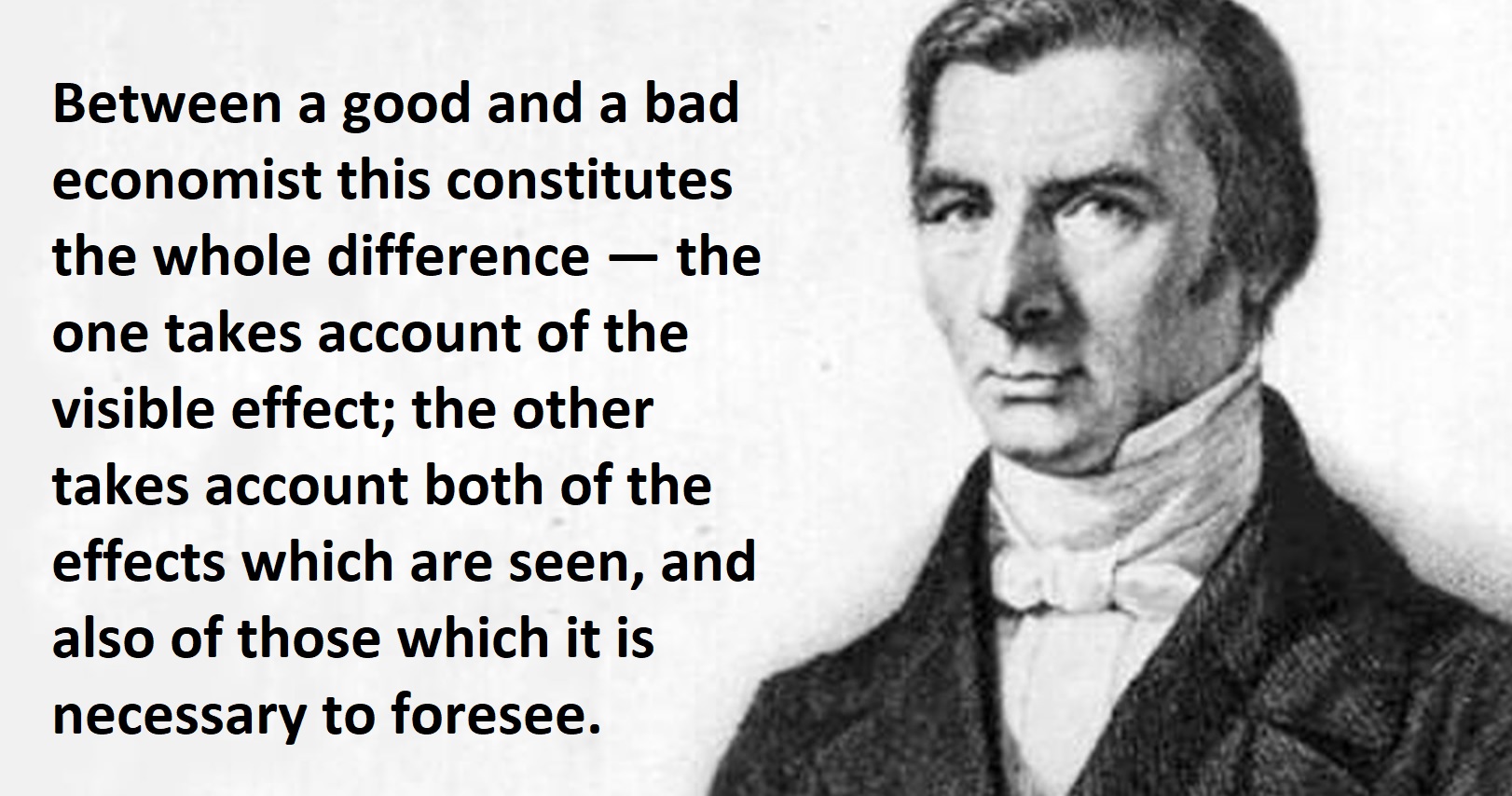
What Vance did not understand (or pretended not to understand) is that government intervention has “unseen” effects that are almost always negative.
Today, let’s look at another example of politicians acting like they can repeal the laws of supply and demand.
It also took place in 2024 and it involved Seattle politicians who thought they could help gig workers by mandating higher pay per delivery from apps like UberEats.
Three economists (Yuan An, Andrew Garin, and Brian K. Kovak) looked at the consequences in a study published by the National Bureau of Economic Research.
You won’t be surprised to learn that the law backfired. Here are some excerpts from their abstract.
How does a task-level minimum pay requirement for gig workers affect their earnings and employment? We study this question in the context of a January 2024 law in Seattle that establishes a per-task minimum pay standard for app-based delivery workers. Drawing on novel cross-platform, trip-level gig activity data, we compare earnings and employment trajectories around the implementation of the law for workers who were doing delivery work in Seattle before the reform against workers who had been active in other regions of Washington State. We find that the minimum pay law raised delivery pay per task, though the increases in base pay per task were partially offset by a substantial reduction in average tips, a major component of delivery pay. At the same time, the policy led to a reduction in the number of tasks completed by highly attached incumbent drivers…, completely offsetting increased pay per task and leading to zero effect on monthly earnings. …These findings highlight the challenges of raising pay in spot markets for tasks where there is free entry of workers.
Here’s a real-world example from the study of how the Seattle mandate increased costs.
And here’s a chart showing how workers did not benefit from the mandate.
All you need to understand is that the benefits of higher mandated pay were offset by lower tips and fewer deliveries.
At this point, some of my left-leaning readers might say that this outcome is okay because workers didn’t actually lose pay.
To which I would respond by asking about the losses to consumers and restaurants (as well as gig drivers who leave the market).
Regarding restaurants, here are some passages from a KUOWreport by Kim Malcolm and Ruby de Luna.
The ordinance isn’t just about wages. It required companies to pay mileage and time spent waiting either for the food, or in this case, sitting in traffic. The law also outlined protections before a driver can be fired or in the industry lingo, deactivated. The thing is, that pay raise lasted a few months. …Things slowed down. Orders weren’t coming in; they still aren’t coming in like they used to. …Customers still want the convenience, but many balked at the fees that the apps tacked on after the new law. …Uttam Mukherjee, co-owner of Spice Waala, that serves Indian street food on Capitol Hill, Columbia City, and Ballard…has expressed concerns early on. Those concerns he says have become real — he’s getting fewer orders coming through those apps because of the added fees that customers are now paying. “A meal might be $12 or $15 in our restaurant,” Uttam Mukherjee told me. “By the time a customer gets it through these apps, it becomes $35, $40 so I wouldn’t buy our own food for that price. Why should we expect customers to do that?” He estimates his business declined by 50%.
This should eliminate any doubt about the mandate being a net negative for the people of Seattle.
I’ll close by recycling a cartoon about the minimum wage.
It perfectly captures the real-world impact of government intervention. I’ve done interviews on this topic (see here, here, and here) and also shared short documentaries on the topic (see here and here).