
Having examined the bad-to-awful fiscal policies of France, Italy, the United Kingdom, Canada, Greece, and Japan, let’s now turn our attention to the United States.
As I’ve done with every nation in this series, we’ll begin by looking at the the degree of fiscal deterioration this century.
Unfortunately, there’s nothing but bad news. Overall government spending in the United States (federal, state, and local) is consuming almost 38 percent of economic output, an increase of more than 5-percentage points of GDP. And gross debt has more than doubled.

That’s some of the bad news.
Another reason to be depressed is that the U.S. has the highest burden of interest payments among developed nations.

Unfortunately, current projections shows that fiscal policy will further deteriorate over the next few decades.
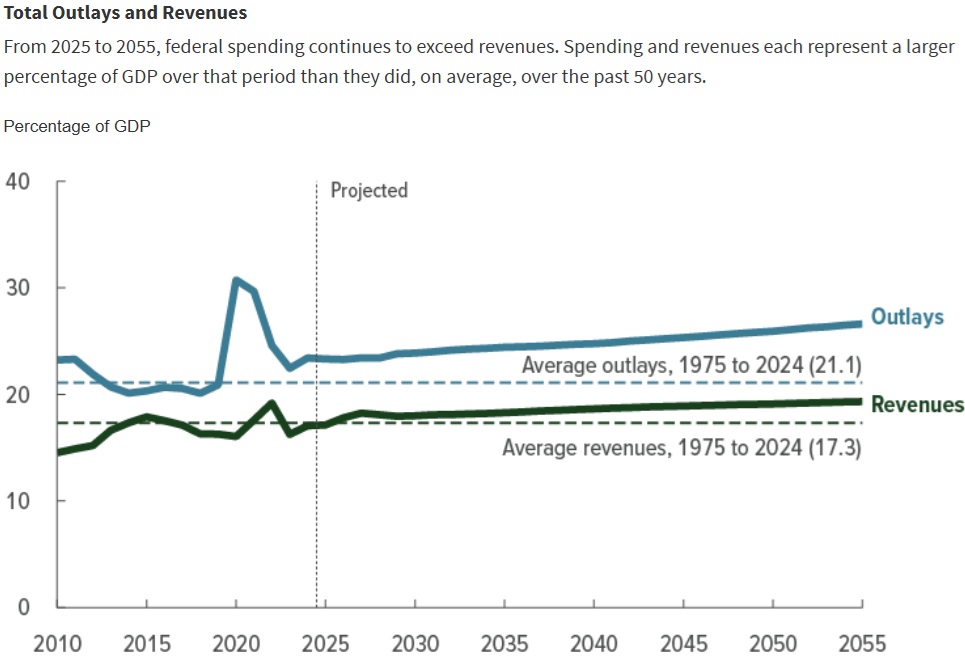
In the absence of genuine entitlement reform, the burden of government spending will continue expanding and debt will continue to climb.
And that puts the nation at risk.
Some argue the U.S. can’t get in trouble because the dollar is the world’s reserve currency.
At best, however, it simply means the U.S. can be a bit more profligate until we reach the tipping point.
Let’s wrap up with this visual from the Economist, which may be the most depressing data in a sea of bad news.
Of all G-7 nations, the U.S. requires the most fiscal adjustment to keep debt from rising further.

The real goal, of course, should be controlling and then reducing the burden of government spending.
If that happens, debt will quickly fall (as we’ve seen in the past couple of years in Argentina).
Sadly, U.S. presidents this century – both the Republicans and the Democrats – are the opposite of Javier Milei.