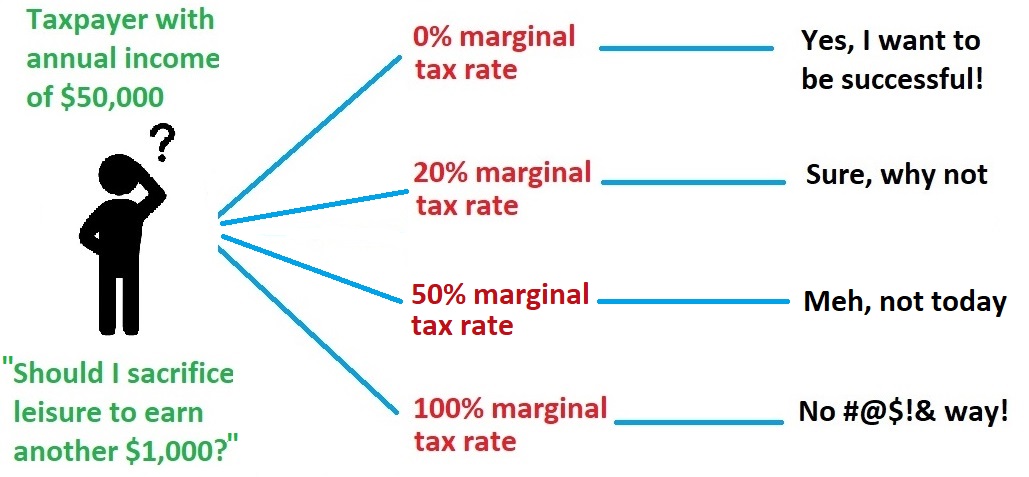
And that’s why today’s column will be part VI in our series about taxes and behavior.
Our case study involves a proposed tax increase in New York City. For background, here are some excerpts from a report in the New York Times by Debra Kamin.
Gov. Kathy Hochul’s plan for a yearly surcharge on second homes in New York City worth $5 million or more could be an elegant political move… But real estate agents and economists say the tax could be catastrophic for the city’s housing market, hurting not the superrich investors who park their money here, but the very middle- and lower-income citizens it’s designed to benefit. …Jim Whelan, the president of the Real Estate Board of New York, said his organization was opposed to the idea of the tax and was holding conversations with Gov. Hochul’s team to share its perspective. “Tax policy impacts behavior,” Mr. Whelan said. “The impact it has on behavior is that people decide to do other things. They decide to purchase elsewhere.
But what makes this story interesting is that the reporter looks at what happened when something similar happened on the other side of the Atlantic Ocean.
…just look at London. A slew of punishing new taxes has transformed London’s luxury housing market over the last decade. The taxes have pushed housing values down and driven international buyers, who have historically made up nearly half of the homeowners in prime London neighborhoods, to consider other markets. …Sales prices of properties in London have dropped more than 20 percent since 2015. As taxes mounted, …smaller landlords threw in the towel, taking tens of thousands of apartments off the market and constricting supply. Average monthly rents, as a result, are now at record highs. …John Fredriksen, the Norwegian-born shipping magnate, told newspapers “Britain has gone to hell” before selling his $338 million mansion and relocating to Dubai. Nassef Sawiris, the owner of the Aston Villa soccer team who is known as the richest man in Egypt, also exited and blamed the government on his way out. …The number of foreign buyers in the Britain registering with a real estate agent — the first step before purchasing property — is now at its lowest level since 2008. At the same time, the real estate markets in cities like Barcelona and Dubai, where tax rules are much friendlier to second-home buyers, are seeing a fresh influx of foreign money. …so many international buyers have turned elsewhere, taking their spending and charitable giving with them, that the market has deflated.
The moral of the story is that tax policy based on class warfare has done damage in London and we can easily predict that class-warfare policy will also backfire in New York City.
And politicians on both sides of the Atlantic Ocean are foolish to ignore those consequences (though their constituents are the ones who suffer while the targeted rich people simply move their economic activity to friendlier jurisdictions).
That being said, I’ll close by observing that London and New York City are not completely analogous in their policy mistakes.
Many high-end buyers left London because of the “non-dom” tax changes, an approach that is different than NYC’s proposed increase in the property tax.
Rent control discourages new housing construction is New York City, but London has never made the mistake of imposing price controls on rental units.
Nonetheless, policy is moving in the wrong direction in both cities, and different statist policies can lead to similarly bad results.
P.S. I can’t resist citing one more passage from the article.
…the governor hopes the new tax will bring in $500 million a year, funds New York City could desperately use at it struggles to pay its estimated $5.4 billion deficit.
This is where the reporter made a mistake in an otherwise good article.
She should not have written that the city could “desperately use” more tax revenue without acknowledging that the fiscal shortfall is entirely caused by irresponsible spending increases.