

As documented here, here, and here, many European nations (France, Spain, Italy, Belgium, Greece, U.K., etc) are vulnerable to a Greek-style fiscal crisis.
Today, let’s add a fourth installment to the series and we’ll start with this segment from a recent interview.
The level of debt will be the trigger for the crisis, but the real problem is captured in this chart from Oxford University’s Our World in Data.
As you can see, the burden of social welfare spending has dramatically expanded over the past six decades.

It’s no coincidence, by the way, that the welfare state became a much bigger burden once European governments imposed value-added taxes beginning in the 1960s.
In an article for National Review, John Gustavsson documents some of Europe’s problems. The Swedish expert correctly observes that spending is the problem.
Here are some excerpts.
French bond yields have risen sharply in the middle of a global bond selloff… Other eurozone countries, largely untouched by the crisis 15 years ago, are now also in the danger zone. …A debt crisis is not by any means a sure thing. What is sure, however, is that such a crisis, were it to happen, would look very different than the one during the early 2010s. …a new crisis would be a truly economic crisis caused by a decade or more of accumulating structural issues: a loss of competitiveness causing a long slog with little economic growth resulting in little growth in tax revenues, combined with an aging population and an underemployed migrant population. …How it ends is hard to predict. Wealth taxes, which most of Europe already abolished for good reason, would almost certainly stage a comeback as left-wing populism surged. …Supporters of EU centralization will argue that the problem is the EU’s lack of authority to directly intervene in the day-to-day fiscal affairs of its member states, that if Brussels had the power to force countries to raise taxes or reduce spending, national budgets could be balanced. …markets will eventually, like in the 2010s, force Europe to do what its leaders will not. To quote the words of the economist Herb Stein, “If something cannot go on forever, it will stop.”National Review
The bottom line is that European nations desperately need Milei-ism.
But most European governments prefer more taxes and more spending. As do most European voters.
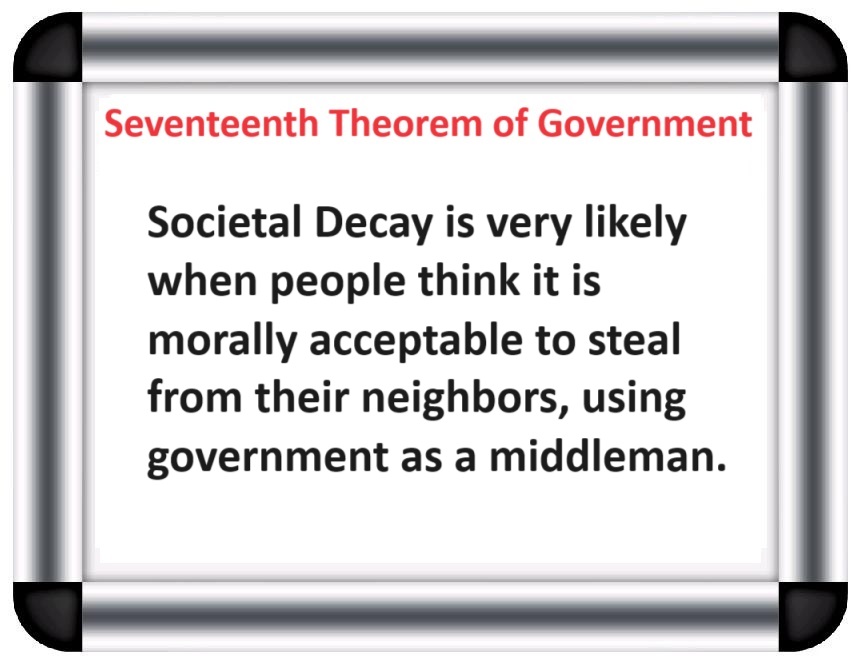
Indeed, my 17h Theorem summarizes the problem.
What these nations need is a Swiss-style spending cap.
But that would be the least-preferred option for politicians and their dependents. Instead, they’ll want higher taxes, money printing, wealth confiscation, and more borrowing (so long as there are people willing to risk their savings by buying bonds from dodgy governments).