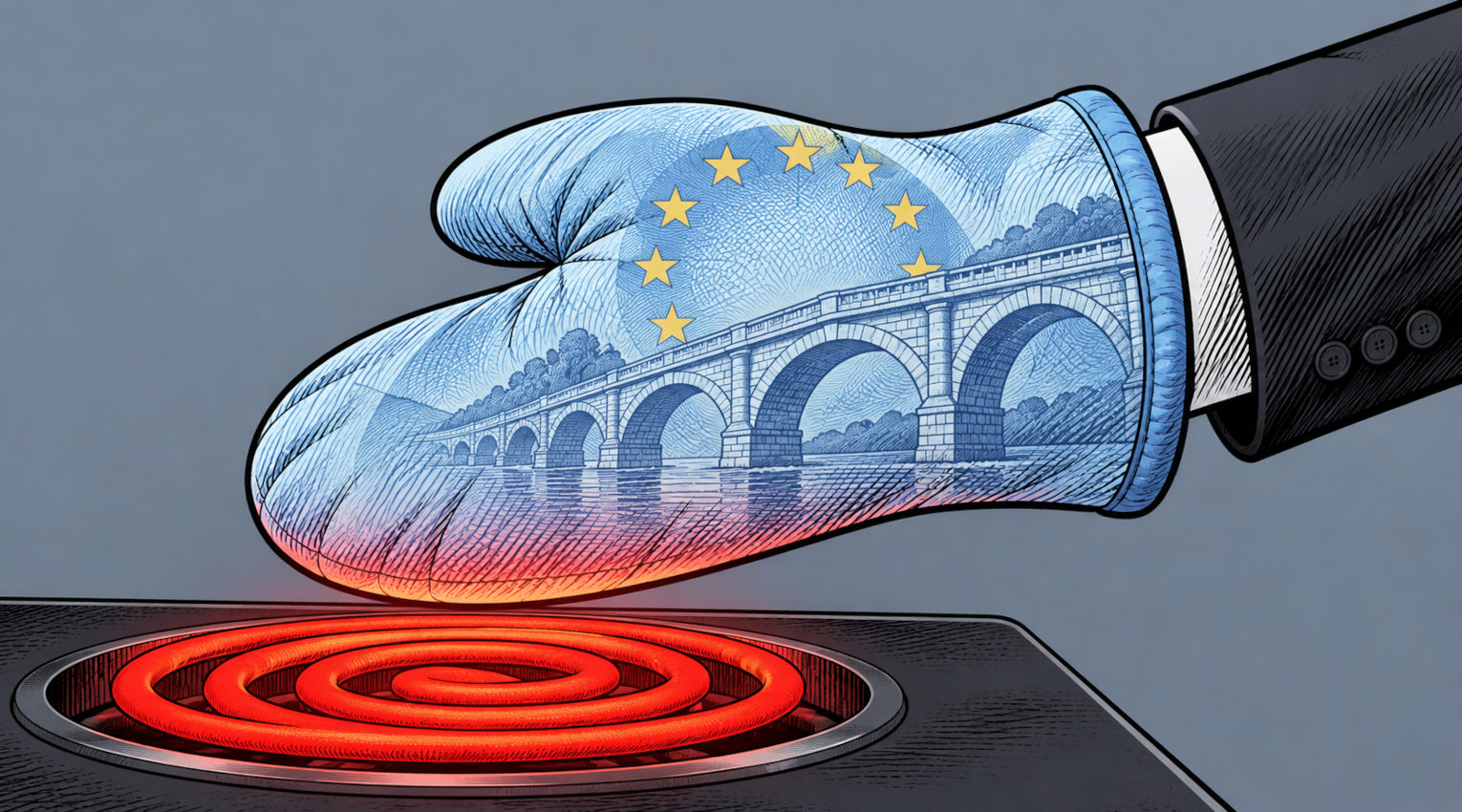
During Europe’s fiscal crisis about 15 years ago, I warned that Europe’s feckless politicians put the euro at risk by having the European Central Bank engage in de facto bailouts of Europe’s decrepit welfare states.
Bailouts, by contrast, would give politicians leeway to waste more money and incur more debt. And that would create the conditions for an even bigger fiscal crisis in the future.
Unsurprisingly, my advice was ignored. Mario Draghi, the head of the European Central Bank last decade, said in 2012 that he would do “whatever it takes” to save the euro. But what he really meant is that he would use monetary policy to prop up Europe’s welfare states.
Let’s see who was right. Did governments respond by putting their fiscal houses in order, as Draghi presumably wanted? Or did they create bigger debt bubbles with more spending.
Lo and behold, I was right. I’ve already shared data on higher debt levels in some European nations. Here’s a completely up-to-date chart, based on the latest IMF data, of debt changes in major eurozone nations since Draghi’s (in)famous speech.
France has deteriorated the most, but all of these nations have gone downhill. And, keep in mind that the situation is far more dire than shown in this chart because of Europe’s demographic outlook is much worse than it was 14 years ago.
As I recently wrote, I don’t know which country will trigger the fiscal crisis (though I have good reasons for including France, Spain, Italy, and Belgium in the chart). But it definitely looks like a huge mess is unavoidable.
So what should happen? Spending restraint is the right approach. But if politicians refuse to be responsible, I’ll reiterate what I wrote back in 2011: Defaults are preferable to bailouts.
Yes, defaults would be messy, but that outcome would send some very important and valuable signals.
The investors who buy government bonds would learn to think carefully before lending money to irresponsible politicians.
Politicians would learn that there are very negative economic and political consequences for fiscal profligacy.
For all intents and purposes, blocking bailouts is a way of dealing with the problem summarized in my 19th Theorem of Government.
Desmond Lachman of the American Enterprise Institute has a different perspective. Focusing on France, he writes that a bailout is necessary. Here are some excerpts.
France’s public finances are firmly planted on an unsustainable path. Over the last 15 years, persistent budget deficits have caused public debt to surge from 80% of GDP to almost 120%. …if current policies persist, the budget deficit will rise from 5.4% of GDP today to around 7% by 2030. Fiscal recklessness from France’s next administration would make matters far worse. So would an economic recession—an increasingly likely scenario at a time of proliferating shocks to France’s already sclerotic economy. …Against this backdrop, the current selloff of French government bonds should surprise no one. …The good news is that the ECB is better equipped to bail France out today than it was in 2010. In principle, it can use its Transmission Protection Instrument to buy unlimited amounts of French government bonds in the secondary market. The bad news is that the use of that instrument is subject to four criteria that France currently does not meet… The ECB now faces a difficult choice. It can stick to the rules and refuse to bail out France… This might enhance the ECB’s credibility, but it would risk a full-blown bond-market crisis and raise the specter of a French default… Such a crisis could cause the euro to unravel, with major adverse spillover effects on the rest of the world economy. …the ECB could waive its rules and, echoing then-ECB President Mario Draghi’s 2012 pledge, make clear that it will do “whatever it takes” to prevent French government-bond yields from blowing out.
I agree with almost everything he wrote, but I nonetheless disagree with his conclusion.
My main disagreement is that a bailout would reverse the three signals I outlined above.
A bailout would reward imprudent investors for buying debt from dodgy governments.
A bailout would reward politicians for irresponsible spending increases.
A bailout would reward voters for treating government like Santa Claus.
Let’s do a thought experiment. Imagine if Draghi had not done “whatever it takes” early last decade and instead allowed various eurozone nations to sink or swim.
Would that have led to worse short-run outcomes? Yes.
However, would that have led to a better fiscal situation today? Also, yes.
Simply stated, people who touch hot stoves should burn their fingers. And burnt fingers 15 years ago would have led to more prudent fiscal choices afterwards.
I’ll close with one final comment. Lachman wrote that the absence of a bailout “could cause the euro to unravel.” Yet he also writes that refusing a bailout would “enhance the ECB’s credibility.”
That sounds a tad bit contradictory.
But perhaps he’s simply describing the range of possible outcomes. Suffice to say that a French default (or a default by any euro nation) does not – or should not – have any implication for the euro.
Would a default by California, Illinois, or New Jersey threaten the dollar? Of course not.
P.S. Since this is a wonky and dry topic, you can click here and here for some bailout-related humor.
P.P.S. I also recommend this 2011 video. All the lessons are still relevant.
P.P.P.S. American readers may think this issue doesn’t affect them, but don’t forget the pernicious role of the IMF.