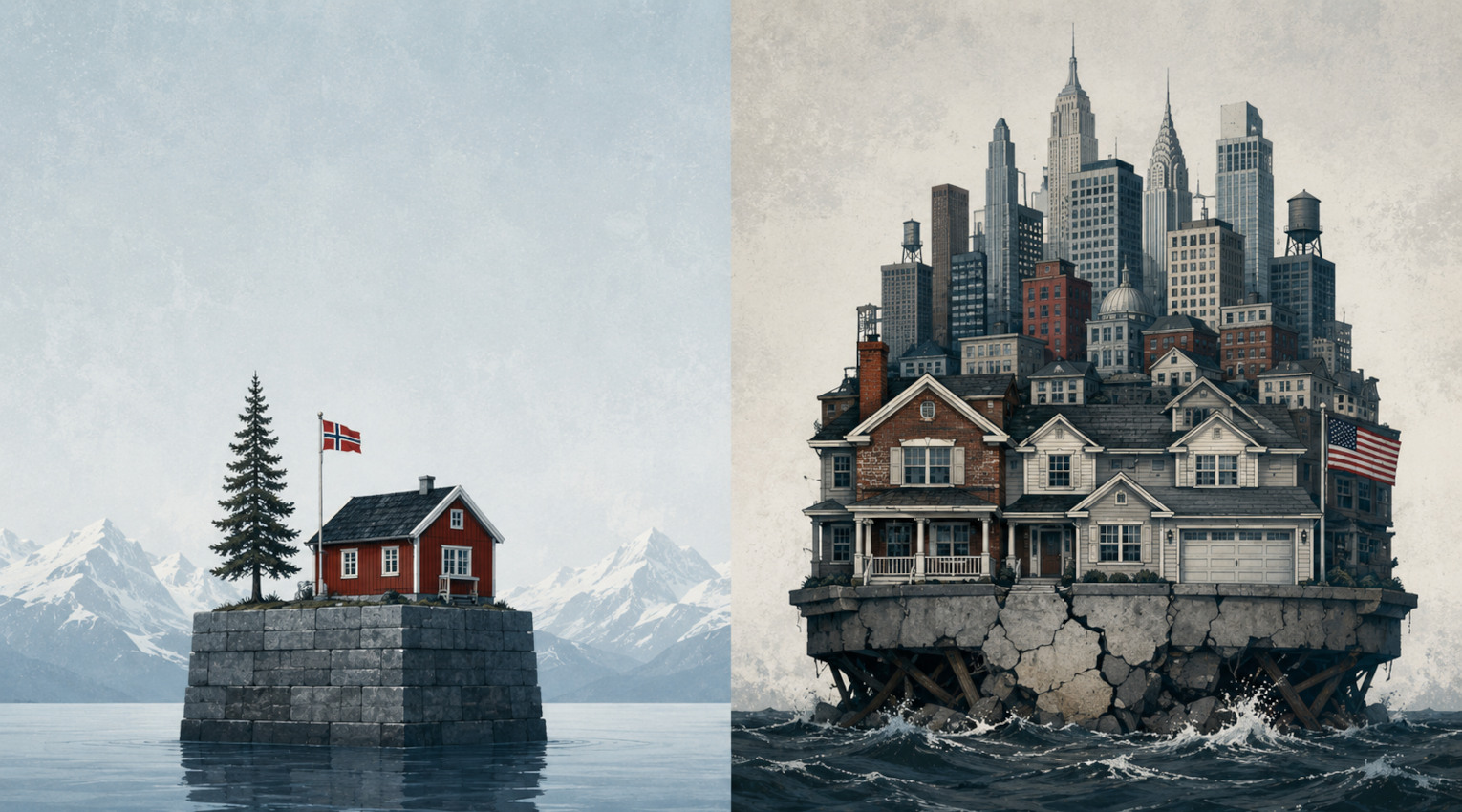
Yes, it it is a high-tax welfare state (like other Nordic nations). But all of those countries are pro-trade, with stable monetary policy, good rule of law, strong property rights, and low levels of red tape.
In other words, Norway and other nations in the region are better than the U.S. on some policies and worse on others. The good news, though, is that both Norway and the U.S. rank somewhat high by world standards.
Norway scores lower than the United States in the latest edition of Economic Freedom of the World.
But it scores above the United States in the latest edition of the Index of Economic Freedom.
Does this mean the United States should be more like Norway? My answer is that we should copy Norway for policies where Norway is better (like trade) but not copy Norway in areas where it is worse (such as fiscal policy).
Other than that, citizens of both countries can and should be happy (as seen in the chart) because we have very high living standards, even when compared to other developed nations.
Other people don’t share my nuanced view. The want America to be more like the Nordic nations, especially Norway.
Here are some excerpts from Nicholas Kristof’s column in the New York Times.
Do you know how to get an American company to grant you excellent wages and amazing benefits, even for an entry-level job? Move to Norway and take the job there. Construction workers, hotel maids, gas station attendants and store cashiers will typically earn more than $20 an hour plus evening or weekend bonuses, about five weeks’ paid vacation each year, a pension, maternity and paternity leave that add up to a year and paid leave when a child is sick. You may even get paid time off if you move homes. Those are broadly the terms for Norwegian and foreign companies alike, including the likes of 7-Eleven shops, Burger King restaurants and ExxonMobil-affiliated gas stations. Which raises the question: If American and other international firms can offer such munificent terms for retail jobs in Norway, could they do so in our country? …“We actually live the American dream,” Jens Stoltenberg, a former prime minister of Norway who is now the finance minister, told me. …Norway is now richer than the United States per capita, and Norwegian workers are more productive than American workers, with higher output per hour.
All this sounds wonderful, but now it’s time for a reality check.
But I don’t need to debunk Kristof’s argument, because he did it himself. If you scroll down to the 27th paragraph, you find this important nugget of information.
…in the case of Norway, its success is mostly a reflection of its oil wealth.
How important is that oil wealth? For an answer, let’s look at two tweets, one from @ApoStructura and the other from @cafreiman.
Congrats to Norway for good luck. But not just good luck. As I wrote nearly 10 years ago, Norway is being reasonably responsible with its oil wealth.
That being said, Norway’s economic data is much stronger thanks to the oil wealth. And that’s not something other countries can copy.
Here’s another section of the column I want to cite, but not because I disagree with Kristof. Instead, I think the person he’s citing is off base.
Lawrence Katz, a Harvard economist, told me that the United States and Scandinavian nations pursued similar policies from the 1940s through the 1960s. That was the period when the United States rapidly expanded educational opportunities, had strong unions and, in the 1940s, experimented with universal child care. The post-World War II period is sometimes thought of as a golden age, for the economic pie both grew and was sliced more equally. “The U.S. in the mid-20th century was sort of like Scandinavia today,” Katz said. But America changed course in the 1970s and eventually embraced the Reagan revolution.
I’ll close by giving Kristof credit for understanding that Nordic nations are not socialist.
When Americans discuss the Nordic system, they sometimes suffer from…misunderstandings. The first is that these are socialist countries. While they are often run by social democrats, they have market economies.
The bottom line is that there are things to admire about Norway and other Nordic nations. But those nations ares not role models. Especially not Norway, unless someone figures out how to magically create massive oil reserves.