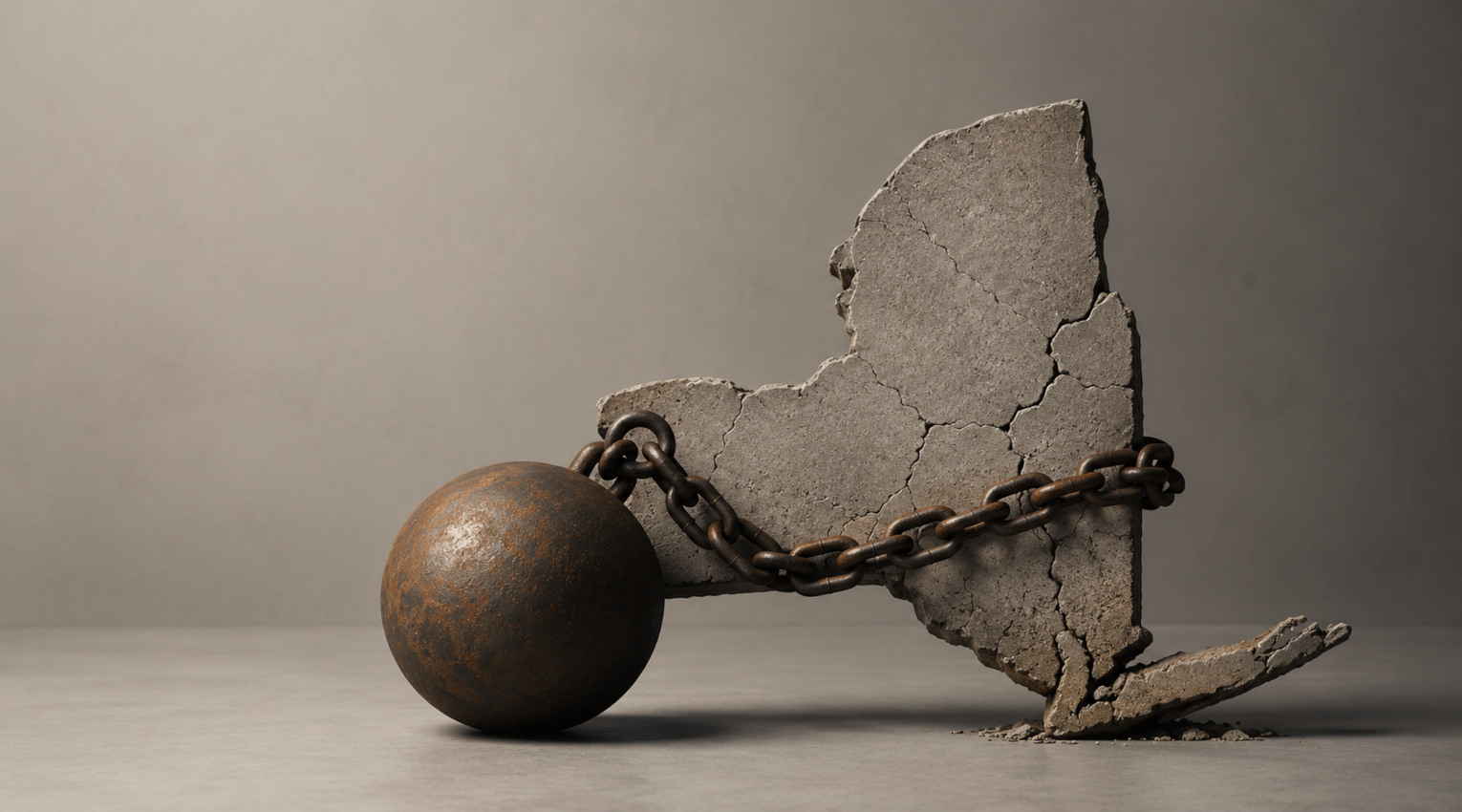
To understand why New York is such a mess, let’s look at some charts from a new report by the Citizens Budget Commission, a non-partisan group based in New York City and Albany.
I’ll start by looking at the state’s real problem, which is that government is too big and growing too fast.
Though New York isn’t the worst state. That dubious honor belongs to Alaska (where politicians squander oil-based revenues with reckless abandon), with California the next worst.
For what it’s worth, the cost of living in New York is above the national average, so it would not be too damning if the state was spending 10 percent or 15 percent above the national average.
But 40 percent more than the national average is absurd. And notice also that per-capita spending in New York is almost twice as large as in Florida.
What are the consequences of bad spending policy?
The answer is bad tax policy. And we see that in this chart looking as tax rates on personal income.
And we also see it in this chart comparing tax rates on corporate income.
If high spending leads to high taxes, what do high taxes cause?
One answer is out-migration. This is something I’ve repeatedly documented (see here, here, here, here, here, and here).
But now we have additional evidence, as shown in this chart.
For a long time, New York politicians have been able to live off New York City’s finance industry, much as California politicians have lived off that state’s tech industry.
Let’s close by citing a few articles. We’ll start with a New York Postreport, authored by Carl Campanile, Vaughn Golden, Craig McCarthy and Matt Troutman, about the aforementioned study. Here are some excerpts.
New York’s share of US millionaires dramatically declined in recent years, causing a nearly $11 billion loss in much-needed tax revenue in just one year, according to a bombshell new analysis. The study released Monday by the Citizen Budget Commisison comes amid fears that socialist Mayor Zohran Mamdani’s push to “tax the rich” will drive even more wealthy taxpayers and their businesses out of New York City. …Many experts and business leaders warned Mamdani’s stick-it-to-the-rich policy dreams – and their growing success among Albany lawmakers – could supercharge the drip-drip of wealthy people. …“In New York, the top 1% of earners pay about 45% of all state income taxes in any given year, so New York’s revenue is very reliant on high earners to stay in New York, and that has been a challenge in recent years,” said Jared Walczak, an economist and senior fellow at the Tax Foundation think tank.
Amazingly (and depressingly), state politicians can’t resist making a bad situation even worse.
Here are some passages from a Washington Posteditorial.
New York Gov. Kathy Hochul (D) this week undid what had been a rare act of fiscal discipline in her state. Taxpayers will now be on the hook for this multibillion dollar mistake. In response to skyrocketing pension obligations for New York state employees, Gov. Andrew M. Cuomo (D) negotiated a deal in 2012 that raised the retirement age and required modest employee contributions. It only affected those hired after the law took effect. The Cuomo compromise was expected to eventually save New Yorkers $80 billion over three decades. But Hochul, up for reelection, caved to a pressure campaign from public-sector unions to roll back these and other reforms. She agreed to move the retirement age for teachers to 58, down from 63. Employees also are now required to contribute less to their own retirement plans. …Hochul also agreed to scale back limits on the practice known as pension spiking. Workers load up on overtime during their final three years before retirement because benefits get calculated based on income during that period.
By the way, the high spending and punitive taxes might be bearable if taxpayers were getting good value.
But let’s look at just one example to illustrate that the state spends money inefficiently. Here are some excerpts from an article in City Journal by Danyela Souza Egorov.
New York State leads the nation in education spending—more than $33,000 per-pupil, 91 percent above the national K-12 average. …New York State has led the nation in per-pupil spending for 19 consecutive years. And no other large urban district spends nearly as much per student as New York City. In fiscal year 2022, for example, Gotham spent $38,163 per pupil, compared with $23,314 in second-place Los Angeles. Despite these massive expenses, New York State posts middling academic outcomes. The state’s fourth- and eighth-graders are of merely average proficiency in reading, per the National Assessment of Educational Progress, and are slightly below average in math. …What do New Yorkers receive for nearly $40 billion in state education funding? Why do our students perform at or below their peers in other states despite this massive price tag?
The same analysis would apply to other areas where the state spends money.
According to Wikipedia, the New York State motto is “Excelsior,” Latin for “Ever Upward.” Based on what’s happening with education, as well as what I’ve reported in other columns (see here, here, and here), perhaps it should be changed to “Pay More, Get Less.”
P.S. If your want to compare somewhat efficient government with wildly inefficient government, my seven-part series on New York vs Florida is very educational (see here, here, here, here, here, here, and here).