I’ve written a four-part series (here, here, here, and here) warning people not to trust economists, and I even wrote a semi-satirical column asking whether economists are “loathsome” people.
Moreover, I wrote that taxpayers should not subsidize economists.
Notwithstanding all those columns, I’m a huge fan of economics.
People who study economics hopefully are well-positioned to understand incentives, trade-offs, opportunity costs, and other important concepts. Indeed, this probably helps to explain why students who study economics earn relatively high salaries compared to most other majors.
And people who understand economics presumably will be less likely to support dumb ideas such as rent control and high tax rates.
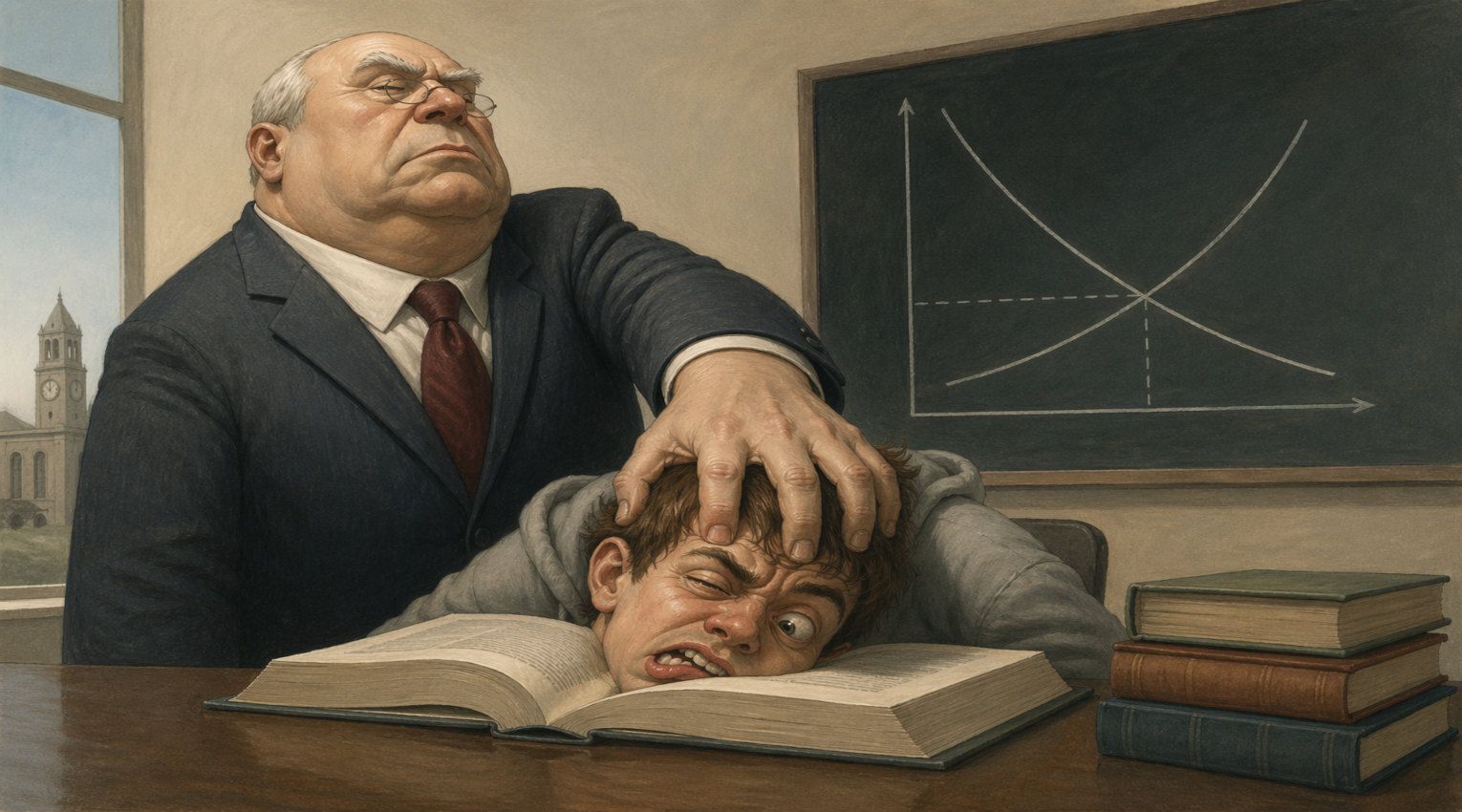
Given this background, I was very interested to see a column in the Wall Street Journal by Professor Samuel Abrams of Sarah Lawrence College. He explains that many of his students know nothing about economics.
I’ve noticed a striking shift among my students. They’re arriving to campus not only skeptical of free markets, but openly embracing democratic socialist ideas. The problem isn’t that students have rejected capitalism. It’s that many have never been taught how it works or why it matters. When we discuss housing, inequality or wages in my course on politics and geography, my students come to conclusions quickly and confidently: Rent control is necessary. Housing is a human right. Markets have failed. But when I ask simple follow-up questions, such as how housing actually gets built if returns are capped, the class goes silent.
So what’s the answer?
Abrams says his students aren’t deficient, merely misinformed. And he proposes that there should be a requirement that students take at least one economics class before graduating.
These aren’t weak students. The issue is that they aren’t debating economic ideas; they’re blindly inheriting them. This is a failure of curriculum, not intelligence. …Up to three-quarters of college students never take an economics course, and only about 3% of colleges require one. …Universities, especially those receiving federal funding, should require students to complete at least one course in economics or statistics before graduating. Students don’t need to study advanced theory, but they’d be well-served to acquire foundational literacy on how prices work, how incentives shape behavior, how trade-offs operate and how to interpret data. …The goal is exposure, not indoctrination. Students should encounter the best arguments on all sides and be equipped to evaluate them. If some ultimately prefer democratic socialism, they could at least provide a reasoned explanation. As it stands today, far too few can appreciate or understand the gift of free markets and the miracles of capitalism.
I have no objection to a “core curriculum” or to the notion that students should learn about economics.
But here are some things I worry about.
What if the classes are taught by the economists who signed the letter against Javier Milei’s reforms that are resuscitating Argentina?
What if the classes are taught by the economists who wrote that the Soviet economy would catch up to and surpass the American economy?