

In the United States, we have a big long-run problem with Social Security. The government’s tax-and-transfer program for seniors faces a massive financial shortfall.
Bizarrely, there is a bipartisan tradition of pretending the problem doesn’t exist, which will make solving the problem even harder in the future (or will lead to even worse policies in the future).
Many other developed nations are making the same mistake. But not all of them.
Most notably, there has been an important shift toward personal retirement accounts in many nations. Countries such as Australia, Iceland, Chile, Switzerland, Hong Kong, Netherlands, the Faroe Islands, Denmark, Israel, and Sweden have opted fully or partly for the “privatization” approach.
For today’s column, let’s look at some charts from a new OECD report on Restoring Public Finances.
We’ll start by looking at how every single nation by 2050 is going to have more old people compared to working-age people. In some cases, like South Korea and Spain, the old-age dependency ratio is going to double.

With more old people and fewer young people, that generally has very negative implications for tax-and-transfer programs.
Our next chart looks at what will happen to government spending for retirement benefits by 2050. Unsurprisingly, South Korea and Spain will suffer the biggest increases.
Interestingly, the burden of retirement spending will fall in a few nations, mostly in the nations with personal retirement accounts.

Last but not least, let’s consider how some countries are responding to their entitlement crises.
But I’ll start by recycling this reminder that not all Social Security/pension reforms are created equal. Some expand government and some shrink government.
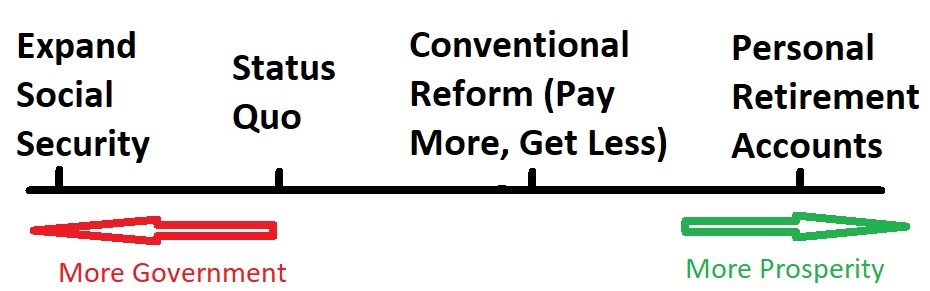
As you might expect, some nations are opting for the right approach and others are choosing the wrong approach.
Here’s a final bit of data from the OECD report. At the risk of understatement, I want nations to go with the third option (“Increasing reliance and expected returns of private pensions”).

I’ll close with a reminder that demographic change (an aging population) is generally very bad news for fiscal policy.
But it doesn’t have to be a problem if nations rely on private savings instead of tax-and-transfer entitlements.
P.S. Here’s my ranking of retirement systems in selected nations.