

In a 2015 presentation to Congressional staff, I discussed why it’s foolish to have a tax code that is biased against saving and investment.
Last month, in a briefing in Chile, I summarized the flat tax and here’s the part where I explain why that tax bias is bad news for workers.
If you’re pressed for time, just watch the last minute.
That’s the part when I complain that our leftist friends want heavy taxes on capital because rich people do a lot of saving and investing.
Yet this chart, generated by ChatGPT shows a very strong relationship over time between worker compensation and the amount of capital in the U.S. economy.

In other words, folks on the left want to heavily tax the activities – saving and investing – that lead to more compensation and higher living standards for workers.
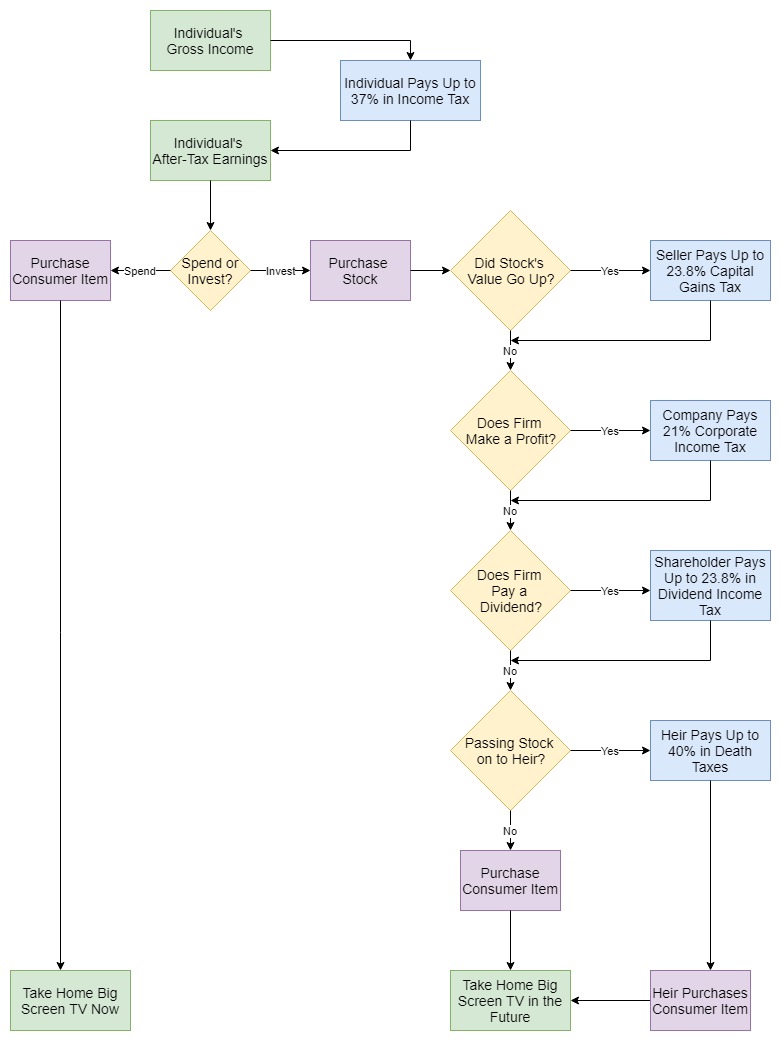
Here’s my flowchart showing the tax code’s bias (given the angle of the camera, this did not show up in the video).
As you can see, several additional layers of tax are imposed on income that is saved and invested.
Indeed, between the capital gains taxes, the corporate income tax, the double tax on dividends, and death taxes, the effective tax burden on capital (deferred consumption) is far higher than the tax burden on immediate consumption.
That’s a good approach if you hate rich people.
It’s not a good approach if you care for non-rich people.
By the way, the same relationship between capital and worker compensation exists for the entire world.
Here’s another chart from ChatGPT.
The relationship isn’t quite as strong (probably because many countries have bad policies that interfere with the efficient allocation of capital), but it is still very clear that more saving and investment is correlated with higher levels of labor compensation.

The key thing to understand is that more investment leads to more productivity and more productivity leads to more worker compensation.
To use a wonky economics term, capital and labor are complementary factors of production. As depicted by this visual.

P.S. Some people grouse that the investment-productivity-compensation relationship is not as strong as it should be. I think they’re wrong regarding the facts (see here, here, and here), but I’m even more concerned that their proposed policies – such as protectionism, union favoritism, and industrial policy – have a track record of undermining prosperity.