

What should politicians prioritize, reducing inequality or increasing prosperity?
Our friends on the left often cite Gini coefficients as part of their efforts to make inequality a central issue.
I think that’s the wrong approach and today’s column will grapple with this topic.
Let’s start with this World Bank data showing the Gini index over time for Germany, the U.S., and Sweden. Being higher on the chart means more inequality, so some people will look at this chart and think Germany and Sweden have better societies.

But Gini data doesn’t consider income levels. In order to interpret charts like the one above, you need to answer other questions.
- In countries that are more equal, are people all similarly successful or similarly impoverished?
- In nations that are more unequal, are people unequally prosperous or unequally destitute?
When you look at those numbers, you find some very interesting results, such as China becoming more unequal in recent decades, but there were big increases in average incomes and big reductions in poverty during the same period (see here and here for data).
You also find interesting results when comparing the United States and Sweden.
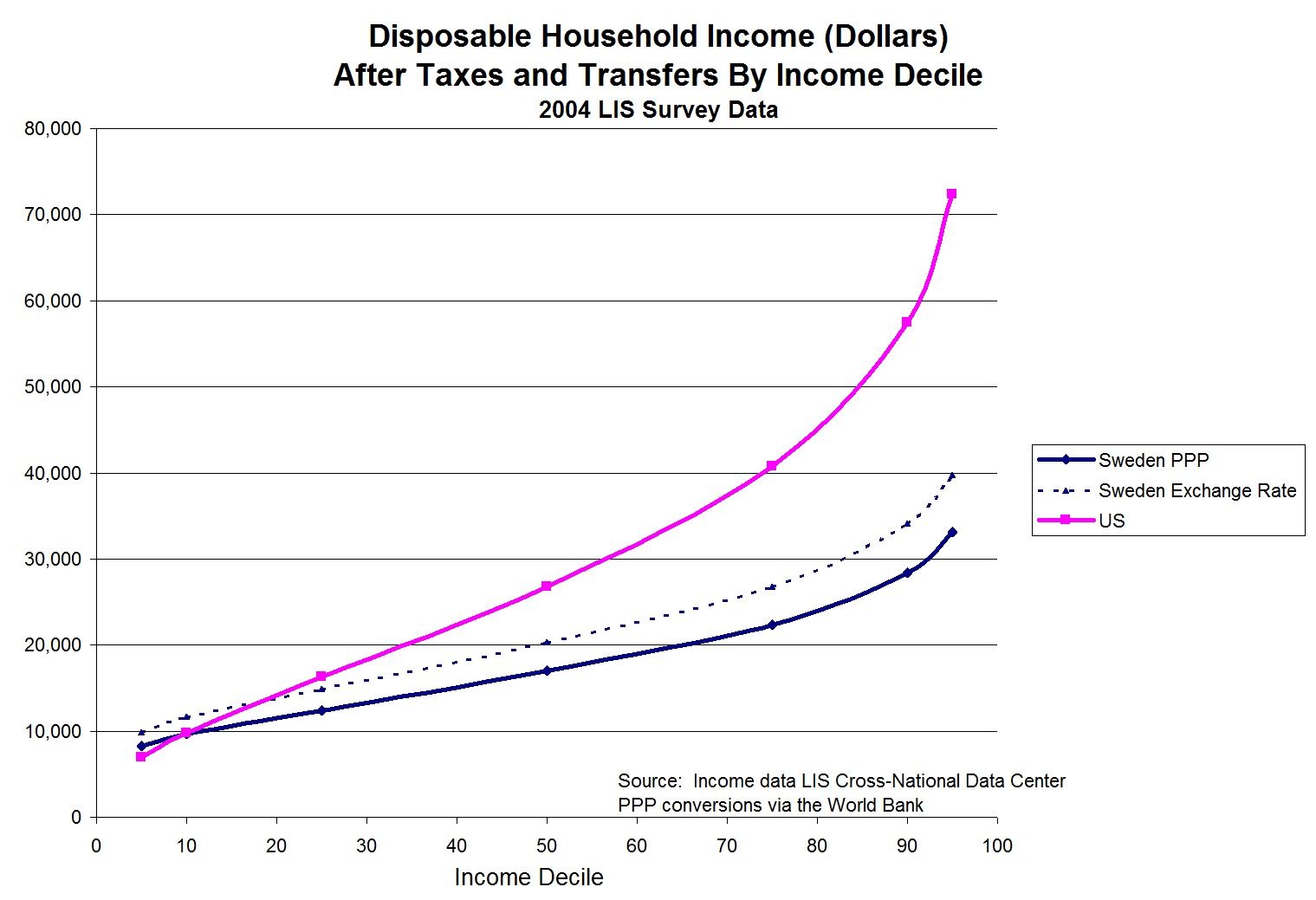
Here’s a chart I first shared in 2015 and then again in 2024 (in Part I of this series).
It shows that the United States is less equal than Sweden, not because poor people have less income, but because everyone else in America has more income.
My obvious interpretation is that it’s better to be the United States.
Now let’s look at some similar data comparing the United States and Germany.
As you can see, low-income people (the bottom deciles) in both nations have identical levels of income. For all the other income groups, however, people are more prosperous in the United States. In most cases, much more prosperous.

Just like with the U.S./Swedish data, I look at the U.S./German data and instinctively conclude the United States is generating better results.
There’s a concept in economics known as “Pareto efficiency” and one takeaway is there there’s a “Pareto improvement” any time at least one person can be made better off without anyone else being worse off.
It certainly seems like the data comparing the U.S. with Germany and Sweden are society-wide examples of this principle.
But maybe today’s charts are more examples of an economic “Rorschach test.”
Maybe folks on the left, with their mistaken view of a zero-sum society, will look at today’s charts and viscerally think Sweden and Germany are somehow getting better results (much as they look at this data from the U.S. and U.K. and jump to wrong conclusions).
In which case I’m tempted to give up trying to educate them.
P.S. This four-part series (here, here, here, and here) is also relevant to today’s discussion.