

I have a four-part series (here, here, here, and here) documenting that Americans are getting richer over time, yet many people feel pessimism and dissatisfaction.
This Kite & Key video helps to explain this seeming contradiction.
If you don’t want to watch a 10-minute video, here are two charts that summarize the message.
This first chart shows that every income group is enjoying higher income levels, adjusted for inflation.

My left-leaning friends will complain that upper-income people got richer faster than poor people got richer, but I’ve never found that a compelling response.
Surely that’s a better outcome than nobody getting richer.
Moreover, this data doesn’t account for income mobility. In the 50-plus years since 1970, many poor households become middle-class or even upper-income. And some in the middle and top dropped to lower-income.
And I can’t resist pointing out that there’s a link between economic liberty and income mobility.
But I’m digressing. Let’s get back to the message of the video, and this second chart helps to explain why many households feel economic angst.
Simply stated, some very important items have become more expensive relative to income.

But why have those items become more expensive?
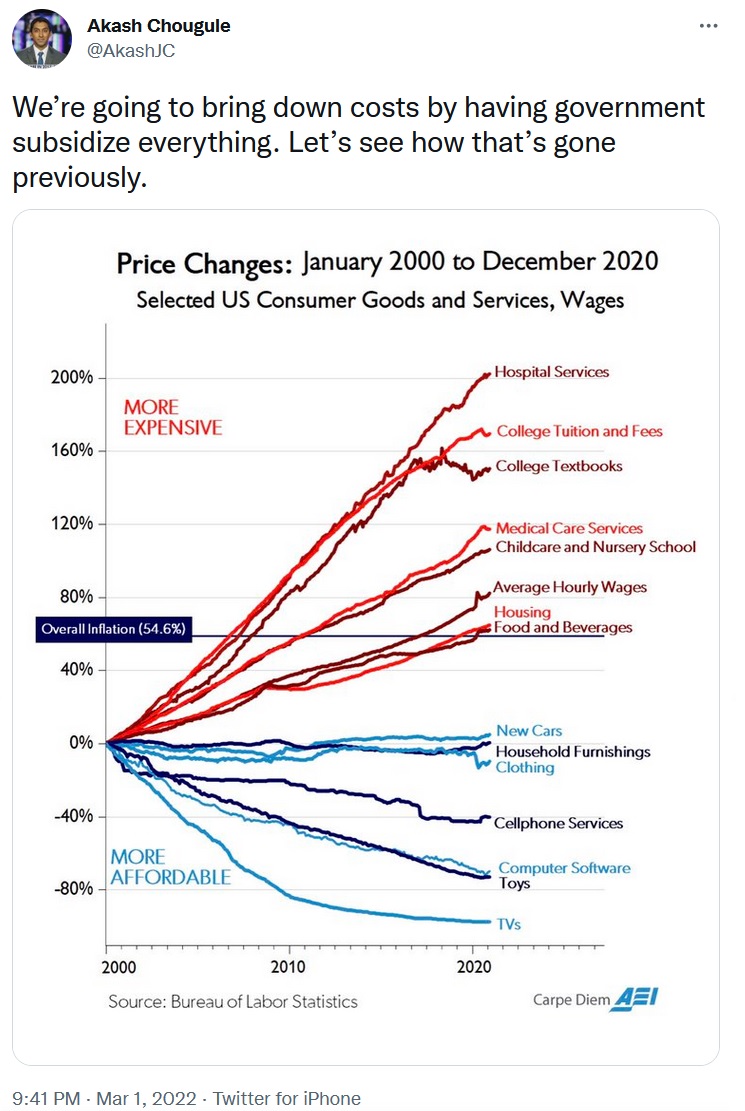
The video is worth watching because we learn that much of the problem is caused by government intervention.
Politicians have decided to subsidize child care, college tuition, and hospital care, all of which increases demand and creates a third-party payer problem.
At the same time, those politicians often impose regulations and other policies that make it very difficult to increase supply.
That combination (increased demand and restricted supply) is a sure-fire recipe for higher prices.
Which is exactly what we see in Mark Perry’s famous “chart of the century.”
In other words, the solution to economic angst is less government rather than more government. As this famous meme reminds us.
P.S. The same problem exists in other nations.