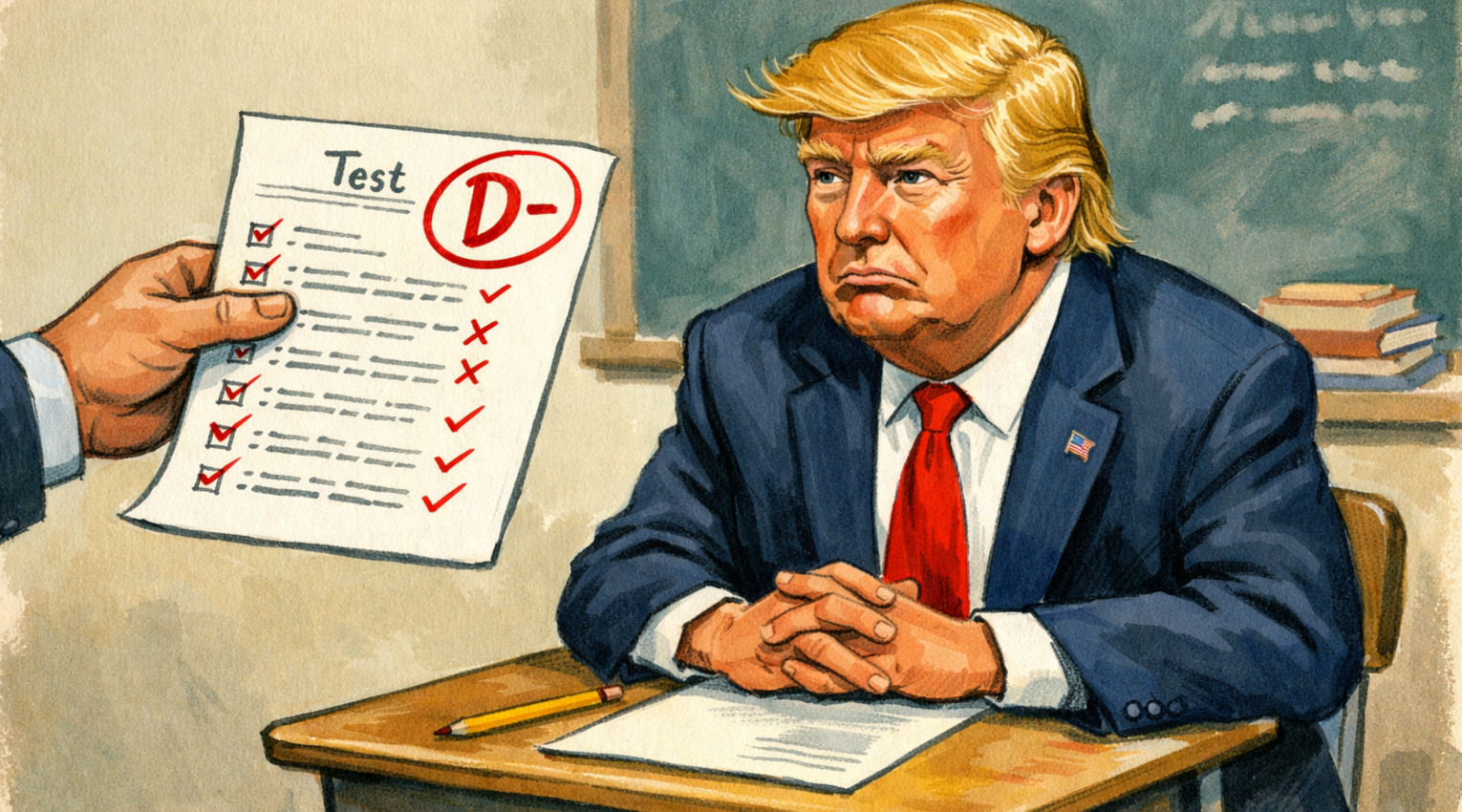
Monetary policy – Like most populists, Trump has an unfortunate knee-jerk desire for easy money. Such policies are popular in the short run (the “sugar high“) but are also a recipe for higher prices and/or financial bubbles in the medium/long run. He wants to depose the current Chairman of the Federal Reserve (who has a pro-inflation track record) because he wants someone even more willing to turn on the figurative printing press.
Regulatory policy – This is Trump’s best area. He instinctively opposes red tape and he has given a green light for his appointees to (mostly) follow a deregulatory agenda.
Rule of law – It’s hard to grade this area. On the positive side, his judicial appointments have largely issued good rulings. On the negative side, Trump governs like there are no rules and norms.
Trade policy – If it was possible to get a grade lower than zero, Trump would qualify. He has been much worse so far in his second term than in his first term.
Though I’m not sure whether to categorize his socialism as bad fiscal policy or bad regulatory policy, so one of his grades should be lower.
Now let’s augment my grades with some observations from others.
We’ll start with a column in the Washington Post by Matthew Lynn, a right-of-center pundit from the United Kingdom.
Trump I is starting to look a lot better. Compared to Trump II, the administration was pro-market and pro-enterprise, neither of which can be claimed for the president’s second term. The Trump presidency of 2017 to 2021 certainly had plenty of flaws. But it was arguably the most business friendly administration Washington D.C. had seen since President Ronald Reagan’s in the 1980s. It may have been characteristically chaotic at times, but there was a serious drive to liberalize the economy, cut regulations, control spending and encourage investment and entrepreneurship. The corporate tax rate was slashed from 35 percent to 21 percent, taking it from one of the highest in the world to one more in line with the global average. …Trump II has been very different. The signature economic policy has been the steepest tariffs imposed by an American government since the 1930s. …The president needs to recover some of the free market drive of his first term. He needs to remind himself of all the things that frustrated him when he was a business guy and start doing something about them. If he doesn’t, his second term will continue to flounder.
For what it’s worth, I think his assessment of Trump’s first term is far too favorable. He’s completely wrong, for instance, about there being “a serious drive to…control spending” in Trump’s first term.
But I agree that the second term seems to be worse.
Now let’s look at some more observations.
Here’s a horrifying – but accurate – headline from NBC.
By contrast, here’s a tweet that should warm the hearts of taxpayers.
Here’s a tweet confirming that Trump is not overseeing a reduction in the size and scope of government.
And here’s an article in Reason that is very dour.
That column included a lot of attention to areas other than economic policy, as libertarians are wont to do.
But if you are a traditional conservative, this tweet from Ryan Ellis should leave you somewhat nauseous.
I’ll close with the observation that Kamala Harris presumably would be trying for a 0.0 grade-point average (though maybe higher since hopefully she wouldn’t be so insanely wrong on trade), so some people will be comforted by Trump being in the White House.
On the other hand, if you expect that Trump’s chaotic governing style and policy mistakes will lead to Democrats having control of both Congress and the White House after the 2028 elections, than it’s quite possible that his second term will wind up leading to worse long-run policy than if Harris had prevailed (a theory I explained in 2012).