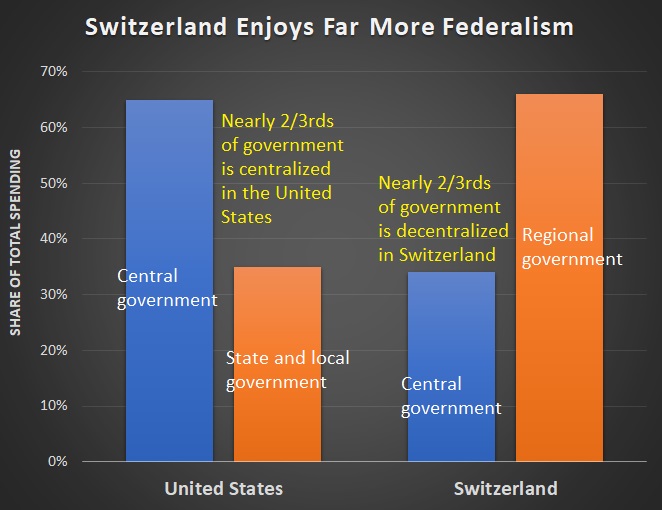
For purposes of today’s column, I don’t want to merely assert that the Swiss approach is better (though it is). I want to explain how decentralization will make the United States better.
And not simply because it’s the system America’s founders wanted.
There are two big non-ideological reasons to support federalism.
First, it will ease tensions in America. People on the left and right have big fights in Washington about one-size-fits-all policies about everything from abortion to tax policy. A decentralized system doesn’t eliminate those battles, but shifting those fights to the state level means that people in Texas can choose one approach and people in Massachusetts can go in the other direction.
Second, it will help inform policy makers of the best way of addressing different issues, even with regard to non-ideological issues such as highway construction and the size of school districts. This is because state-based lawmakers will be able to see what works best in other states – something that is not possible when major decisions are made in Washington and local officials are mere administrators.
To show federalism shouldn’t be a right-vs-left issues, let’s look at some excerpts from an article in the Intelligencer by Sasha Issenberg.
The author is envisioning two semi-autonomous blocs of states, but I think these arguments also apply to 50 states making 50 choices.
The breadth and depth of the dysfunction has even Establishmentarian figures ready to concede that our current system of governance is fatally broken. …Policy wonks across the spectrum are starting to rethink the federal compact altogether, allowing local governments to capture previously unforeseen responsibilities. …center-left urbanists Bruce Katz and Jeremy Nowak exalt such local policy innovation specifically as a counterweight to the populism that now dominates national politics across the Americas and Europe. Even if they don’t use the term, states’ rights has become a cause for those on the left hoping to do more than the federal government will. Both Jacobin and The Nation have praised what the latter calls “Progressive Federalism.” …Whether measured by county, state, or region, the partisan divide has grown… Red places have grown redder (at least in their presidential votes), blue places bluer. …If we are already living in two political geographies, why not generate a system of government to match?
To augment, Professor Ilya Somin at George Mason University’s Law School has a couple of columns in the Washington Post (here and here) citing left-leaning academics who now favor more decentralization.
I have no philosophical objections to the left-leaning federalists. If they get their way and some states use decentralization to push for bigger government, I’ll warn them they are making policy mistakes, but that’s their choice.
All that matters is that residents should have the right to move away from states imposing bad policy (which already is happening). And that’s already been a teachable moment for the left is states such as Vermont and California.
The bottom line is that leftist arguments for federalism are fine, but I obviously prefer the libertarian(ish) arguments.
We are really 50 micro-countries that have chosen to coexist as one. …we ought to examine the ways in which this vastly diverse group of people has managed to get along and prosper for almost 250 years. …From the beginning, even before we were this big and diverse, our system was designed to allow for peaceful coexistence among very different people. Each state possesses its own executive, legislative, and judicial branch, along with its own constitution. …The founders’ intention was always localized control. This structure of government is what we call federalism. The founders intended the states to operate as laboratories for new ideas and programs. If a state tried a successful approach to a problem, others would take note and replicate it. If a state did something terrible, the harm was mitigated and would impact fewer people. And the federal government was on hand to step in if a state infringed upon individual rights. …People in California shouldn’t be able to force their way of life on people in South Carolina, or vice versa.
…in America today, for every problem, real or imagined, a national “solution” is proposed, regardless of how individual, local, or varied the issues are. …Americans are overwhelmed with ever more “federal government knows best” policies and programs centralized in Washington. And what it does not mandate, the federal government manipulates… America’s Founders did not envision the federal government as being involved in virtually any decision made by anyone, much less as the domineering senior partner for almost every decision made by everyone. …The current nationalization of every decision is blatantly inconsistent with individual rights and our Founders’ federalism, designed to tightly constrain the national government to few, enumerated powers. …Federalism gives citizens an exit option that sharply limits government’s ability to mistreat them.
Good federalism is competitive federalism. It compels junior governments—states—to, well, compete for the talents, affections, and assets of mobile citizens. Consumers and producers can sort themselves into jurisdictions that provide an attractive mix of amenities and public services at an acceptable tax price. …more people get more of what they like. Successful state experiments may induce others to follow; the dispersion of state school choice policies over the past decade may be an example of such “yardstick competition.” Finally, the fear of losing productive firms and citizens may help to discipline spendthrift, overregulating state governments. …competitive federalism has numerous advantages if you put a premium on living in a reasonably free and prosperous society. …our Constitution facilitates (and, rightly understood, nearly commands) competitive federalism. …federalism’s future may hang on a bunch of lawyers and judges. Then again, America’s federalism, more than any other country’s, has always been a lawyerly province, because we live under a constitution that makes it so.
I like all of these arguments, and all three of these columns are worth reading in their entirety.
But the arguments might only be persuasive to readers who already believe in liberty.
So I’m going to close today’s column by citing some research from (the decidedly non-libertarian) International Monetary Fund.
Here are some excerpts from the study, which was authored by Julio Escolano, Luc Eyraud, Marialuz Moreno Badia, Juliane Sarnes, and Anita Tuladhar.
This paper provides new evidence on the impact of decentralization on fiscal behavior, focusing on the EU. Our paper contributes to the literature in two main respects. First, we look at different dimensions of fiscal decentralization (expenditure and revenue decentralization, as well as transfer dependency) and their interactions. Second, we take into account whether fiscal institutions geared toward maintaining budgetary discipline among subnational entities can offset the potential fiscal risks of decentralization. Our results show that fiscal decentralization may improve fiscal performance. First, we find that spending decentralization improves the fiscal position of the general government. This is consistent with the efficiency arguments in favor of spending autonomy. Nevertheless, high transfer dependency reduces the positive effect of spending decentralization.
Regarding the last sentence, true federalism is having subnational governments raise and spend money. So I’m not surprised that national-to-subnational transfers undermine the benefits of decentralization.
But let’s not digress. Here’s Figure 3 from the IMF study.
As the authors wrote:
We use fiscal data from Eurostat covering the years 1995-2008 and look at different indicators (balance and debt) to assess the performance of the general government. The main findings are…Spending decentralization is associated with better fiscal performance at the general government level (Figure 3).
These findings are very powerful precisely because they come from the IMF. Likewise with some pro-centralization research from the OECD that I wrote about in 2020.
By contrast, it’s not surprising that academic economists acknowledge the benefits of federalism.
P.S. As I recently wrote, federalism is a way of minimizing (or at least constraining) the type of fraud we see in states such as Minnesota.