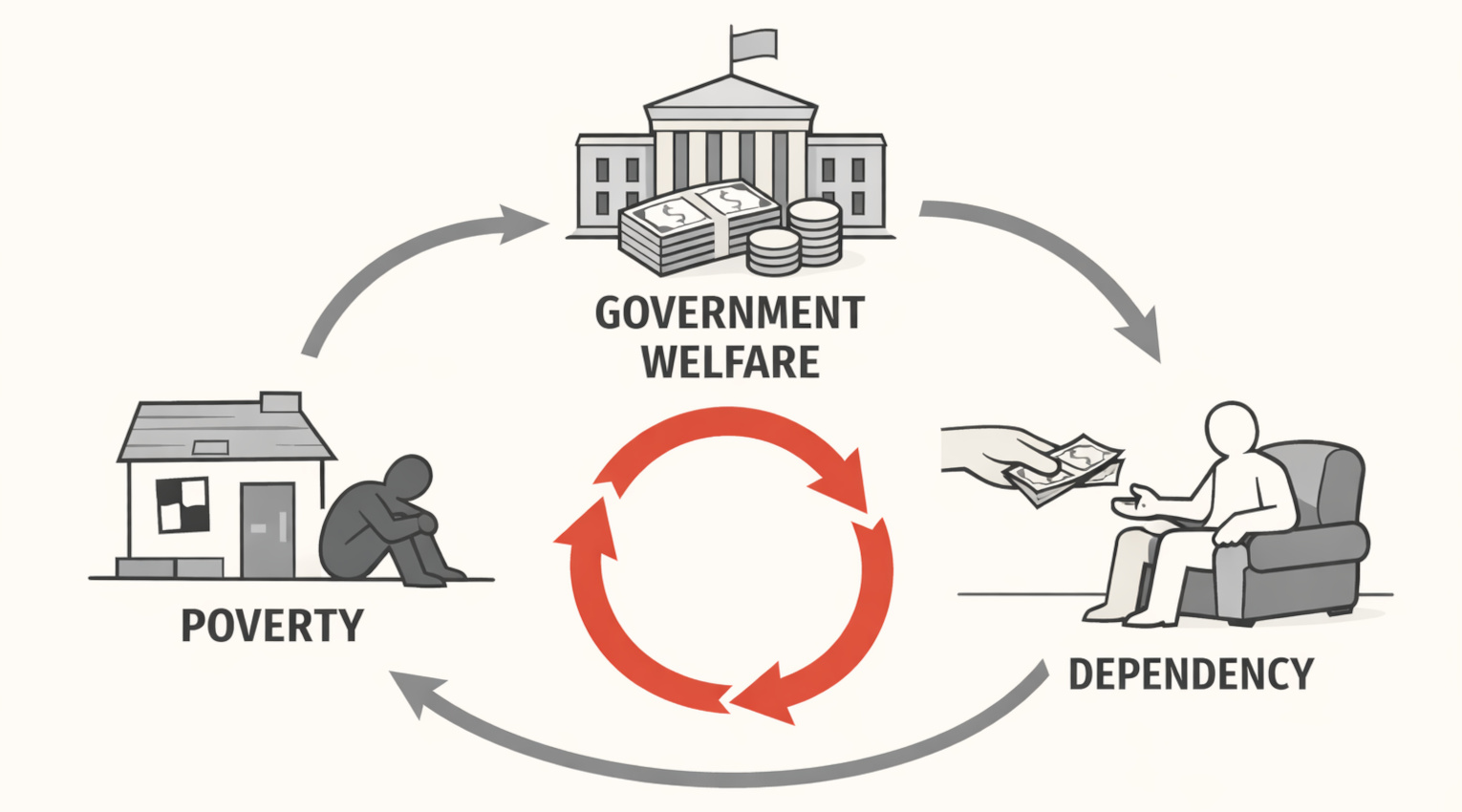
In 2024, I wrote a two-part series (here and here) asking whether the goal of government poverty policy should be dependency of self-sufficiency.
Needless to say, self-sufficiency is the obvious answer (as depicted by this cartoon).
Which is why, earlier this year, I shared some very depressing research showing that the so-called War on Poverty in large part has resulted in less earned income and more reliance on government handouts.
In today’s column, let’s expand on those depressing numbers.
We’ll start with this chart, which shows that the nation has made less progress in the fight against poverty ever since politicians expanded the welfare state.
The chart comes from an editorial in the Washington Post.
Here are some excerpts.
Richard Burkhauser of the Civitas Institute and Kevin Corinth of the American Enterprise Institute…have assembled the longest poverty data series that accounts for taxes, transfer payments and health insurance, stretching 84 years from 1939 to 2023. …Over that entire time span, no matter what baseline they chose, the absolute poverty rate fell by at least three-quarters. When including the value of health insurance, poverty fell by up to 97 percent. …The story most Americans are familiar with would credit the reduction to the modern welfare state after President Lyndon B. Johnson announced the War on Poverty in his 1964 State of the Union address. Burkhauser and Corinth’s research allows this claim to be tested. They find that poverty was already in rapid decline from 1939 to 1963, before the federal government’s war against it began. That decline was almost entirely due to rapid economic growth causing incomes to rise.
That’s the good news.
Now for some less encouraging analysis.
The poverty rate fell before the War on Poverty without significantly increasing working-aged people’s dependence on government. …The dependency rate was very low during the rise in living standards that predated LBJ’s Great Society programs, but it tripled by the mid-1990s. …Sadly, dependency on government…remains much higher today than when Johnson embarked on his Great Society initiatives.
Here’s a chart showing this grim development.
By the way, the Congressional Budget Office has numbers that echo the Burkhauser/Corinth analysis.
So there’s no debate about the accuracy of the data.