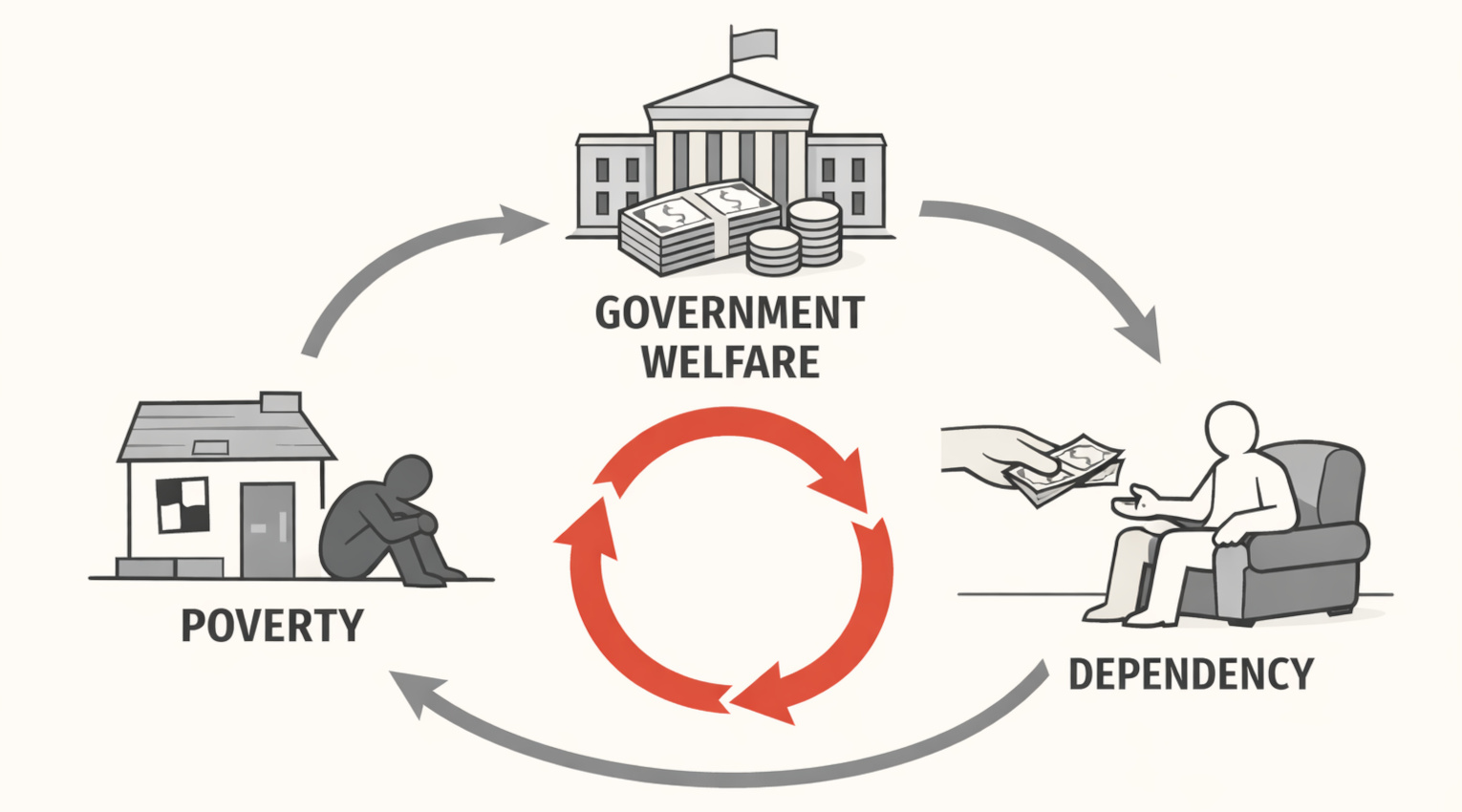
I wrote recently about how government handouts are creating dependency (perhaps deliberately) for low-income Americans, and I elaborated on this topic for Austin Peterson’s show.
The real issue in this debate, as discussed in my two-part series (here and here), is whether the goal of government policy should be dependency of self-sufficiency.
Let’s now look at some new evidence, courtesy of research by Richard Burkhauser and Kevin Corinth of the American Enterprise Institute. Here are some of the key findings from their abstract:
From 1939–1963, poverty fell by 29 percentage points, with even larger declines for Black people and all children. While absolute poverty continued to fall following the War on Poverty’s declaration, the pace was no faster, even when evaluating the trends relative to a consistent initial poverty rate. Furthermore, the pre-1964 decline in poverty among working age adults and children was achieved almost completely through increases in market income, during which time only 2–3 percent of working age adults were dependent on the government for at least half of their income, compared to dependency rates of 7–15 percent from 1972–2023.
The big takeaway is that something very good was happening before the 1960s. Poverty was declining because poor people were earning more income. Unfortunately, that positive trend ground to a halt after politicians declared a so-called War on Poverty.
There’s far more detail, so I encourage readers to peruse the entire study.
But for those with limited time, here are two charts that are worth sharing.
First, Figure 1 shows that poverty was falling before the aforementioned War on Poverty. But ever since, there’s been little progress.
Next, we have Figure 8 from the study, which is even more depressing.
It shows that dependency rates have increased since the War on Poverty began.
The bottom line is that we all want poor people to have better lives. But trapping people in government dependency is not right way to achieve that goal.