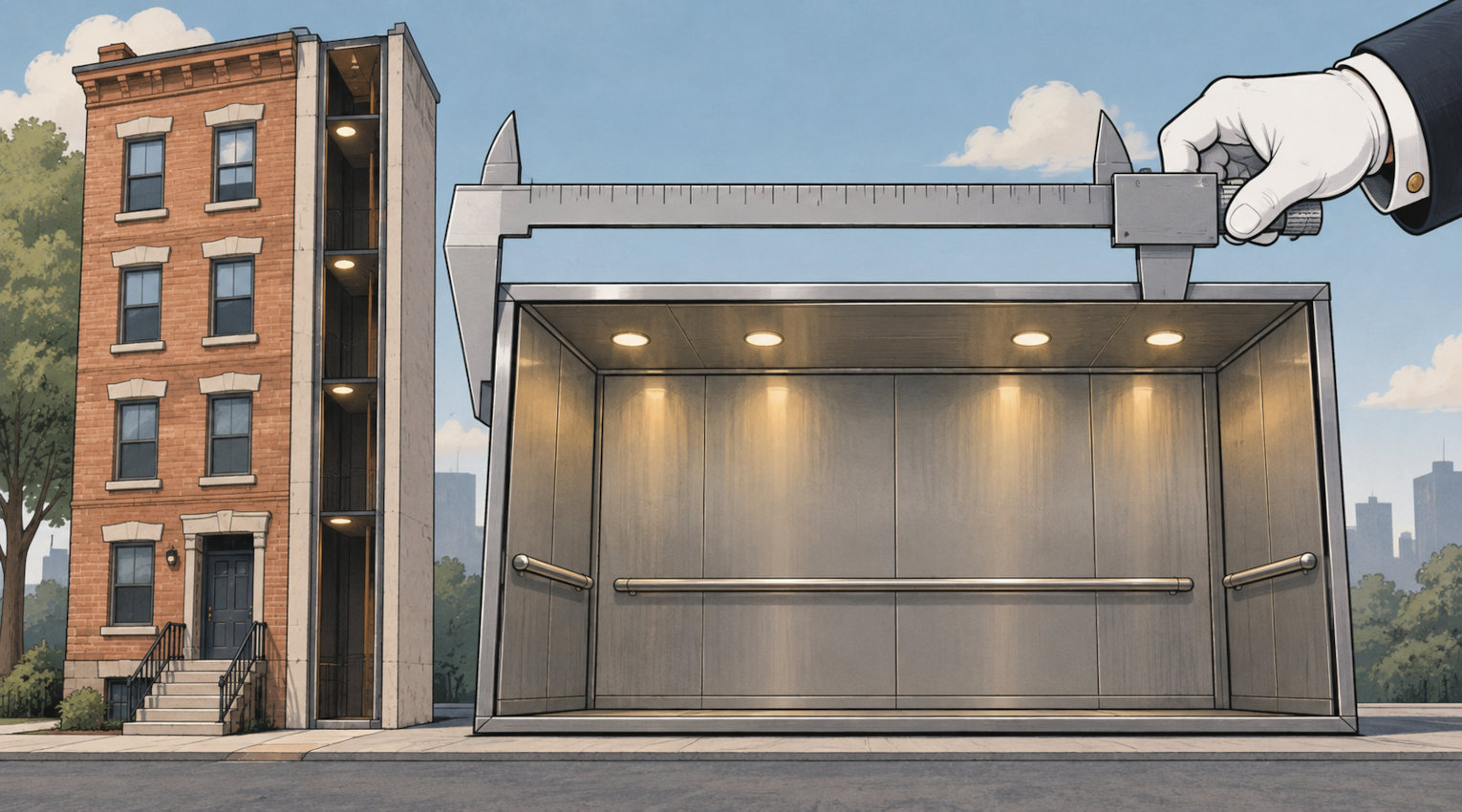
Instead of tackling a big topic, such as tax policy or trade policy, let’s look today at the niche issue of elevator policy.
Like me, you probably didn’t even realize this was an issue. This Reason video is a great introduction, including some fascinating history of the elevator industry (if you have limited time and just want to learn about the pernicious role of government, skip the first half and start watching at 8:44).
But if you don’t want to watch even half of a video, just look at this chart, which appears at 9:25.
It shows that the United States has far fewer elevators, per capita, than various European nations (most of which are not nearly as rich as the U.S.).
When I look at a chart like that, my immediate instinct is that government is somehow responsible.
And my instinct in this case would be correct, as you can see from these passages from a Washington Postcolumn earlier this year by Stephen Jacob Smith and Allie Cannington
The United States, according to our research at the Center for Building in North America, has become one of the last high-income countries to still build walk-up apartment buildings. Elevators in the U.S. and Canada are the most expensive in the world, and the U.S. has fewer of them per capita than any high-income country… In Europe and other high-income countries, small, new three- or four-story apartment buildings with a handful of units typically come with a simple elevator — even when not required. In the U.S., developers avoid installing elevators for small buildings since the high cost can wreck a project’s economics. …There’s plenty of blame to go around for the high costs and low availability of American elevators, but one direct lever the federal government has is the 1988 Fair Housing Amendments Act. The law was intended to promote accessibility in housing but, in a twist of fate, it contributes to making the installation of an elevator in a small apartment building almost impossible. …The minimum dimension standards for an elevator for a small apartment building are much larger than actually needed for accessibility. …European elevators are relatively inexpensive and easy to add. Elevators for a small building in high-income countries like France or Germany cost around $50,000 after adjusting for cost-of-living differences and typically take up a bit more than 30 square feet on each floor. In the U.S., they can push $200,000 and consume more than twice the amount of floor space. …Clarification from the federal government on elevator sizes is not going to fix the nation’s elevator market overnight. Cities and states would still need to change their own rules. And elevator accessibility standards are far from the only thing driving up costs in ways not found abroad — there are also American building codes’ stretcher requirements, a raft of more technical fire-safety rules, a general regulatory disconnect from the global parts market and labor agreements that make installing, maintaining, servicing and modernizing elevators more labor-intensive than elsewhere.
Let’s also look at a column in the Post from earlier this month by Jule Weil.
Here are some excerpts.
…a nonprofit, the Kelsey, …is part of a national movement to bring elevators to more residential buildings. One way to do it, the organization’s leaders say, is to promote elevators that are smaller and cheaper. It’s an idea that’s catching on in a few states, but opposed by the U.S. elevator industry… U.S. elevators are so expensive that small apartment buildings rarely have them. That’s partly because the standard U.S. elevator is designed to be large enough to fit a stretcher in case of emergency and to allow a wheelchair to turn around. Many cheaper European and Asian elevators aren’t. …In an exhaustive report two years ago, Smith documented that American elevators cost at least three times more than residential elevators in Western Europe and East Asia, in large part because American elevators are about twice as large. As a result of their high cost, they don’t get built as often. …Sparked by Smith’s work, Maine removed some elevator safety requirements this year, and New York City is testing allowing existing walk-up buildings to install elevators that don’t meet the standard size requirements. Washington state passed a law this year allowing buildings of up to six stories and 24 units to use smaller elevators. …elevator companies have opposed many of the proposed changes — which could allow European and Asian companies to sell their products in the U.S. market. …the goal of the elevator reform advocates is…to create more elevators where there would otherwise be none at all.
If you really want to get in the weeds, you can even read the 122-page report mentioned in the above video (and written by Stephen Smith, who co-authored one of the columns cited above).
I’ll close by adding my two cents.
The best elevator policy (whether looking at the national government or state and local governments) is no elevator policy.
Developers of either residential or commercial properties should install – or not install – the elevators they think will be most appealing to customers.
At this point, some of my left-leaning readers doubtlessly will conjure up visions of a reckless, wild-west Dystopia (the elevator version of the satirical “Libertarios” cereal).
In reality, I’m envisioning a world of mutually reinforcing private rules, as I described in a 2012 column. Lenders won’t lend to developers without some sort of private certification of safety and soundness. Similarly, insurance companies won’t sell policies to homeowners or building owners without that type of certification.
And lest anyone think I’m envisioning a fantasy world, that’s the business model of Underwriters Laboratories, a private-sector safety organization that’s been around since the 1800s.
P.S. Since I’ve shared my strange experiences with foreign bathrooms (see here, here, and the postscript of here), this is an opportunity to share my one strange experience with foreign elevators. More than 20 years ago, when I first started giving speeches overseas, I checked into a hotel in Europe and then walked to the elevator and pressed the up button. The elevator then descended to the ground floor and the bell dinged. But the elevator door didn’t open. After a minute or two, the elevator then rose. So I hit the up button again, wondering what had gone wrong. The elevator soon descended again and the bell dinged again, but once again the door did not slide open. By this time, another person was also waiting. And when I stood there, unsure what to do, he stepped in front of me and opened the door (probably wondering whether I was a blithering idiot). I followed him on to the elevator and sheepishly explained that I had no idea that there were elevator doors that had to be manually opened (at which point he probably figured I was a provincial American rather than a blithering idiot, which I reckon was a step in the right direction).
P.P.S. If you want another example, other than Underwriters Laboratories, of how the private sector can handle tasks that most people would assume can only be done by government, look at bail bondsmen.