Since I’m currently in Europe as part of the Free Market Road Show, I’m going to share some more data (for other examples, see here, here, here, and here) on why the United States should not become more like Europe.
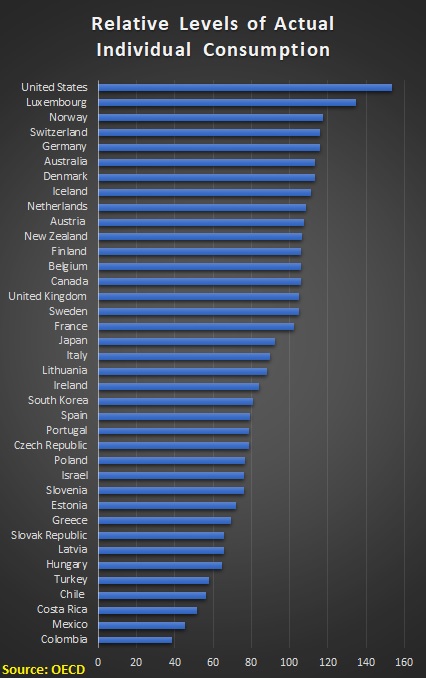
As I noted a few years ago, people in the United States enjoy much higher levels of “actual individual consumption” than Europeans.
Indeed, using those AIC numbers, Americans have about 50 percent higher living standards than major European countries such as France and Italy.
Why look at AIC data?
There are pluses and minuses of any measures.
I normally like per-capita GDP numbers, especially for comparisons over time. Though in some cases it is not the ideal measure.
In the short run, changes in inflation-adjusted GDP are instructive.
But AIC also has advantages.
In an article last year for the OECD, Sergio Montoya and Jarmila Botev explain one big advantage.
To compare macroeconomic indicators across countries, we must adjust for differences in currencies and price levels to ensure we are comparing apples with apples… Purchasing Power Parities (PPPs) are the right tool for this because they are constructed based on prices of a common and comprehensive basket of goods and services… However, GDP per capita is not the best indicator to compare material well-being across countries. For instance, it is affected by a large share of foreign residents in Luxembourg, the presence of multinationals in Ireland, and the large oil and gas industry in Norway… By contrast, Actual Individual Consumption (AIC) covers the goods and services purchased by households, as well as those provided by the government and non-profit institutions (such as health services or education), making it a better indicator to compare material well-being across countries.
That article included this chart. The darker dots are AIC and the lighter dots are GDP.
I added a red vertical line to indicate America’s AIC, which is greater than the AIC for any other nation.
So what’s the lesson to learn?
Diyar Kassymov doesn’t focus on AIC data, but he explains in a column for the Foundation for Economic Education that the “European Model” should not be emulated.
Here are some excerpts.
For many Americans, it seems like Europe is the paradise continent with high salaries, good education, and free healthcare. So they advocate for the US to adopt a “European Model”—tax and tax, spend and spend, regulate and regulate. …But does the European model really work? …countries with massive welfare states like Sweden, France, and Belgium have high unemployment—approximately 9%, 8%, and 6%, respectively. …Taxation cuts profit margins, undermining the attractiveness of European countries for entrepreneurs and making it harder for small businesses to secure investment. High tax rates therefore make the EU venture capital market far smaller than its US counterpart. Total VC investment in the US in 2024 reached $215 billion; meanwhile, in the EU, it only reached $51 billion. …The lack of employment opportunities leads to brain drain. Europeans account for 30–60% of elite professional visas to the US. In total, since the year 2000, around 60,000 brains a year have moved from Europe to the US on elite professional visas. …Some American politicians and economists only see the beautiful facade of Europe. But if you look deeper, you discover that the foundation of European prosperity was built long ago, by brave entrepreneurs… Europe, with high taxes and stifling regulation, …faces an existential choice: reform, allow freedom, and encourage entrepreneurship, or see the sun set on its once mighty economies.
I’ll close with a few thoughts.
Most important, we should understand that Europe is not a monolithic blob of statism.
The bottom line is that there are some things I want the U.S. to copy from Europe. But Mr. Kassymov is correct that European fiscal systems feature excessive taxation to fund excessive spending.