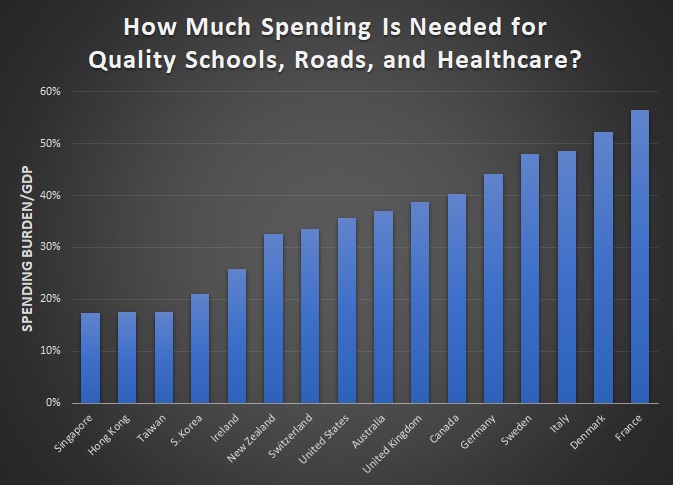
My goal was to show that you don’t need a bloated public sector to have a successful nation with good-quality schools, roads, and healthcare.
Indeed, small-state jurisdictions such as Singapore and Switzerland probably do a better job providing those services than nations such as Italy and France.
I’m revisiting this topic today because Natasha Sarin of Yale Law School has a column in the New York Times that contains a major error.
Here are some excerpts.
Tax cuts offer a salve…but…worsening our fiscal situation without fixing any of the problems that make America feel unaffordable today. Tax cuts are a Band-Aid, not a solution. The thing is, America is already a low-tax country — far lower, as a share of gross domestic product, than almost all other highly developed economies. …you can’t significantly decrease the government’s expenses, because most of them are baked in. …if the tax rate goes much lower, it will cease to be possible to run this large and complex country. …For those who prefer not to live in a failed state, the other option is to keep taxes steady, or even raise them…and in exchange give Americans a government that works. …That takes more revenue, not less. …A century ago, the Supreme Court justice Oliver Wendell Holmes Jr. said that “taxes are what we pay for civilized society.” The reverse is true, too. Without taxes, society falls apart.
Is she right? Do we need higher taxes to run the country, to protect against being a “failed state,” and to have a government that works?
To answer these questions, I went to the IMF’s database to find various jurisdictions that have smaller burdens of government than the United States.
Here’s a partial list. Do any of these jurisdictions qualify as “failed states”?
Not all these nations are rich, but they are all functional and successful societies. And they somehow mange to be that way even though (or perhaps because) they have small governments.
Though I should emphasize that they only have small governments by modern-day standards.
Let’s go back more than 100 years to assess the size of government in some of the world’s richest and most successful nations.
My eyesight probably isn’t as good as it used to be, but I don’t see any “failed states” in this chart. And this was at a time when the burden of government spending, on average, consumed only about 12 percent of GDP.
Moreover, there was no welfare state in any of these countries in 1913.
Yet they somehow managed to enjoy very rapid growth and to go from agricultural poverty to industrial prosperity during the small-state era.
P.S. There are examples of genuine failed states that have small governments (Haiti, Sudan, etc), but no rational person thinks those nations are a mess because of fiscal policy.
P.P.S. Ms. Sarin makes another remarkable error in her column
…we’re not like any nation where those at the top pay their fair share. …billionaires and centimillionaires live largely on investment income that taxes barely touch.
Actually, there are two errors in the above passages.