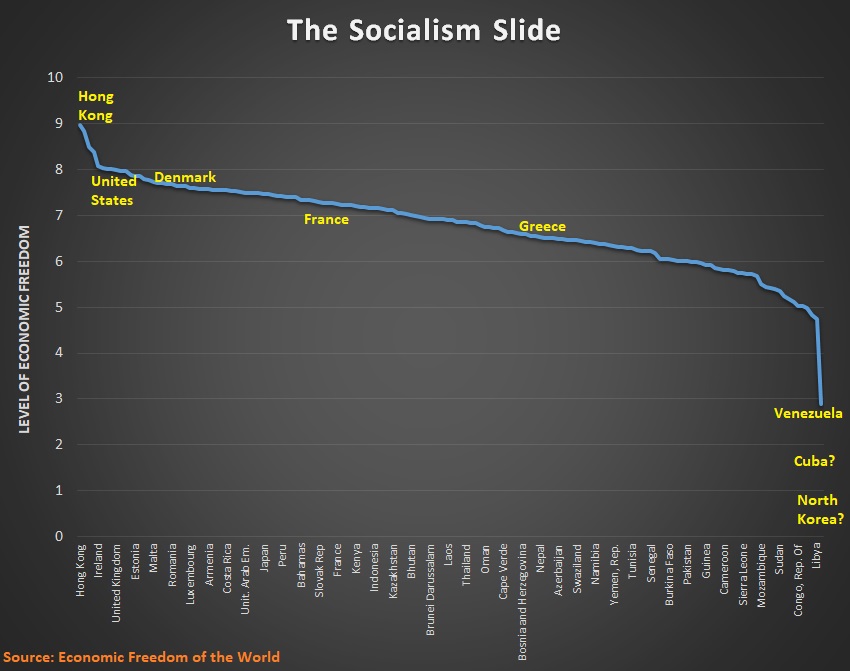
So let’s have a follow-up discussion, starting with an admission of guilt. I wrote a column in 2019 talking about the “socialism slide.”
Technically, however, it should have been called the “statism slide.” At least if you accept the classic definition that socialism is based on government ownership, central planning, and price controls.
After all, some of the poorly ranked nations back then, such as pre-Milei Argentina, had some policies that could be called socialist, but there were also lots of other bad policies (inflation, protectionism, etc).
So what’s a socialist country and what isn’t?
In an article for the Independent Institute, Scott Beyer supports the traditional definition.
Under capitalism, productive assets—businesses, factories, capital—are largely private-owned and directed through markets. Socialism seeks to replace private control of this “means of production” with social ownership, be it direct government ownership, worker-owned enterprises or other collectives. A government that owns major industries and directs production is practicing socialism… That brings us to a test: which countries actually embody socialism? …Scholars characterize the Scandinavian system as welfare capitalism, combining markets with extensive redistribution. …they themselves disavow the socialism label; former Danish Prime Minister Lars Løkke Rasmussen, responding to American leftists, said that his country was “far from a socialist planned economy. Denmark is a market economy.” …The countries that are usually cited by socialism’s critics fit the label much better. Cuba’s constitution explicitly describes its economy as socialist, establishes government ownership of property, and makes government planning and pricing central to economic management. …North Korea’s constitution, presented in 1972, is even less ambiguous. Titled the Socialist Constitution of the Democratic People’s Republic of Korea, it enforces similar top-down protocols. …The larger lesson here is that almost no modern country is completely socialist—even ones that set out to be… Nor do market-based countries become completely free of socialism. The U.S. itself contains large sectors defined by government control.
My friend Sven Larson, originally from Scandinavia, has a different perspective.
He argues that big welfare states are socialist. Here are some excerpts from one of his articles for the European Conservative.
…the socialists placed their spotlight on the economic role of the state. Specifically, they were concerned about the state’s ability to reduce the economic differences between individual citizens, and citizens clumped together in ‘classes’ or other social categories. …but it was not until Karl Marx formalized a theory for what is now best known as ‘economic inequality,’ that the socialist movement gained the systemic intellectual prowess to propel its ideology into the making of policy. …The socialist ideology has been practiced in various forms, most notoriously under the Soviet empire, which stretched its tentacles from Saxony to Sakhalin. However, this was but one form of socialism—a special case… Another definition, centered around economic redistribution, is…the foundation of what is by far the most successful practice of the socialist ideology. It has been put into policy practice and has been allowed to define the purpose of government in almost every European country, in Canada, and in the United States. …Wherever economic redistribution is the main function of government, socialism will gradually expand this practice, until there are no longer any meaningful economic differences between individual citizens. …Democratic socialism has been successful in both Europe and America. By creating large, redistributive welfare states, socialist practitioners have achieved a large part of their goals without having to be associated with the extremes of their ideology in countries like the Soviet Union, China, Cuba, or North Korea.
So who’s right, Beyer or Larson?
I’m tempted to sound like a two-faced politician and say both of them.
But maybe that’s actually the right answer. The difference is that Beyer is writing about Marxist socialism and Larson is writing about democratic socialism.
Ultimately, though, what I really care about is economic liberty and human prosperity. So I oppose statist policies, regardless of how they are labelled.