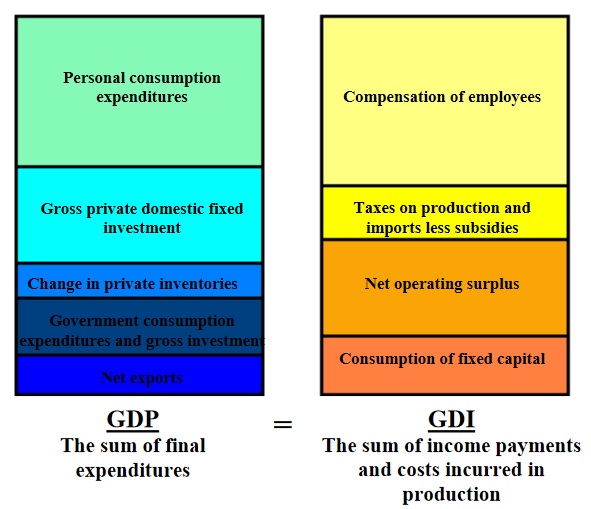
My big complaint* is that some people, especially financial journalists, don’t understand that GDP is a measure of how national income is allocated (with the big categories being consumption, investment, and government).
This leads them to falsely think more government spending means more GDP, when it merely means additional national income is diverted away from consumption or investment.
It also leads them to incorrectly assume that consumer spending drives the economy, when the causality runs in the other direction.
These reasons are why I prefer “gross domestic income,” or GDI, which is a measure of how national income is generated (with main categories such as wages and business profits).
The two numbers – GDP and GDI – are basically different sides of the same coin, but I find that people think more rationally when looking at GDI.
Having just groused about GDP being an inferior measure of prosperity, I’m now going to defend it. Why? Because some ways of measuring the economy are much worse.
Look at these excerpts from a report earlier this year in the New York Times by Lydia DePillis.
…gross domestic product, the number that serves as a measure for economic progress around the world, is hardly a barometer of human flourishing. …For decades, economists have tried to devise an alternative metric to capture a broader picture of prosperity, which would change the goals that nations try to achieve. …So last year, the United Nations set up a commission to design a more focused set of indicators… The result, released this month, is a dashboard of 31 metrics grouped in four buckets representing peace and human rights, sustainability, quality of life, and inequality. …One commission member and early proponent of a G.D.P. alternative is Joseph Stiglitz, the Nobel Prize-winning former chief economist of the World Bank.
Hopefully, the skepticism is because the campaign to replace GDP is mostly an ideological project. For instance, one of the “four buckets” is “equity and inclusion” and would give nations a lower score for inequality.
But what if all income classes in an unequal country are richer than the income classes in a nation that gets a “better” score for inequality?
But you don’t have to believe me. The proponents of the alternative measure – such as Joseph Stiglitz, Heather Boushey, and David Leonhardt – are very open about wanting a new methodology because it will help advance their ideological goals.
*My small complaint is that GDP data will sometimes lead to inaccurate assessments. For instance, Ireland is a successful nation, but it’s not nearly as rich as GDP data imply. Likewise, Washington, DC, appears rich because a disproportionate share of the money diverted from the economy’s productive sector winds up being spent there. In reality, of course, very little productive economic activity takes place in America’s capital city.