People sometimes will get excited about big-picture tax fights – whether politicians should raise taxes, whether they should add a VAT, or whether they should scrap the IRS for a flat tax.
On the other had, there are a handful of tax issues that induce drowsiness but are nonetheless very important for purposes of tax policy. Here are five of them.
Lucky readers today will get a column that involves #1 and #4 on this list.
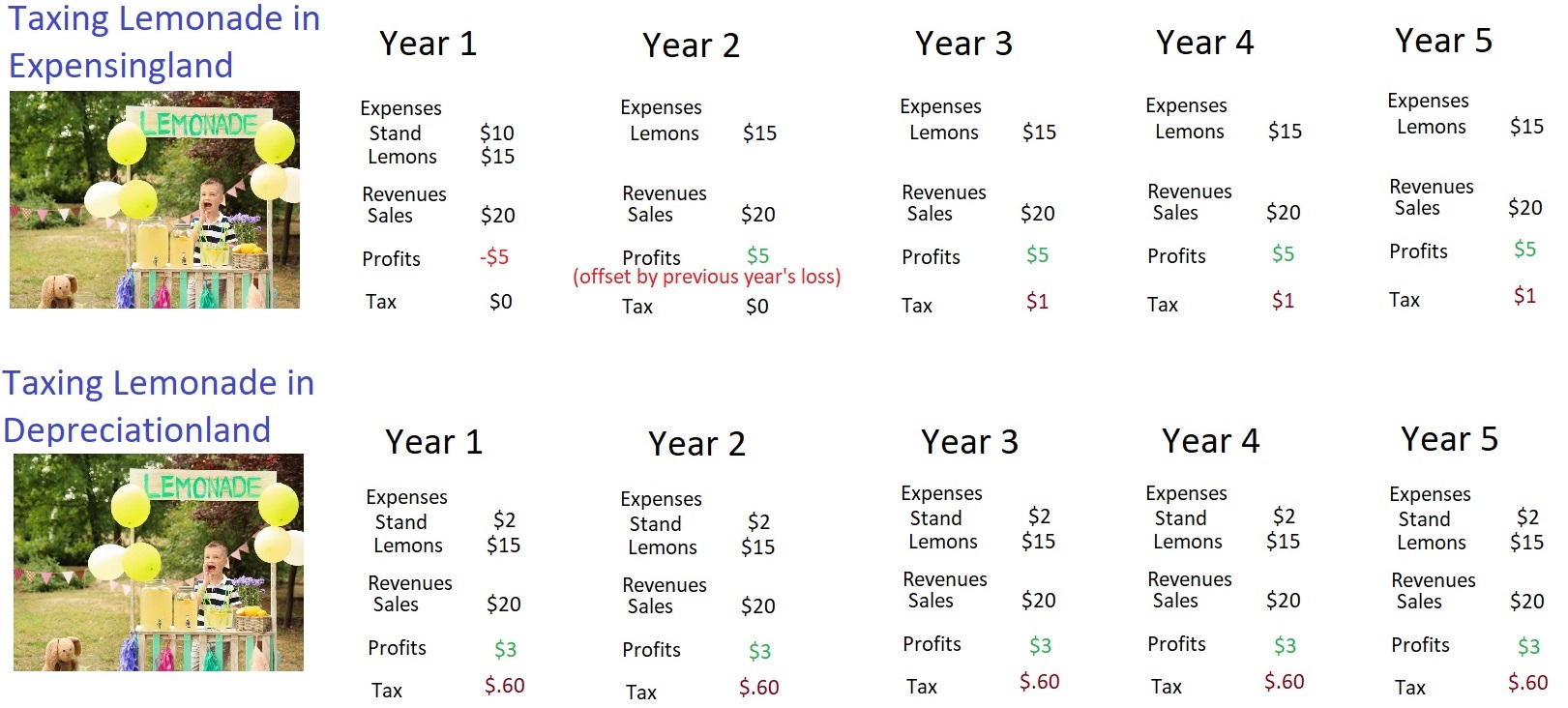
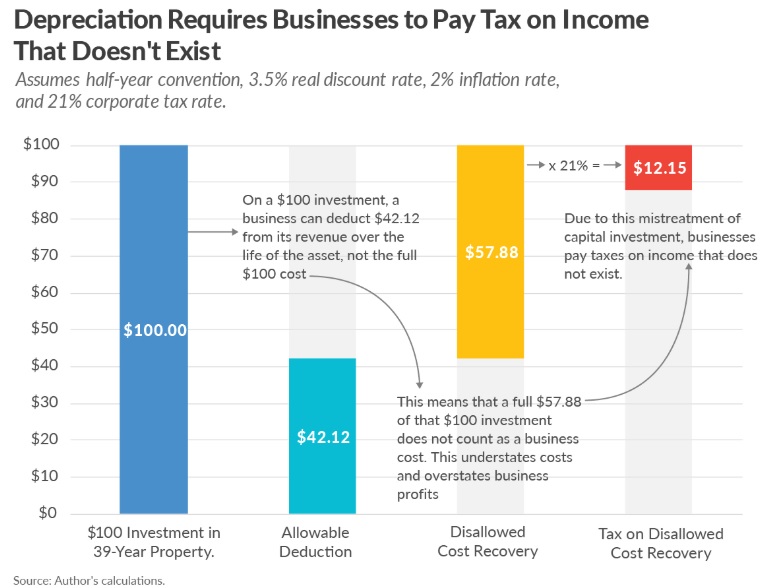
Regarding #1, the issue revolves around whether companies are allowed to recognize costs when they occur, known as expensing.
Here’s my amateur visual to explain the process.
And here the Tax Foundation’s professional visual.
Though both visuals make the same point. At best, depreciation results in a tax before actual cash income is generated. And when you factor in the time value of money, this means a tax bias against companies that invest.
Regarding #4, the debate is whether companies should be allowed to offset profits in some years with losses in other years.
I don’t have an amateur visual for this issue, but here are twotables from the Tax Foundation to show how it works.
Now that I’ve shared all the boring material, now let’s look at a recent tweet by Elizabeth Warren.
Since Sen. Warren is an infamous demagogue, you won’t be surprised to learn she is seeking to inflame rather than inform.
Fortunately, I don’t have to spend time debunking her (like I did in 2021), because someone has already has.
Here are some passages from the Washington Post‘s editorial on the topic.
The companies that Warren lists, which include airlines, entertainment companies and health care companies, did make a profit last year. But they still paid no income tax because Congress, correctly, gives them the ability to deduct expenses that further economic growth. First, they can deduct past losses against present profits. This standard practice, known as “loss carryforward,” is completely normal across the developed world. It protects businesses in more volatile industries from being taxed more harshly than those in steadier industries. Second, when corporations reinvest their profits in building new facilities, buying new equipment or developing new technologies, the corporate tax lets them deduct that investment. The owners of the corporation never actually received that money. The corporation sent it back out the door as soon as it came in, so taxing it as income would be wrong.
Though the editorial observes that there are some unjustifiable loopholes for companies.
Several of the big companies that didn’t have a corporate tax liability last year are electric utilities. They benefit from numerous green energy tax credits that Democrats enthusiastically supported. Democrats supported them precisely because they would encourage the kind of green investments that utilities are making, and utilities are making them because they’ll reduce their tax liability. This is evidence that their policy is doing what they wanted it to, not evidence of a scheme.
…businesses are going to do everything they can to minimize their tax liability with the tools that Congress has given them. They would be neglecting their employees, customers and shareholders if they didn’t.
Amen.
I’d much rather have money remain in the productive sector of the economy rather than letting it be seized by the most short-sighted, corrupt, venal, and irresponsible people in the country.