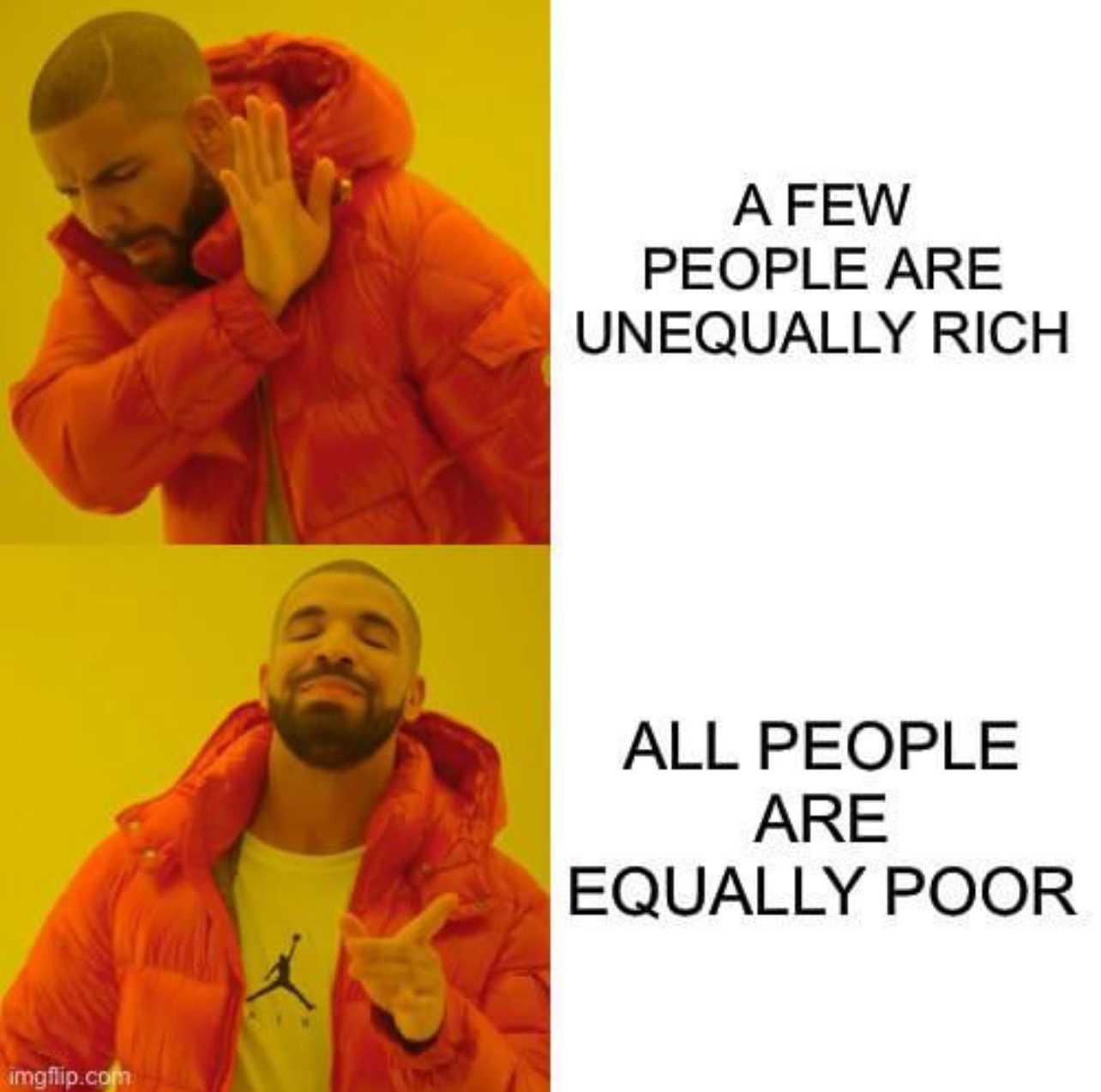
But I also think it is socially divisive. I don’t like when a small group is undeservedly demonized by demagogues.
And what really frustrates me is that advocates all seem to suffer from the zero-sum fallacy. They actually think if Person A is rich, then Person B has to be poor.
Last but not least, there’s the perverse envy factor. As Margaret Thatcher noted, some folks on the left are willing to hurt poor people so long as rich people are hurt even more.
I’m contemplating all these factors as I remember the column I wrote in 2023 about a so-called mansion tax in Los Angeles.
Let’s look at some updated data about that class-warfare initiative, courtesy of a column by Professor Michael Manville in the Washington Post. Here are some excerpts.
In 2022, Los Angeles voters approved an ambitious attempt to redistribute real estate wealth to fund affordable housing. Measure ULA, nicknamed the “mansion tax,” placed a 4 percent tax on property sales over $5 million and a 5.5 percent tax on sales over $10 million. …It was, its proponents said, “a tiny tax on mega mansions” aimed only at “millionaires and billionaires.” …But the devil is in the details. Any tax will create some combination of two outcomes: new revenue and changed behavior. …Measure ULA’s goal was to raise revenue, but it was written like a tax to change behavior. Revenue-maximizing taxes tend to have low rates and broad bases. ULA had the opposite. It applied a high rate (transfer taxes rarely exceed 2 percent) to a very narrow base (just 4 percent of the city’s sales are over $5 million). …It made ULA’s revenue reliant on a small group of people who, precisely because they weren’t everyday owner-occupants, could avoid the tax by choosing not to sell.
And that’s exactly what happened.
When the tax took effect, higher-end sales plunged, and stayed down. Measure ULA, which was projected to raise up to $1.1 billion annually, has averaged just one-third of that. It has also diminished other local revenue. In California, property can’t be reassessed unless it changes hands, so ULA, by reducing transactions, is depressing…local property tax revenue.
But revenue shortfalls are not the only negative consequence.
Worst of all, the tax seems to be discouraging new housing. Measure ULA…isn’t just a tax on mansions. It falls on any transaction over $5 million, including sales of commercial, industrial and multifamily parcels. These parcels are crucial inputs to new development; constructing an apartment building often means buying a parcel to build on and selling it once complete. ULA takes a bite out of both. A Rand study published in May estimates that the ballot measure has reduced construction of large apartment buildings by 30 percent. If that’s right, the tax is aggravating the crisis it was written to remedy.
And guess what happens when politicians pursue policies that restrict the supply of housing?
Prices go up, by a lot in the case of Los Angeles, as you can see from this chart that was included with the column.
So Los Angeles wanted to tax the rich. What happened was revenue shortfalls and less new housing.