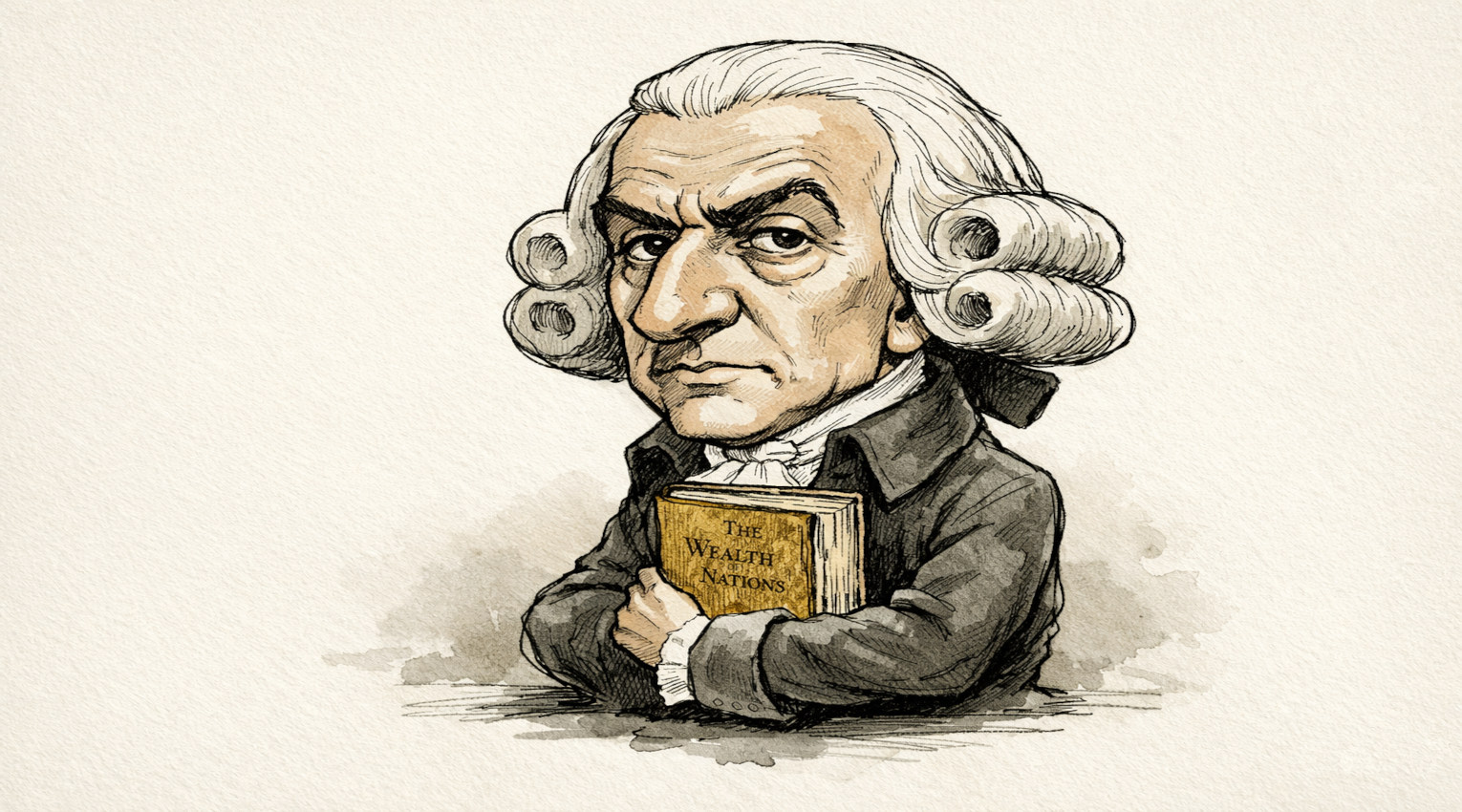
March 9 was the 250th anniversary of the publication of Adam Smith’s Wealth of Nations.
I wanted to celebrate that occasion yesterday, but decided acknowledging Argentina’s rapid improvement in the Index of Economic Freedom was more timely.
So let’s pay tribute today to Smith, starting with this video from the Fraser Institute (part of a great six-part series).
This is Adam Smith’s “invisible hand” and it explains how society becomes more prosperous with a system based on voluntary exchange and self interest.
But the Wealth of Nations is much more. It’s about the division of labor. It’s about trade. And it’s about the classical liberal version of a free society.
Let’s now look a some excerpts from a March 6 Washington Postcolumn by Jesse Norman.
Adam Smith is, by any objective measure, easily the most widely cited and widely quoted economist who ever lived. Astonishingly, his work still frames the central questions we face, not just about free markets, trade and capitalism, but about the nature of human society… “The Wealth of Nations,” as his second major work came to be known, was an extension of that project. The book is not, as sometimes believed, a hymn to greed, a paean to market fundamentalism and red-in-tooth-and-claw capitalism. It was an attempt to understand how a commercial society could generate prosperity without collapsing into corruption….Perhaps Smith’s deepest insight is that a commercial society is a moral achievement. It channels self-interest into productive activity through competition under the rule of law. It lifts living standards by expanding exchange. …It depends on justice, on open rivalry and on citizens capable of judgment.
I was especially interested in the analysis of Smith’s understanding of trade policy.
In his own time, Smith’s great target was mercantilism… Against this, Smith argued that wealth lies in a nation’s productive capacity, not in the accumulation of treasure. The free exchange of goods and services through trade enlarges the market, deepens specialization and raises living standards through competition. It is cooperative, not combative. Imports are not humiliations; they are benefits to consumers and inputs to producers. …If trade policy becomes a vehicle for insulating incumbents from competition, productivity suffers. Investment tilts toward lobbying rather than innovation. The rhetoric is nationalist; the reality is parochial.
Sounds like Adam Smith understood “public choice” nearly 200 years before it became an academic discipline.
Norman’s column mentioned that Wealth of Nations was Smith’s second major work.
The first was The Theory of Moral Sentiments, so let’s look at another one of the Fraser videos. You’ll see that Smith was a big believer in virtue.
This video gives us an opportunity to discuss Smith’s overall philosophy.
Here are some passages from Erik Matson’s discussion in Discourse.
In American political discourse, we usually associate the word “liberal” with progressivism and the Democratic Party. But the earliest political sensibilities called liberal in English were a far cry from progressivism. Rather, classical liberalism centers on a presumption of liberty and a skepticism of the governmentalization of social affairs. The political sensibilities that became widely known as liberal in Britain by the end of the 18th century find their clearest expression in what Adam Smith called “the liberal plan of equality, liberty and justice.” What exactly was Smith’s plan—and why did he choose to describe that plan as liberal? …Equality indicates equality under the law: Laws are known to the members of society and enforced in a uniform manner. …Liberty indicates freedom within the rules of justice. We might call this negative or “mere-liberty,” …This characterization of liberty is apparent when Smith writes of several economic restrictions as “evident violations of natural liberty, and therefore unjust.” Justice in the liberal plan…corresponds to what Smith calls in his other great book, “Theory of Moral Sentiments,” “commutative justice,” which enjoins each to abstain from the person and property of others, and to keep his contracts.
Time to pivot back to economics and share one more Fraser Institute video.
Here’s a much-needed look at how Adam Smith had deep disdain for cronyism.
I’ll close by noting that some leftists have tried to “cancel” Adam Smith.
Here are some excerpts from a National Reviewreport by Professor Daniel Klein.
For the sake of our culture and of ourselves, we shouldn’t let leftists lie about history. …A case in point concerns the legacy of Adam Smith, the great Scottish moral philosopher and economist. His grave and statue in Edinburgh, Scotland, are going to be considered for “reconfiguring” by the “Slavery and Colonialism Legacy Review Group,” a body appointed by the left-leaning Edinburgh City Council… Smith has been “linked” to “slavery and colonialism.”…only in the same way that Martin Luther, the great religious reformer, can be linked to indulgences and Martin Luther King Jr., the great civil-rights leader, can be linked to Jim Crow. Adam Smith fulminated against the injustice of slavery in his first book, The Theory of Moral Sentiments, speaking of slave traders as the brutal and baseless refuse of the jails of Europe. …For years Smith was acknowledged by British abolitionists as an opponent of slavery. Yet now, …we’re supposed to believe that his “link” to slavery was discreditable? …Smith had no association with slavery and should be seen today as a giant in the kind of clear-headed moral thinking.
As far as I know, the effort to cancel Smith has failed.
The article is from 2021 and I visited Edinburgh last year and Smith’s state and Smith’s grave were still there (and it wasn’t raining, so my trip was well timed!).
P.S. While Smith is rightly credited with making economics (or “political economy”) a field of study, he didn’t get everything right. In Wealth of Nations, he embraced what later became known as the Marxist labor theory of value. It took nearly another 100 years before the economic profession went through the “marginal revolution” and figured out why that was wrong (see the first video in this column).
P.P.S. When I mock economists, I’m obviously exempting Smith (and myself, of course) from any criticism.