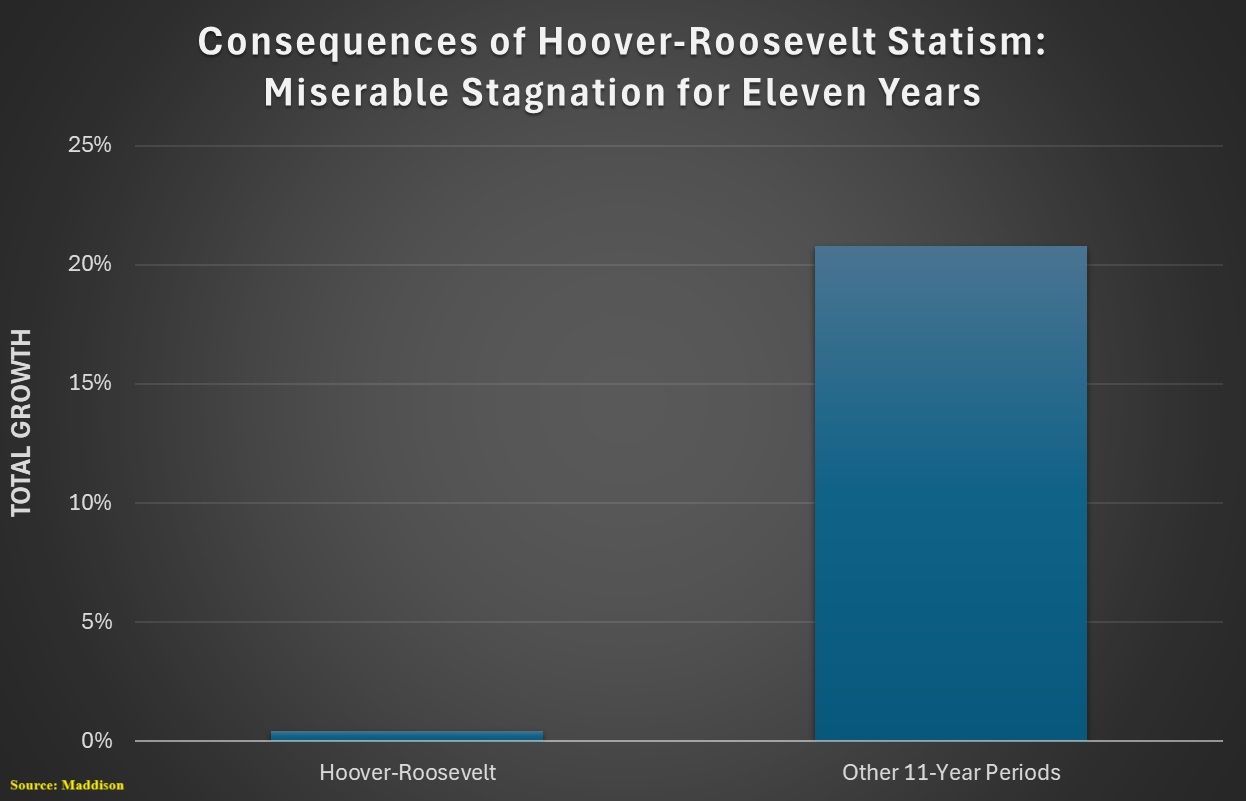
No wonder the U.S. suffered the worst 11-year period in U.S. economic history. Heck, no other 11-year period even came close to the stagnation America endured during the Hoover-FDR era of statism.
And that’s an understatement, as documented in George Selgin’s new book, which is reviewed by George Will in the Washington Post.
Progressives’ retrospective aspiration for a new New Deal is shared by “national conservatives.” They, enthusiastic about the current administration, also believe government should comprehensively intervene in the economy, politically allocating capital… But economist George Selgin’s latest book refutes progressives’ triumphalist nostalgia for the New Deal. It thereby demonstrates that “national conservatives” are oblivious regarding the cautionary lessons of Franklin Roosevelt’s experience. These kindred spirits on the left and right should read “False Dawn: The New Deal and the Promise of Recovery, 1933-1947.” Selgin mines a mountain of scholarship to prove this: New Deal measures failed to achieve, and often impeded, recovery from the Depression. …The Depression was, Selgin says, the first economic crisis the federal government tried to end by using all its resources. But the economy did not recover… The New Deal’s core idea was a non sequitur: In a Depression prices fall, therefore recovery would come if prices were forced to rise. Hence the National Recovery Administration wrote (with business interests dominating the process) “codes of fair competition” cartelizing about 550 industries, outlawing competition that might lower prices. …The 1940s began as 1939 had: Seventeen percent of the labor force was completely unemployed or on work relief, adults were working 20 percent fewer hours than in 1929, industrial production was still 10 percent below the 1929 peak. FDR’s incessant regulatory fidgets, and vocal hostility toward business, produced a climate of uncertainty that paralyzed investing… Lessons are, however, forgotten. Donald Trump’s administration, ardently admired by “national conservatives,” is the most economically interventionist administration — by this important metric, it is the most progressive administration — since the New Deal.
In a column for Law & Liberty, James Hartley also reviews George’s new book. Here are some excerpts.
As George Selgin argues in his new book, False Dawn: The New Deal and the Promise of Recovery, 1933–1947, the New Deal probably made things worse. An activist government rapidly changing policies seemingly on a whim is not a recipe for success. …Selgin meticulously dissects the “twin pillars of Roosevelt’s recovery program.” First, the Agricultural Adjustment Administration (AAA) aimed to raise the prices of agricultural products… As a relief measure for farmers, the effect of such a policy is obvious. But, did it help economic recovery? The evidence here is pretty overwhelming that it did not. …Even within the agricultural sector, the effect on recovery was negative. …What about the other pillar of the New Deal, the National Recovery Administration (NRA)? It was even worse. An ever-expanding set of rules trying to micromanage just about every aspect of business behavior, the NRA was the clear centerpiece of the Roosevelt Administration’s effort to promote economic recovery. Price and wage controls, production limits, industry codes, business and worker councils, the list goes on and on. …as Selgin documents, the New Deal was a haphazard collection of unrelated policies without any underlying economic model.
The bottom line, as George documents, is that most everything Roosevelt did was wrong.
P.S. Here’s CF&P’s video on statism and the Great Depression.
P.P.S. George Selgin’s scholarship also extends to private monies, which I discuss in this video, and the failure of government money, as documented in this video.