
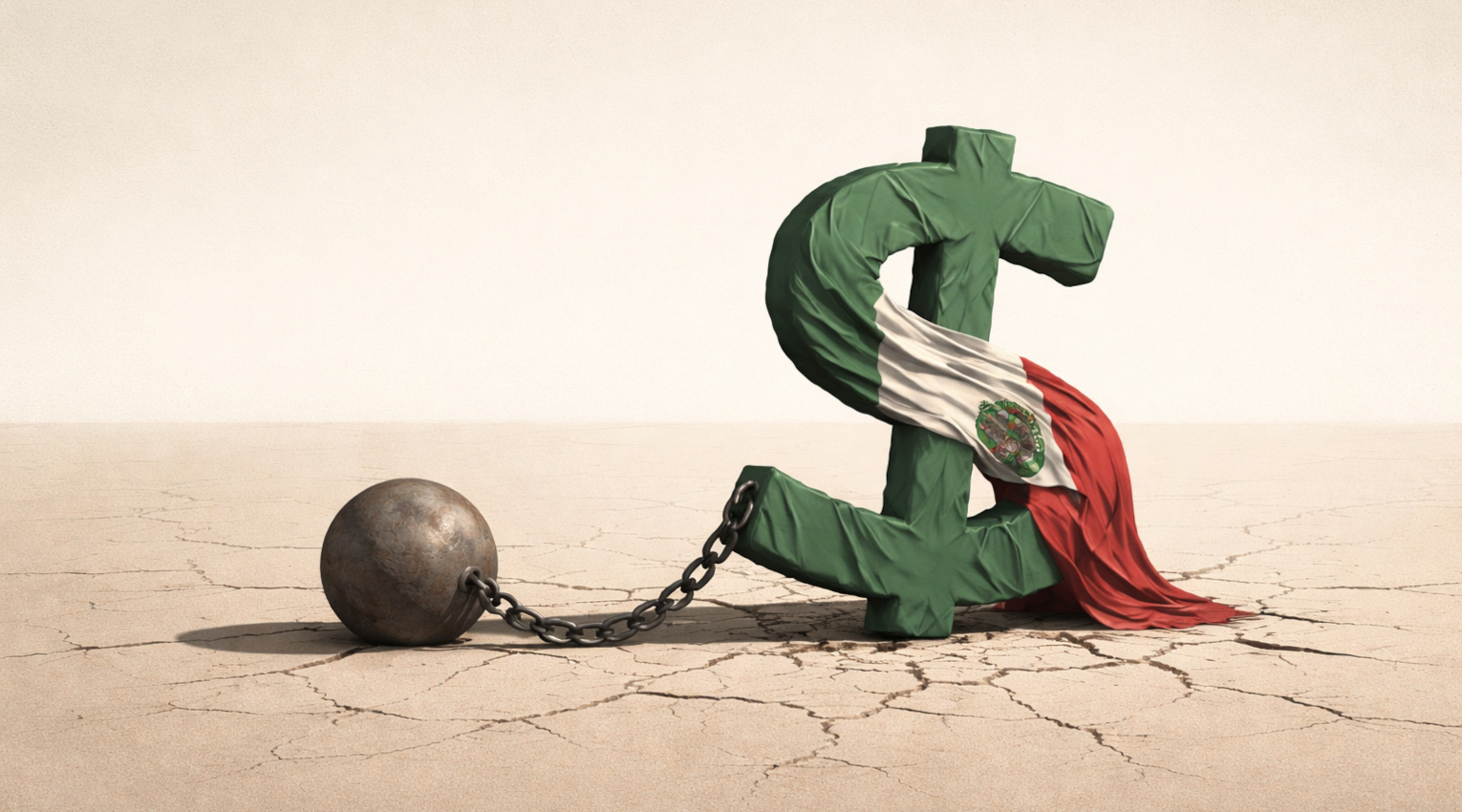
With so many bad things happening in Washington, I almost feel guilty writing about another country.
But since I’m in Mexico City teaching at Universidad de la Libertad, I want to write at least one column about Mexican economic policy.

Based on this recent chart from Robin Brooks at the Brookings Institution, something has gone wrong in recent years.

As you can see, Mexican growth was keeping pace with U.S. growth from about 2006-2017. But then Mexican growth ground to a halt, pre-pandemic, during the pandemic, and post-pandemic.

There are two possible explanations for this Anti-Convergence-Club example.
- First, U.S. politicians might be doing something smart. But American growth has not been spectacular over the past eight years, so that explanation doesn’t hold water.
- Second, Mexican politicians might be doing something dumb. And since economic freedom is lagging in Mexico, this explanation seems very reasonable.
In his column, Brooks mostly focuses on explaining that Mexico has stagnated, so I have no idea whether he would agree or disagree with my hypothesis.
But here’s some evidence for my viewpoint. Here’s a chart, based on IMF data, showing that the fiscal burden in Mexico has increased over time.
Both taxes and spending are now a heavier weight on Mexico’s economy, and note that most of the additional spending burden has been imposed since Mexico opted for populist-left rule in 2018 (AMLO followed by Sheinbaum).

Fiscal policy is just one of many variables that determine economic output.
And the EFW data clearly shows that rule of law and red tape are the biggest problem areas. Nonetheless, it is bad news that those mistakes are now being exacerbated by fiscal mistakes.
Since I was combing through the IMF database, I also created this chart that shows per-capita GDP levels over time.
The overall picture is weak growth over the past 45 years, though there was improved performance after 1985 thanks to some pro-market reforms.
In recent years, however, per-capita GDP has been completely flat.

The bottom line is that Mexico is caught in the “middle-income trap.” A few nations have shown how to break past that barrier, but there’s is almost no hope (at least in the next few years) that Mexican politicians will adopt a Milei-style agenda.
P.S. Trump’s trade taxes are bad news for Mexico, and that’s not the fault of Mexican politicians. So weak Mexican data in 2025 (and future years) is partially the fault of the United States.
P.P.S. The chart comparing U.S. and Canadian growth is eerily similar to the U.S.-Mexico chart at the beginning of this column. Which sort of makes sense given Canada’s statist policies over the past 10 years.