As documented in my series on capitalism (see here, here, here, here, here, here, here, and here), markets deliver amazing results.
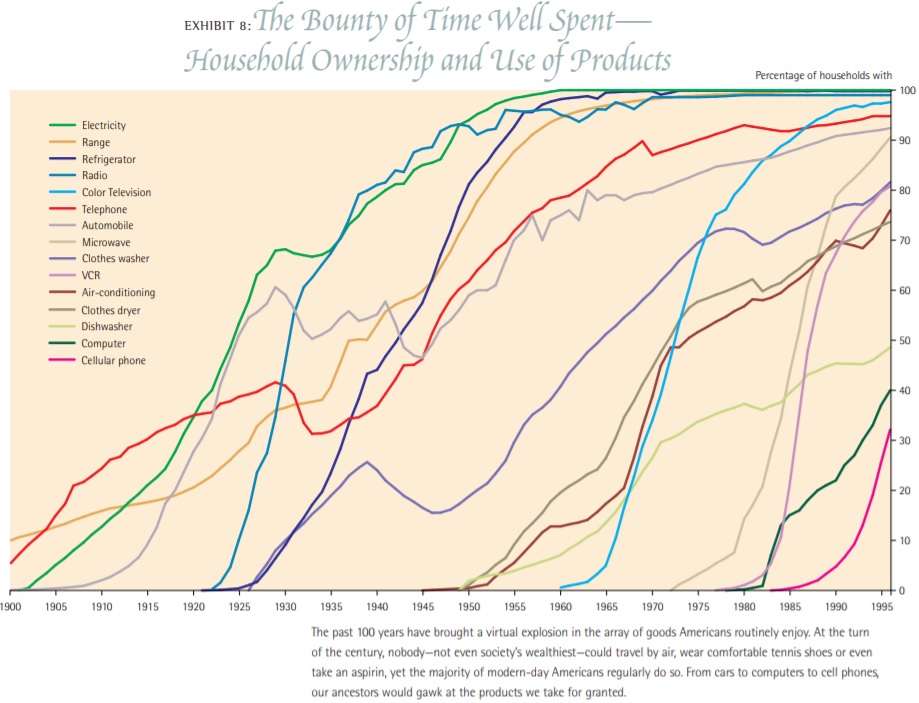
One of my favorite charts shows when various technologies were unveiled and how quickly they were adopted by the populace.
This data shows that appliances initially began as luxuries for the rich but then became basic goods for the rest of us. Exactly as Joseph Schumpeter observed when writing about silk stockings more than 80 years ago.
I was reminded of the above chart while reading a recent report in the Washington Post by Shira Ovide. Here are some excerpts.
…evidence is piling up that the AI boom may instead be widening the gap between America’s economic aristocracy and everyone else. …Some influential economists assess that while recent technology revolutions created more jobs than they destroyed, they also widened inequality by walloping middle-class workers and enriching corporations and higher-income professionals. What happens if another inequality-sparking technology collides with already historically large U.S. income gaps and an economically pessimistic American public? …Daron Acemoglu…said in an email. “I am genuinely afraid that it would threaten social peace and the very foundations of democracy.” …While it’s common for new technologies to be adopted first by higher-income people and regions, Mark Muro at Brookings said that AI could ossify the existing gap between America’s regional economic winners and losers.
Sounds like artificial intelligence is great for rich people and bad for the rest of us.
So what’s the evidence?
Here’s the chart that accompanied the story. It shows the top 20 percent of households enjoying more consumption.
But do you know what else it shows?
Consumption (i.e., living standards, quality of life, whatever you want to call it) is also increasing for everyone else. And it seems to be increasing at a faster rate in recent years.
This chart isn’t evidence against AI, or against free enterprise.
It’s evidence that AI is like electricity, telephones, microwaves, and computers. Rich people are the early adopters and early beneficiaries but competition does a wonderful job of making various goods and services widely available to everyone else.
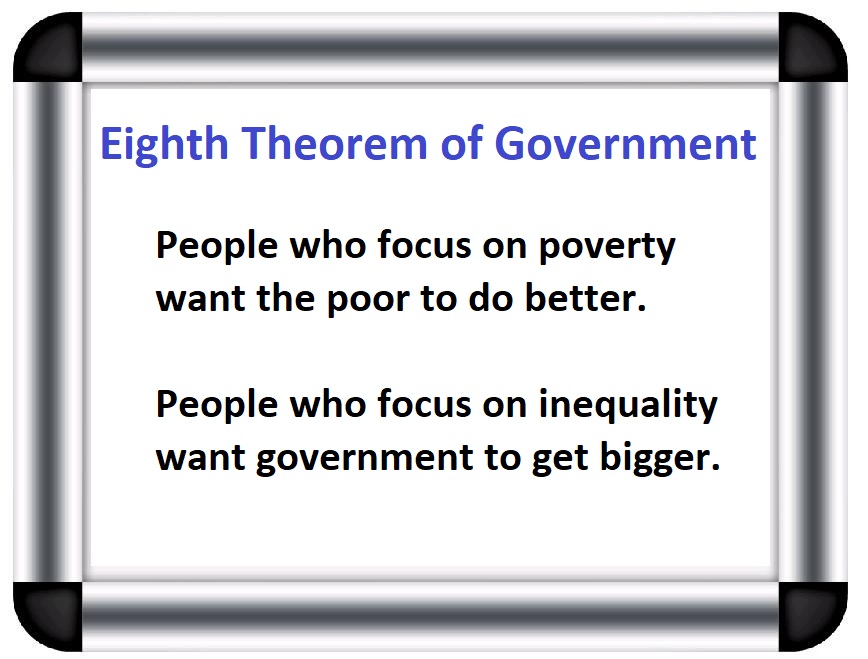
People who fixate on inequality seem motivated by dislike for the rich rather than by wanting to help the poor.
This doesn’t mean, by the way, that artificial intelligence will help every single person. Maybe some jobs will get displaced, just as the electric light bulb hurt the candle industry and personal computers hurt the typewriter industry.
But trying to stop “creative destruction” is akin to trying to stop progress. And that will make everyone poorer in the long run.
P.S. The W. Post story also grouses that rich people are benefiting from investments in AI companies. I don’t think that’s a bad thing. Indeed, it’s one of the reasons I favor personal retirement accounts instead of America’s bankrupt Social Security system. I want everyone to benefit from capital accumulation.