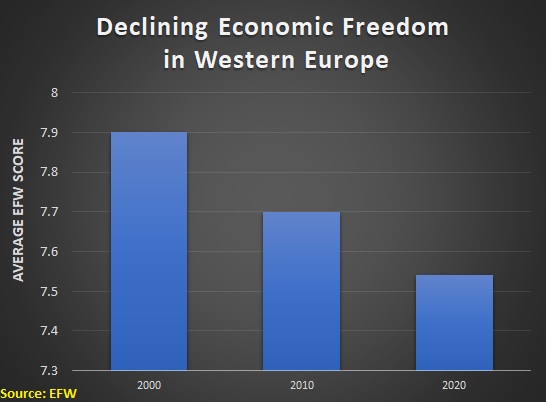
The bad news is that economic freedom has been declining in Western Europe.
To make matters worse, Europe has a big demographic problem, with a growing number of older people over time who have been promised benefits and a shrinking number of younger taxpayers who are available to finance all that spending.
The net result is that some European nations almost certainly will suffer a fiscal crisis, similar to what happened to Greece and the rest of the “PIGS‘ more than 15 years ago.
All that sounds depressing. And it is depressing.
But the Washington Post has an editorial suggesting that some European politicians recognize the problem and want to move in the right direction. Here are some excerpts.
Europe’s most important leaders are increasingly, and publicly, recognizing theirs is a continent in deep crisis. It’s a welcome change… The European Union has come to prioritize regulating industry more than allowing it to flourish. …European leaders gathered last week inside a 16th-century castle and only agreed on an “action plan” to make Europe more competitive. In characteristic fashion, the details remain unclear. German Chancellor Friedrich Merz called on the E.U. to “deregulate every sector.” Italian Prime Minister Giorgia Meloni said Europe cannot “continue to hyperregulate” industry. …Europe too often rotates between overly aggressive regulation coming out of Brussels and spending big on industrial policy inside national capitals. The continent is having trouble getting out of this slow-growth trap.
I’m not impressed.
The statements cited in the editorial remind me of the Draghi Report back in 2024. Some decent rhetoric but a lack of good policy to fix the problems.
If we look at non-EU nations in Europe, the United Kingdom is a total mess. Switzerland is an outpost of sanity, to be sure, but it’s too small to change the continent’s overall trajectory.