In Part I of this series, I took snippets from a recent speech to explain that government spending is the disease and red ink is the symptom of the disease.
For today’s column, let’s share more excerpts from that same speech to show how red ink can lead to fiscal crisis.
You’ll notice I used Greece as an example.
There’s a good reason for that. A fiscal crisis occurs when investors (the people and institutions that buy government bonds) decide that a government no longer is trustworthy. So they either stop buying that nation’s debt, or they demand higher interest rates to compensate for the risk of default.
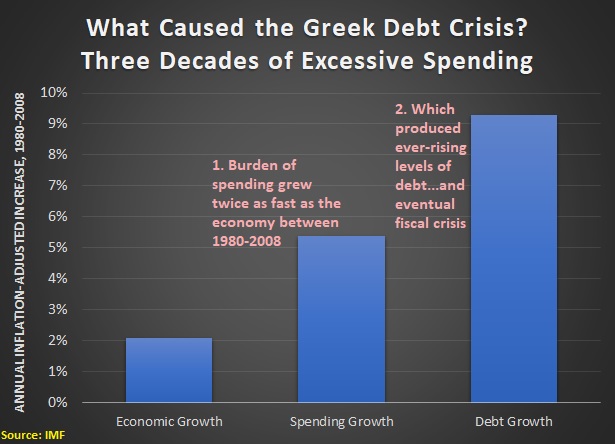
And if you look at Greece, we see an all-too-typical case of a nation that was spending recklessly. Whether you’re looking at several decades of data or just the few years leading up to the 2009 crisis, Greek politicians were violating fiscal policy’s Golden Rule. Government was growing faster than the private sector.
Unfortunately, the United States is making the same mistakes that Greece made.
I’ve recreated the chart I did for Greece. But instead of looking at the 28 years of data leading to the Greek crisis, this next chart look at the last 28 years of data for the United States.
The good news is that we’re going in the wrong direction at a slower rate.
Our spending burden is growing faster than GDP, but not twice as fast, as happened in Greece before its crisis.
Our debt burden is growing more than twice as fast as GDP, but that’s better than growing more than four times faster, which happened in Greece in the decades before its crisis.
The bad news is that we’re nonetheless heading in the wrong direction
At the risk of understatement, going in the wrong direction at a slower rate is nothing to celebrate. It simply means it takes longer to get to the same undesirable destination.
That being said, I don’t think the United States is on the brink of a crisis, but we should worry.
And Desmond Lachman of the American Enterprise Institute is definitely in that camp. Here are some excerpts from one of his recent articles.
As 30-year US bond yields climb to their highest level since 2007 in response to the country’s unsustainable public finances, we must ask whether…the US seems to be going bankrupt gradually, and it would seem to be only a matter of time before it goes bankrupt suddenly. There can be little question that the US public finances are on an unsustainable path that will end in tears. …Recent long-term bond yield increases are…another sign that real trouble is brewing in the US bond market. …Over the past year, 10-year Treasury bond yields have increased by more than 75 basis points to their present level of around 4.65 percent while 30-year Treasury bond yields are now uncomfortably above 5 percent.
Since he mentioned rising interest rates, here is some sobering data from Robin Brooks of the Brookings Institution.
As you can see, interest rates on 10-year government bonds have significantly increased in recent years. And not just in the United States.
By the way, the movement in interest rates is not necessarily caused by investors worrying about default.
They also may fear there will be higher inflation over the next decade, so they demand higher interest rates to compensate for that risk.
Also keep in mind that most central banks were grossly irresponsible during the pandemic. They created lots of excess liquidity, which caused interest rates to be artificially low about 2020 (and also created the conditions for the subsequent spikes in inflation).
So let’s close with data from Investing.com on the price of default insurance on five-year government debt for various nations, along with some of my commentary.
It’s very bad news that the United States is viewed by markets as having riskier government debt than nations such as Italy, Spain, and France.
It’s no surprise that Swiss government debt is viewed as very safe. That country has a very effectivespending cap, which has actually led to less government debt while almost every other nation is adding more red ink.
P.S. I suspect that periodic shutdown fights and debt limit fights help to explain why the U.S. looks bad. Investors want to be compensated for the risk that there may be delays on interest payments to bond holders.
P.P.P.S. It’s not uncommon for a nation to be a good example or bad example at different points in time. Consider how the U.S. and U.K. got good results under some leaders (Reagan and Thatcher) and bad results under others (Biden and Johnson).