We can then use research to build upon theory by looking at how various policies change outcomes in the real world.
And research is doubly important because many people don’t understand basic economics. They will likely only be convinced when shown evidence.
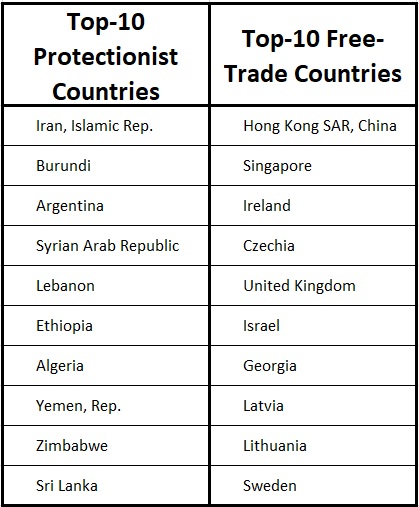
This is one of the reasons that I put together a table in late 2023 showing the world’s 10-most protectionist nations and 10-most free-trade nations, followed by a comparison of average per-capita GDP in those countries.
I was hoping this would be compelling evidence for people who don’t understand trade (such as some recent residents of public housing in Washington, DC).
Especially since per-capita GDP in the free-trade nations was 14 times greater than per-capita GDP in the protectionist nations.
Given what the White House has been doing, I obviously was not very persuasive.
So I’m hoping that J.D. Tuccille of Reason is more effective. Here are some passages from his recent article in Reason.
President Donald Trump…complained that if the import taxes go away, the U.S. will become a “third-world nation.” That would be quite a trick. Despite the president’s repeated claims that high tariffs produce greater national wealth, most countries that adopt them are very poor, while those that keep trade barriers low are wealthier. …if tariffs are linked to prosperity, it’s an inverse relationship, according to a recent report on America’s declining economic freedom for Canada’s Fraser Institute. The authors, Robert A. Lawson of Southern Methodist University and Fraser’s own Matthew D. Mitchell, write: “High-tariff countries are generally low-income countries while low-tariff countries are generally high-income countries.” …The U.S. used to have the sort of tariff rates that correlate with prosperity. The Trump administration is now emulating the trade policies of what he has termed in the past “shithole countries.”
Here’s a table from the Fraser article cited by Tuccille.
The countries don’t match exactly with my list because I was using the 2021 data and they’re using the 2023 data. Also, I used the IMF data for per-capita GDP and they are using the World Bank data.
But the conclusion is the same. Nations with high tariffs have much lower levels of per-capita GDP.
As you can see, the countries with high trade restrictions are mostly basket cases. The Bahamas is an exception, but it has a somewhat successful economy because its high trade taxes are accompanied by zero income tax.
By the way, protectionists sometimes claim that protectionism is good because the U.S. became richer in the 1800s.
Protectionists used to cite Japan, but that doesn’t happen any more since Japan has suffered several “lost decades.”
The bottom line is that there are zero protectionist success stories. Either today or at any point in world history.
P.S. I can’t resist calling attention to one more excerpt from Tuccille’s article
Lawson and Mitchell point out that “with the exception of China, every country Trump has singled out for treating America unfairly is more open to trade than the United States itself.”
Exactly. Trump has not been targeting protectionist nations. He’s mostly been going after countries that are better on trade than the United States.