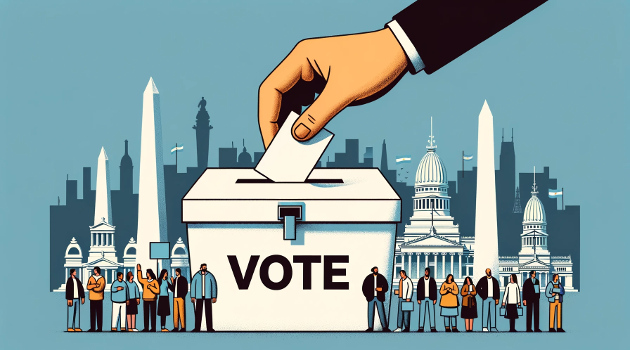
I explained two months ago that Argentina’s mid-term elections are critically important, and here’s some of what I said in an interview with Austin Peterson.
I’ll be paying close attention to the results later today for three reasons.
Right-leaning politicians around the world are aware that Milei’s policies are economically successful, and they might be willing to copy them if they also see evidence of political popularity.
Based in part on some bad results in a regional election in September, I fear the national mid-term elections will be confirmation of the 23rd Theorem.
He inherited an economic crisis and he immediately slashed spending, leading to lower inflation, less poverty (notwithstanding U.N. lies), and a restoration of growth.
Unfortunately, now that the economy is back on its feet, I worry voters will revert to their normal pattern of voting for more handouts (with November of 2023 going down in history as an exception that proves the rule).
Let’s look at what a couple of close observers think is at stake in today’s elections. We’ll start with a column in the New York Times by Ricardo Hausmann, a former government minister in Venezuela (before the socialists) who is now a professor at Harvard.
Here’s some of what he wrote.
When Argentines vote in midterm elections on Oct. 26, the main issue is simple: Do they want to stabilize their economy once and for all? The country’s economic future depends on whether voters can muster the political will to back President Javier Milei’s original coalition and his reform program — or backtrack by empowering opposition parties that promise more spending and debt default. …Mr. Milei’s program…delivered a surprisingly fast recovery: Inflation fell from triple digits in December 2023 to around 30 percent this past Aug. ..Mr. Milei has shown his commitment to fiscal discipline and responsible management of the country’s money supply. Ultimately, Argentines need to reach a political consensus around the idea that stability is not a partisan slogan but a foundation for growth. The pivotal question on Oct. 26 is whether they will signal to themselves, and to markets, that Argentina is ready to break with old habits and anchor its future on a commitment to stability — whatever it takes.
Next, let’s look at some excerpts from an article for he Independent Institute by Alvaro Vargas Llosa, the President of the Fundación International para la Libertad in Peru.
If he does not win a massive victory in the mid-term elections in late October, the possibility of further reforms and tangible results beyond the mitigated inflation will almost disappear. What reforms? Everything from labor reform (hiring and firing workers is a nightmare in Argentina, where labor is taxed even higher than in Europe) to pension reform (private pensions were taken over by Cristina Kirchner’s government in 2008) to tax reform (according to the Argentine Institute of Fiscal Analysis, Argentines pay some 155 different types of taxes and levies). Such reforms must go through Congress, which means Milei will be political toast if he does not win an outsized victory. Without these reforms, investment, sustained economic growth, and job creation will become a pipe dream.
Las but not least, here are some passages from a new report in the U.K.-based Economist.
Never before have midterm elections in Argentina grabbed so much global attention. …Mr Milei won office in 2023 by exciting voters with radical plans and furious condemnation of “la casta”, the political class. Since then, huge cuts to spending have pulled monthly inflation down from 13% to about 2%. Poverty has fallen to its lowest level since 2018. Mr Milei has slashed red tape, improving everything from internet access to airlines. …Now, Mr Milei’s project is at risk of unravelling. …Still, LLA should perform much better in national midterms than it did in September. …voters…may be unenthusiastic about Mr Milei, but they loathe the Peronists. Mr Milei is also more popular in the interior of the country than in the province of Buenos Aires. Many voters will still reward him for reducing inflation.
The article concludes with some political analysis.
Markets will tumble if, together with his allies, Mr Milei fails to marshall the third of the seats in the lower chamber that he needs to prevent his vetoes being overturned. If his party polls below 30%, then chaos will ensue… A good scenario for Mr Milei is a five-point win, with his party securing enough seats to defend his vetoes. Any serious reforms on tax, labour or pensions would still require serious coalition-building to get through Congress.
I wrote months ago to express hope that Milei was actually converting Argentinians into freedom lovers. We’ll know later today if I was being hopelessly naive.
I’ll close today’s column with this quote from the 1964 speech that launched Reagan’s political career.
Argentinians have their version of a rendezvous with destiny today.
P.S. I realize that I’m very focused on Argentina. That being said, there are some other important political contests this year, such as a death tax referendum in Switzerland and New York City deciding whether the next mayor should be a run-of-the-mill corrupt leftist or a lunatic socialist.