I get a good amount of feedback on my Theorems of Government, including many suggestions that I turn them into a book (a semi-appealing idea, but I’m a bit discouraged that my last book didn’t have the impact I hoped).
Other people ask me to identify my favorite theorem, or most important theorem.
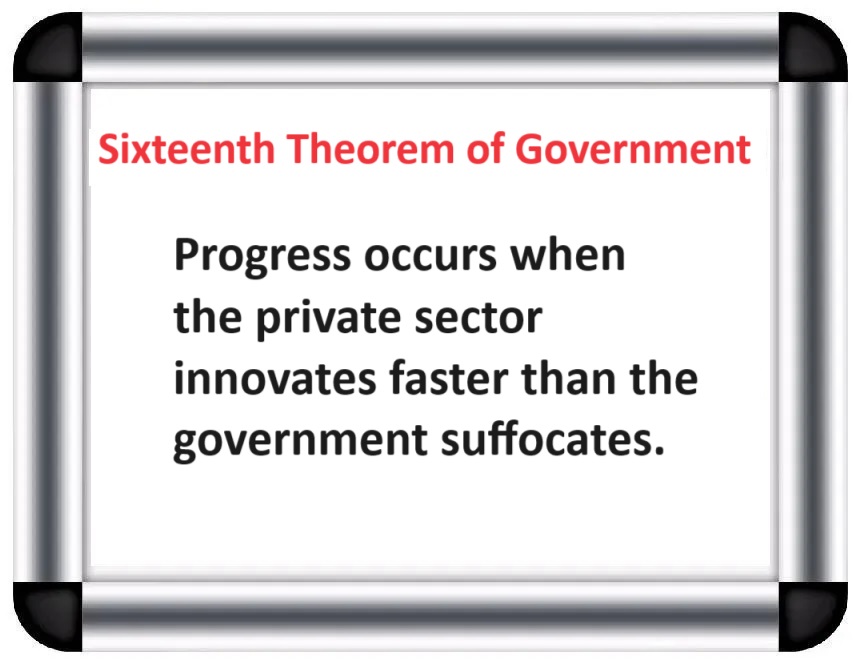
That’s easy, because I think my Sixteenth Theorem is the one I wish everyone in Washington (and elsewhere) would understand and internalize.
I like this theorem because it correctly observes that the private sector is the primary source of prosperity and government is the main impediment.
But this theorem is also my favorite because it makes clear that you don’t need Libertarian Nirvana to enjoy progress. So long as there is some constraint on government, we can get richer over time (albeit at slower rates if government expands).
I’m discussing my theorems because one of my buddies, Jim Carter, has a new column that summarizes what they mean.
Here are some excerpts.
Dan Mitchell’s “20 Theorems of Government” land not as abstractions but as reminders of truths America’s founders understood almost instinctively. The theorems…capture the recurring failures of centralized authority and the virtues of free people operating in free markets. …They are explanations of what government always does when left unchecked and how society always suffers when the state’s reach exceeds the citizen’s grasp. …the larger the government becomes, the more incompetent and unresponsive it grows. Bureaucrats answer to political pressure, not consumer choice, and the results are inevitable: waste, rigidity, and indifference. …Worse, when dependency becomes a norm, the cultural foundations of liberty erode. A nation that forgets how to rely on itself cannot long remain free. …Taken together, Mitchell’s 20 Theorems point to a conclusion Milton Friedman drew decades ago: The problem is not the quality of the people in government; the problem is the nature of government itself. …If Americans wish to preserve both prosperity and freedom, they will have to internalize these theorems as practical truths, not relics of libertarian theory.
By the way, most of my theorems are not breathtakingly original. Economists like Milton Friedman (and the Public Choice crowd) made similar points, in some cases before I was even born.
My contribution is to simply come up with pithy ways of expressing important truths.
I’ll close with two final observations. First, there are actually 23 theorems, but I was slack in updating that part of the website.
Second, I didn’t start creating theorems until 2015, which means my Golden Rule (unveiled in 2011) does not count as a theorem.
However, it would rival the Sixteenth Theorem as the one that is most important (and my 20th Theorem tries to get across the same point).
P.S. If pressed to select a secondary favorite, it would probably be the 8th Theorem, which exposes the real goal of those who focus more on inequality rather than poverty.