Let’s look today at European fiscal policy. But instead of focusing on the immediate issue (the likelihood of another fiscal crisis), we’re going to investigate whether we can learn anything by looking at what’s happened in the past.
My two cents, based on these charts, is that European governments have given us very powerful evidence that tax increases are simply a recipe for more spending and more debt.
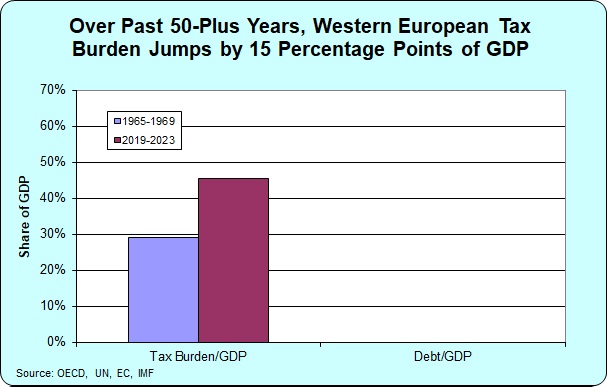
The first chart shows how tax burdens in Western Europe (specifically, the 15 pre-enlargement members of the European Union) have jumped dramatically over the past five decades (and I used five-year averages to avoid any risk of cherry-picking one year with unusual data).
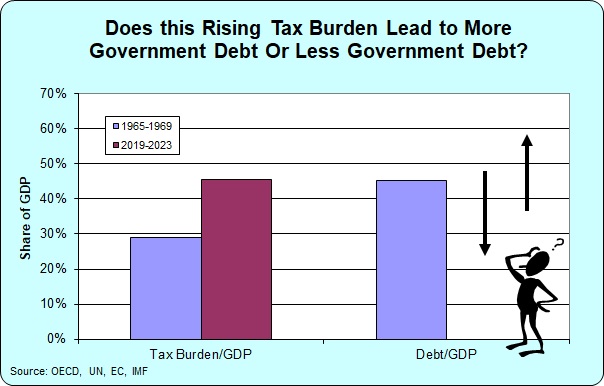
The second chart then points out that average government debt in those nations was about 45 percent of GDP in the late 1960s, back when tax burdens averaged about 29 percent of GDP.
And I ask what happened to debt levels over the past 50-plus years? There’s been a massive increase in tax burdens. Did politicians use the revenue to balance budgets and pay down debt?
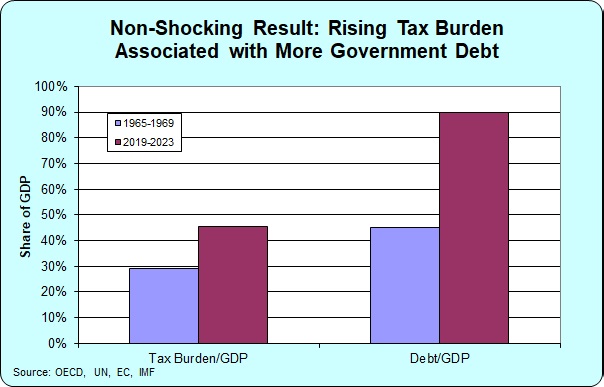
The third chart then answers those question by pointing out that debt levels have skyrocketed.
In other words, politicians spent every penny of additional tax revenue, and then spent even more.
This should be all the evidence needed to confirm that tax increases are the wrong way of dealing with fiscal problems.
And these lessons from Western Europe apply to the United States.
In other words, Milton Friedman is correct. If you give politicians more money, they will spend it. And red ink will become an even bigger problem.
I’m sharing this data because we’re now going to look at a new report from Brookings by William Gale, Ian Berlin, and Sam Thorpe. They argue that the United States should have a higher tax burden.
Here are their main findings.
…the U.S. faces an unsustainable fiscal future. …How should the U.S. respond? …In brief, we find that (a) the U.S. does not face a short-term crisis, so it can employ gradual adjustments which may minimize short-term harm; (b) consolidation should occur in a strong economy with monetary accommodation; and (c) tax increases could play a comparatively larger role — and spending cuts a smaller one — in US consolidations than in European adjustments.
And here’s a chart the authors shared showing tax and spending levels in countries that decided to address fiscal problems.
The report has plenty of interesting information and cites lots of worthwhile research.
But it ignores the elephant in the room, which is that Europe has been doing tax-heavy consolidations for decades and the result has been more debt.
For all intents and purposes, the authors pretend that the problem of “public choice” does not exist.
But there’s more than one elephant. Another problem with the Brookings report is that it basically concludes that the United States should be more like Western Europe. Yet at no point does it look at the implications for American prosperity.
So here’s a chart recently shared by @cremieuxrecueil.
At the risk of stating the obvious, the United States is far richer than most other developed nations, including our friends in Europe (by the way, the green bars are European nations and the pre-enlargement EU-15 nations are all on the list).
The obvious takeaway is that European nations should be copying the United States, not the other way around. Yet Gale and his co-authors want America to be more like Europe.
Call me crazy, but I don’t think the United States should copy the policies of nations that have much lower living standards. Especially when tax increases would almost surely worsen America’s fiscal outlook.