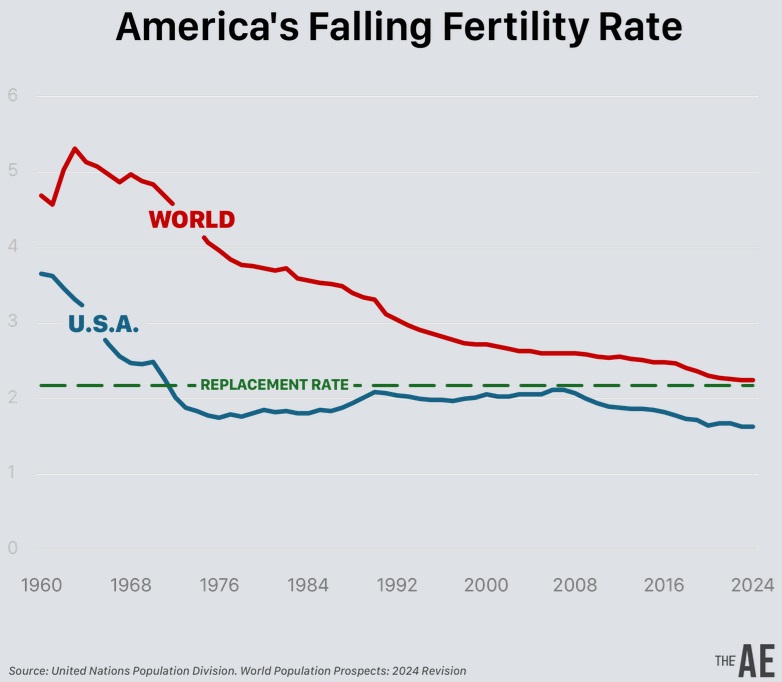
Today, in Part II, let’s look at some new analysis, starting with this chart capturing the dramatic changes in fertility, both in the United States and the world.
Like all good libertarians, I think people should be free to have as many children as they want, whether zero kids or 10 kids.
But as an economist working on fiscal policy, that chart is terrifying.
It comes from an article in the American Enterprise by Jesús Fernández-Villaverde. Here are some excerpts.
Humanity has entered a new era of rapid population decline. Globally, the total fertility rate is likely already below replacement… In the US, it’s around 1.6 – without immigration, our population would have already begun to decline. If we are unable to address our fertility crisis, the US will face an existential economic crisis driven by a steep decline in fertility rates—one that could have an impact measured in the quadrillions of dollars. …The implications of declining fertility in the US are the most crucial economic issue of our time. …total output growth is crucial for addressing the funding of Social Security, Medicare, Medicaid, servicing our public debt… Once we begin to contemplate the fiscal implications of a declining population, it becomes difficult to focus on anything else. …This is not mere speculation. The current economic challenges facing many European economies primarily arise from the rapid increase in spending on social security and healthcare for the elderly.
I confess that this is the first time I’ve seen quadrillions (1,000 trillion) used as a measure of America’s long-run challenge.
That’s not a good sign, to put it mildly.
For what it’s worth, the author closes his article by emphasizing the need to boost fertility rates.
The first option is to do nothing, kick the can down the road, eventually suffer some sort of crisis that politicians will use as an excuse for massive tax increases, followed by even further decline and crisis.
I’ll close by observing that Singapore and Hong Kong have some of the world’s lowest birth rates, but they won’t face a fiscal crisis because they rely on private savings instead of being saddled with tax-and-transfer entitlement programs.